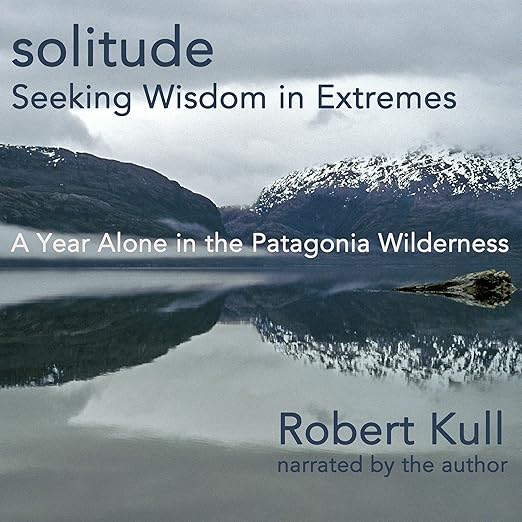
Quick Take
- Narration: Robert Kull reading his own diary is the only possible choice for this material, and the rawness of his self-narration, unpolished in places, deeply honest, is inseparable from the book’s value.
- Themes: radical solitude as philosophical experiment, the tension between nature and technology, the self that survives removal from society
- Mood: Austere, frequently uncomfortable, and genuinely searching, not a comfortable listen
- Verdict: A polarizing memoir that rewards readers willing to sit with a narrator who is not always likable and whose conclusions are hard-won rather than reassuring.
I spent a week with Solitude on my morning walks, which felt both appropriate and slightly ironic. Kull spent a year alone on a remote Patagonian island to explore what deep solitude does to the body and mind. I was spending forty minutes a day walking through a city neighborhood. The distance between those experiences is part of what the book examines: most of us process the idea of radical isolation from within the noise of ordinary social life, and Kull is specifically interested in what happens when you remove that scaffolding entirely.
The setup is extreme by design. Years after losing his lower right leg in a motorcycle crash, Kull traveled to coastal Patagonia with enough equipment and supplies to live alone for a year. His only companion was a cat. He was working on a doctoral dissertation in environmental studies, which gives the project an academic frame, but the actual experience he describes exceeds any academic frame quickly. The wild forces of Patagonian nature, wind, rain, the enormous ocean, are rendered with the kind of attention that comes from having nothing else to attend to. Those descriptive passages are the book’s most beautiful.
Our Take on Solitude: Seeking Wisdom in Extremes
The reviews for this book split cleanly between those who found the honesty transformative and those who found the narrator deeply frustrating, and both responses are legitimate. Kull is not an easy subject. He is academically trained but frequently confused, spiritually searching but often self-indulgent, physically capable but also notably unprepared for specific practical challenges. The one-star reviewer’s catalog of preparation failures, wrong staples, unused solar panels, navigational errors despite having a compass, is not invented. Kull documents his own incompetence with the same unflinching attention he gives to his inner states. Whether that reads as admirable honesty or infuriating navel-gazing will depend on what you want from this kind of writing.
The question of his treatment of the cat is raised by one reviewer and is not something I can assess fully from the text alone, but it is present in the memoir and Kull does not present himself in an entirely flattering light in those passages. Readers who are sensitive to animal welfare concerns should know that the cat’s experience on the island is part of the account.
Why Listen to Solitude: Seeking Wisdom in Extremes
Kull narrates his own work, and the self-narration is both the book’s greatest asset and its most significant liability depending on your tolerance for unpolished delivery. This is not professional audiobook narration. It is a man reading his own diary with the emotional proximity that implies. The passages of genuine fear, when the storms are worst, when the isolation becomes crushing, when the body fails him, carry a weight that produced narration cannot manufacture. The passages of philosophical meandering, which are extensive, can feel slow in audio in a way they might not in print.
The comparison to Thoreau is one the book itself courts, and it is instructive. Thoreau at Walden was performing a version of solitude for literary purposes. Kull is doing something messier and more genuine, he is actually alone, actually scared, actually uncertain whether the enterprise is coherent or self-deluding. The epilogue, which several reviewers identify as the book’s most valuable chapter, is where the retrospective perspective finally brings the experience into something like resolution. It is worth the journey to get there.
What to Watch For in Solitude: Seeking Wisdom in Extremes
The book is genuinely long at fifteen and a half hours, and the middle section, where the daily repetition of isolation is the point, can feel like its own version of that repetition for the listener. One reviewer described hundreds of pages of tedious details and monologues before the payoff arrives. In audio, that texture is even more present than it would be in print. If you are a listener who needs narrative propulsion to stay engaged, this will test you.
The philosophical framework that structures Kull’s reflection draws on academic environmental studies and Eastern spiritual traditions. Those elements are integrated rather than specialized, but listeners who find academic prose style in audio fatiguing should be aware that the reflective sections carry that quality.
Who Should Listen to Solitude: Seeking Wisdom in Extremes
Readers who have found value in accounts of extended wilderness solitude, who have already engaged with Thoreau, Kerouac’s outdoors writing, or AT and PCT thru-hiking memoirs, will find Kull’s book a more philosophically serious and spiritually raw version of that tradition. Listeners who want to understand what deep solitude actually does rather than what we imagine it does should try this. Skip it if you need a narrator who is competent and likable, or if fifteen hours of psychological suffering without guaranteed insight is not something your current reading life has room for.
Frequently Asked Questions
Is Solitude: Seeking Wisdom in Extremes an academic book or a personal memoir?
It is primarily a memoir, a diary of Kull’s year in Patagonia, with philosophical and academic reflection woven throughout. The academic frame comes from his doctoral work in environmental studies, but the writing is personal and journal-like rather than scholarly.
How does Kull handle the physical challenges of living with one leg in a remote wilderness?
He addresses his disability directly and honestly, including the ways it creates specific challenges in Patagonian conditions that an able-bodied person might not face. It is not a dominant focus of the narrative, but it is present throughout.
Is the epilogue meaningfully different from the rest of the book, and is it worth listening to the whole thing to reach it?
Multiple reviewers single out the epilogue as the point where Kull’s retrospective perspective finally clarifies what the year meant. Whether the journey is worth it depends on your patience for unresolved searching. The payoff is real but not dramatic.
Does the book take a position on whether radical solitude is worthwhile or achievable as a spiritual practice?
Kull arrives at qualified conclusions rather than definitive ones. He does not advocate for others to replicate his experiment. The honest answer the book arrives at is something like: solitude reveals what you bring with you, and that is both the limit and the value of the practice.