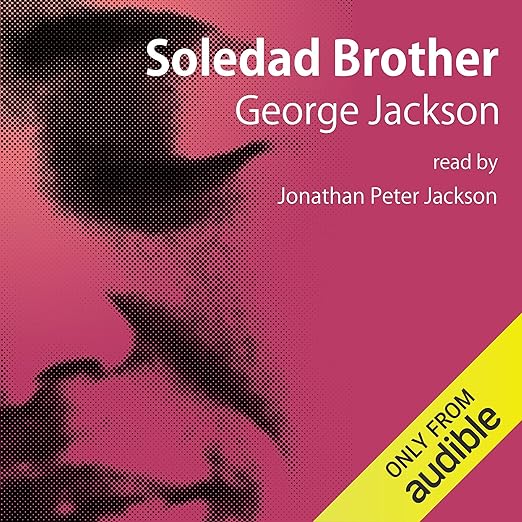
Soledad Brother, narrated by Jonathan Jackson Jr., stands as one of the most significant audiobook casting decisions in recent memory. George Jackson's letters from prison, written between 1964 and 1970 during his incarceration at Soledad and San Quentin, are read here by his nephew, a choice that transforms what might otherwise be archival documentation into something that feels like a living transmission across generations. At eleven hours and thirty-two minutes, this audiobook covers Jackson's correspondence with family members, friends, attorneys, and political comrades as he moved from petty criminal conviction to Black liberation consciousness to international symbolic figure, and finally toward his death at San Quentin in 1971 under disputed circumstances.
Jackson begins these letters as a young man trying to explain himself to his parents, particularly to his mother, with whom his relationship is tender and strained in equal measure. The early letters are about ordinary prison difficulties: how to behave, what to read, how to manage the particular humiliations of incarceration with dignity intact. What happens across the decade of correspondence collected here is one of the most documented political transformations in American literature. By the later letters, Jackson is writing with a fury and a theoretical clarity about the American prison system, about capitalism, about racism, and about the specific conditions of Black men in the carceral state, that had not yet been articulated at that scale from inside a prison at that moment. The letters do not read as unified manifesto. They read as a mind in motion, working out positions across months and years, revising and intensifying and sometimes contradicting itself as the conditions around him change and as his reading expands to include Fanon, Marx, and the emerging Black radical tradition. Reviewers consistently describe the reading experience as simultaneously enraging and heartbreaking. One wrote of feeling sad, proud, emotional and just so angry. Another described the letters as putting you in that cruel jail cell right next to him. A third called the book essential for young men from fourteen upward. All of those responses are coherent and none of them captures the full effect, because the letters' power comes from the gap between what Jackson imagined as possible, a life with dignity, with meaningful relationships, with political purpose, and what the system was willing to give him, which was nothing and finally a bullet.
Jonathan Jackson Jr. brings a specifically familial weight to the narration that is audible in every letter. His uncle George Jackson was killed at San Quentin in 1971; Jonathan's own father, also named Jonathan Jackson, was killed at the Marin County Courthouse the previous year. The family's losses are inscribed in the text as grief, anticipation, and love, and Jonathan Jackson Jr. reads them with the full knowledge of what came after each page. This is not a performance of sadness imposed on neutral text. It is a family member speaking words written by a man who loved his family and whom his family loved, and that difference is present in every sentence of the eleven-hour listen.
Written to Be Spoken in Someone's Imagined Voice
The audio format makes a specific argument about these letters that the print edition cannot fully make. Letters are written to be read aloud, to be spoken in someone's imagined voice in someone else's ear. Jackson wrote these knowing that his correspondents would hear his voice behind the words. Jonathan Jackson Jr.'s narration recovers that dimension of the text. For listeners who have read the text on the page, the audiobook is not redundant: it is a different relationship to the same document, shaped by the narrator's familial position in the story. For listeners who have not encountered the letters before, the audiobook makes an argument for their historical necessity. These are not just primary sources about the 1960s prison movement but evidence about the specific human cost of a system that has changed less than its administrators typically claim. The 4.7 rating across more than 600 listeners is among the more meaningfully earned scores for a title in this category.
Letters to a Younger Brother Named Jonathan
Pay attention to the evolution of Jackson's prose style across the decade of letters. The early correspondence is careful and somewhat formal, calibrated to an audience, his parents and attorneys, who he knows may not share his increasingly radical framework and who he is trying not to alarm. The later letters are looser, more urgent, less concerned with audience management and more committed to saying what he believes regardless of reception or risk. That arc is the book's structural spine: it is the story of a man who stops translating himself for people he loves and starts writing from inside his actual understanding of what is happening to him and around him. Also listen for the moments where Jackson's care for specific people breaks through the political argument. His letters to his younger brother Jonathan, who would die at seventeen in the Marin County Courthouse raid, carry a combination of protectiveness and political instruction that is among the most affecting writing in the entire collection.
The Form the Truth Takes Here
Anyone seriously interested in American criminal justice history, Black political thought in the 1960s, or the literature of incarceration should consider this audiobook essential rather than optional. It is primary source material read by a narrator whose relationship to the text is itself historical and irreplaceable. Skip it if you want an objective overview of the era: Jackson is not objective, and neither is the narration. That is not a flaw. It is the form the truth takes here. Listeners who want the analytical frame alongside the primary source should pair it with secondary historical scholarship on the Soledad Brothers case and the broader Black liberation movement of the period.
Before You Press Play
- Narration: Jonathan Jackson Jr. narrating his uncle George Jackson's prison letters is one of the most meaningful narrator-to-text relationships in any audiobook currently available, bringing a familial gravity that no other casting decision could replicate.
- Themes: Racism and the carceral state, Black radicalism in the 1960s, resistance and the costs of defiance
- Mood: Urgent and unbowed, written from inside a system designed to break the person writing
- Verdict: Soledad Brother is primary source material of the highest historical and moral order, and Jonathan Jackson Jr.'s narration transforms the listening experience into something close to an act of testimony.
Why is it significant that Jonathan Jackson Jr. narrates this audiobook rather than a professional voice actor?
Jonathan Jackson Jr. is George Jackson's nephew. His uncle George Jackson was killed at San Quentin in 1971; Jonathan's father, also named Jonathan Jackson, was killed at the Marin County Courthouse the previous year. The narration carries a familial and historical weight that no professional casting decision could replicate, transforming the audiobook into an act of intergenerational witness.
How does this audiobook engage with the disputed circumstances of George Jackson's death?
The letters collected in Soledad Brother end before Jackson's death in 1971, so the book does not directly address the August 21st events at San Quentin. The introduction and framing provide historical context, but the audiobook's core is the letters themselves rather than a retrospective account of what happened to Jackson.
Is Soledad Brother appropriate for younger listeners, or is this audiobook best suited to adult audiences?
At least one reviewer specifically recommends the book for young men from fourteen upward. The letters are serious, historically dense, and emotionally demanding, but they are not graphically violent. The political and philosophical arguments Jackson develops are challenging and reward the kind of careful engagement that older teens and adults are better positioned to bring.