
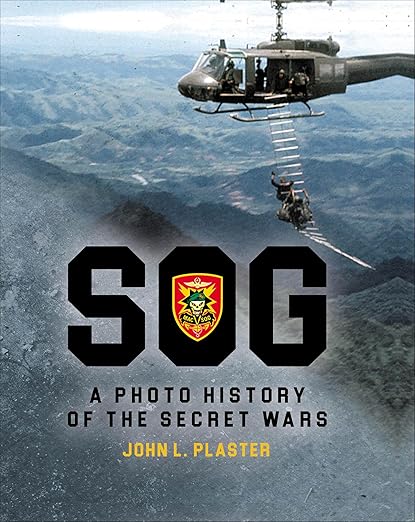
SOG begins with an act of deliberate erasure. In 1972, the U.S. military destroyed all known photographs of the Studies and Observations Group, the classified unit that ran the Vietnam War's most sensitive covert operations, with the intention that the record would remain permanently suppressed. What the program's administrators did not know was that veterans had quietly preserved hundreds of images in private collections for more than three decades. John L. Plaster's audiobook, narrated by Arthur Morey, reconstructs that record, bringing to light the operations, commanders, and individual soldiers who were officially never there. At fourteen hours and seventeen minutes, this is a substantial listen, and the material it covers, Operation Tailwind, the Son Tay raid, SOG's defense of Khe Sanh, Hatchet Force operations, Bright Light rescues, and HALO insertions, is among the most operationally interesting and least publicly understood chapters of the Vietnam conflict.
Thorne, Howard, Meadows, and Sisler Are Not Abstractions
Plaster writes as a SOG veteran who understands the operations from the inside, and that first-person familiarity gives the narrative a particularity that secondary histories cannot match. The figures at the center of the book, Larry Thorne, Bob Howard, Dick Meadows, George Sisler, the operator known as Q, are not abstractions. Plaster knew them or knew people who did, and the accounts of their actions have the quality of testimony rather than historical reconstruction. Reviewer GJ noted having only recently become aware of SOG despite years of studying the Vietnam War, which is itself a measure of how effectively the classification regime suppressed this material. The book that should not exist, as GJ described it, is an apt summary of what Plaster set out to write and largely succeeded in delivering.
The operational scope of SOG's mission extended far beyond what most histories of the Vietnam War acknowledge. Running missions into Laos, Cambodia, and North Vietnam itself, SOG operated under rules of engagement and deniability requirements that placed its personnel in extraordinary jeopardy without the institutional support or public acknowledgment that conventional soldiers received. Plaster gives the darker programs, which he acknowledges were darker than even the broader classified record suggests, the same factual treatment as the more straightforwardly heroic rescues and raids, which gives the account an honesty that hagiographic military writing typically lacks.
Seven Hundred Recovered Photographs Absent From the Audio
Arthur Morey's narration approaches this material with a respect that never tips into sentiment. The accounts of individual operations are delivered at a pace that allows the complexity of each mission to register without compression, and Morey handles the recurring technical nomenclature of special operations, the unit designations, the insertion methods, the code names, with the same fluency as the more narrative passages. For listeners who have read about the Vietnam War primarily through conventional unit histories or political histories of the conflict, Morey's steady delivery of Plaster's more granular material provides a significantly different angle on what the war looked like at its most classified levels.
The audiobook format does require acknowledging a significant limitation for this particular title. SOG: A Photo History is built around more than seven hundred photographs that Plaster recovered from veteran collections. These images are described in the text but absent from the audio. Listeners who want the full experience of the book, where the faces and equipment and operational environments are visible rather than narrated, will need to supplement the audiobook with the print or digital edition. The narrative alone is coherent and historically valuable, but the visual dimension is not a supplementary feature here: it is core to what makes this edition of Plaster's history distinctive and worth recovering from three decades of suppression.
The Audiobook Tolerates Interrupted, Episodic Listening
The book is deeply sympathetic to the soldiers it documents, as one would expect from an insider account, and it does not engage extensively with the political decisions that deployed them or with the moral dimensions of covert cross-border operations in neutral countries. That is not a criticism of Plaster's intent, which is explicitly to honor and document the veterans whose service was classified, but listeners who want a critical examination of special operations strategy or the policy decisions behind SOG's missions will need to look elsewhere. This is a record of what happened and who was there, not an evaluation of whether it should have happened.
The chapter structure does not follow a strict chronological arc, which can make the narrative feel episodic rather than building to a single culminating argument. For listeners who prefer sustained narrative momentum, the operational-episode format requires a different kind of attention than a conventional biography or narrative history would. Each chapter largely stands alone as a complete account of a specific operation, figure, or program, which also means the audiobook tolerates interrupted listening better than a more tightly structured narrative would.
A Reviewer Whose Father Served as a Pilot
Military history listeners with a specific interest in Vietnam-era special operations, unconventional warfare, or the classified infrastructure of the Cold War military will find this audiobook among the most substantive primary-source accounts available. Reviewer William Brown, whose father served as a helicopter pilot in Vietnam, captured the particular value of the book for listeners with personal connections to the conflict. For general military history audiences, the audiobook provides a genuinely revelatory introduction to a chapter of American military history that remains less known than its significance warrants. Those who can access the print or digital edition alongside the audio will get the fullest version of what Plaster assembled. The audio alone is worth the time for the narrative, but the photographs are a significant part of what makes SOG historically important and should not be overlooked entirely.







