In Brief
- Voice: Samuel Eriksson keeps the delivery measured and grounded, trusting the material's real intensity rather than dramatizing it further.
- Big ideas: Vietnam-era special operations, MACV-SOG, survival under extreme odds, elite-unit brotherhood
- Atmosphere: Tense, unflinching, and historically weighted
- Worth it?: A rare, detailed firsthand MACV-SOG account best suited to readers of serious military memoir who want unfiltered testimony.
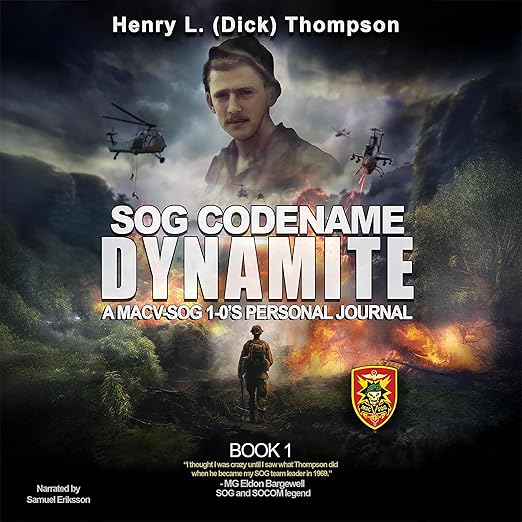
Samuel Eriksson's narration opens on a helicopter skid, the exact image the synopsis uses to describe LT Dick Thompson, codename Dynamite, stepping into combat with a clear and focused mind, aiming to kill before he can be killed. The SOG Codename Dynamite audiobook covers Thompson's path from Airborne Ranger to team leader inside MACV-SOG, the secret American unit that ran missions into Laos, Cambodia, and North Vietnam between 1964 and 1972 with no Geneva Convention protection and, officially, no existence at all. This is first-person combat memoir at its most exposed: a man describing missions where his team started every operation already surrounded by a numerically superior enemy trained specifically to hunt SOG units down.
Classified Until the 1980s, Rare Even Now
What separates this from a general Vietnam memoir is its specificity. Thompson is not reconstructing the war from a distance, he is describing exact tactical decisions made in the seconds before contact, the calculus of a soldier who has accepted that dying is a live possibility on every single mission. Reviewer Alabexis frames this as valuable precisely because so many of the men who lived through MACV-SOG never got their own account on record, naming Bob Howard, Dick Meadows, Gavin Storter, and Moose Monroe as peers whose stories went untold. That context raises the stakes of this book beyond one man's memoir into something closer to a historical record filling a real gap.
Reviewer JP's response, simply marveling at how a young person could make the choices Thompson made, gets at something the book does well: it never asks the listener to fully understand the decision to volunteer for this kind of danger, only to witness what it demanded once made. Charles Lee Allen's review calls Thompson's writing an economy of force, and that discipline carries through the audio version as a story that moves without padding.
Much of what Thompson describes here remained officially classified for decades after the war ended. MACV-SOG's existence and operations were not fully declassified and opened to public account until the 1980s and 1990s, which is part of why so few firsthand narratives from team leaders like Thompson exist even now, echoing Alabexis's point about teammates whose stories went untold. That classification history is not just historical trivia, it directly explains why a book like this carries the specific weight and rarity that reviewers keep pointing to.
Eriksson Trusts Heart-Stopping Material to Speak Itself
Samuel Eriksson narrates with the kind of measured intensity this material needs, treating the firefights with the same clear-eyed focus Thompson describes using in the field rather than dramatizing them for effect. Combat memoirs live or die on whether the narrator trusts the material to be frightening on its own terms, and the source text gives Eriksson plenty to work with without needing embellishment, since Thompson's own account is described by reviewers as heart-stopping and jarring in its detail.
This is also framed, both by the synopsis and by reviewer Alabexis, as a historical document as much as a personal one. The book positions itself as a resource scholars will eventually turn to for granular, ground-level MACV-SOG history, and Eriksson's steady, unshowy delivery supports that framing well. He is narrating testimony, not action fiction, and the difference is audible in how little the performance reaches for excitement that the facts already supply.
Military memoirs at this level of specificity come loaded with acronyms, unit designations, and jargon, MACV-SOG itself, plus the operational language of Airborne Ranger and Special Forces training, and a narrator has to move through that vocabulary without stumbling or slowing the momentum of a firefight description. Eriksson's handling of that density suggests real preparation, treating the specialized language as simply part of Thompson's natural voice rather than something requiring separate, careful enunciation that would break the narrative's flow.
A Companion PDF Covers Maps and Unit Photos
This is graphic material. The synopsis is direct about the brutality involved, including detailed hand-to-hand combat and the deaths of teammates left behind in hostile jungle, and listeners should expect the audiobook to sit inside that intensity rather than glancing past it. If you are looking for a broader strategic overview of the Vietnam War, this is not that book. It stays close to one team leader's direct experience rather than zooming out to policy or larger campaign context.
Worth noting for anyone who buys the audiobook: the listing indicates a companion PDF is included alongside the audio, which is a common and useful feature for military memoirs that reference maps, unit photos, or documentation, and is worth checking for inside your library after purchase rather than assuming the audio alone covers everything the physical edition offers.
A Generation Before American Sniper or Lone Survivor
Readers already drawn to elite-unit memoirs, Vietnam-era special operations history, or first-person combat writing in the vein of the veterans Alabexis lists as Thompson's real-world peers will find exactly what they are looking for here. This is series book one, and Thompson's account of getting on what the synopsis calls his 'path' as a child through to leading MACV-SOG missions gives newcomers to his story a clear, complete entry point.
This is not a casual listen, and it is not for anyone who wants their military history softened for a general audience. But for listeners who want testimony this specific, this close to the ground, and this rarely recorded, given how few of Thompson's actual teammates left written accounts of their own, SOG Codename Dynamite delivers a first-person record that reviewers consistently describe as both historically important and genuinely gripping in the moment-to-moment telling. At just under eight hours, it is a substantial but not overwhelming commitment for listeners newer to military memoir looking for a serious entry point into the genre.
Listeners who gravitated toward Chris Kyle's American Sniper or Marcus Luttrell's Lone Survivor for their unflinching, ground-level combat detail will find a similar register here, though SOG Codename Dynamite reaches back a full generation earlier into a conflict and a unit that has received comparatively less mainstream attention. That relative obscurity is itself part of the book's appeal for readers specifically seeking out under-told chapters of American military history rather than the most famous ones.
Before You Listen
What time period and region does the SOG Codename Dynamite audiobook cover?
It covers Dick Thompson's service with MACV-SOG roughly between 1964 and 1972, including missions into Laos, Cambodia, and North Vietnam carried out by a unit that operated with no official government acknowledgment.
Does the SOG Codename Dynamite audiobook include graphic combat detail?
Yes. The synopsis and multiple reviewers describe direct, unflinching detail about firefights, hand-to-hand combat, and the deaths of teammates, so listeners sensitive to combat violence should be prepared going in.
Is Samuel Eriksson's narration performed like a dramatized war story, or closer to reported testimony?
Closer to testimony. Eriksson's delivery stays measured and grounded rather than dramatized, which suits a book that reviewers describe as historically valuable firsthand documentation rather than embellished war fiction.
Is this the first book in a planned series, and does the audiobook stand on its own?
Yes, this is book one of the SOG Codename Dynamite series, and it covers Thompson's path from childhood through his rise to MACV-SOG team leader as a complete, self-contained account.