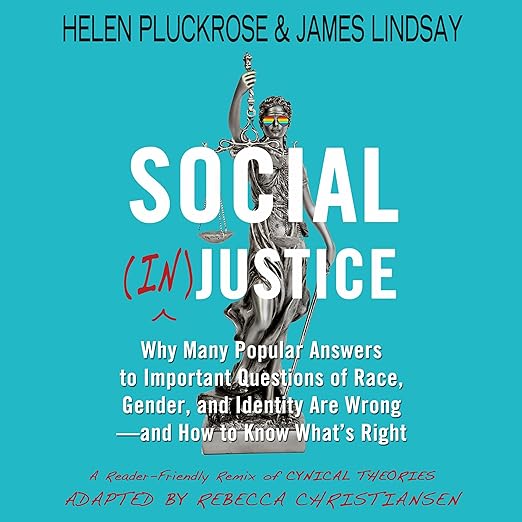
Cynical Theories became an internationally acclaimed bestseller, translated into more than fifteen languages, and Social (In)justice is Helen Pluckrose's reader-friendly adaptation of that book's central argument for this audiobook's wider audience. Can a shorter, more accessible version preserve the original's evidentiary rigor while dropping most of its academic scaffolding? Pluckrose, who co-authored the original with James Lindsay, uses this six-hour audiobook to trace what she presents as the evolution of a specific set of ideas that now shape mainstream discussion of race, gender, and identity, arguing many of those ideas are more recent inventions than their current prominence suggests. The title's parenthetical structure, Social (In)justice, is a small but pointed piece of rhetorical design: it visually embeds the word injustice inside justice itself, suggesting the book's core claim that ideas marketed as advancing justice can, in Pluckrose's argument, function as their opposite. That kind of title-as-argument construction is common in polemical nonfiction, and naming the device explicitly helps a listener understand what kind of book they're pressing play on before the first chapter begins.
Pluckrose Reads Ideology Like Medieval Religious Doctrine
The book moves through specific claims Pluckrose treats as symptomatic of the broader shift she's describing: language framed as literal violence, science framed as inherently sexist, objective claims about health dismissed as culturally biased, and traits like punctuality or individualism read as evidence of white supremacy. She argues these positions, however widely repeated now, are not grounded in scientific fact and don't hold up against the complexity of actual social reality. The stated goal, per the book's own framing, is defending the liberal democratic principles Pluckrose credits with raising living standards worldwide and enabling the very debate she's having. Whether or not you find that framing persuasive, it's presented with real specificity rather than vague grievance. Pluckrose's academic background is in medieval and early modern religious writing, which she has said informs how she approaches ideology generally, tracing how belief systems develop internal logic, orthodoxy, and boundary-policing over time regardless of their specific content. That framing shapes how Social (In)justice is structured: less as a political take and more as an intellectual history of how a specific set of ideas moved from academic theory into mainstream institutional practice.
This is explicitly the condensed, accessible version of a longer academic argument, not a new or different one. Listeners already familiar with Cynical Theories will recognize the throughline; listeners coming to this material for the first time get Pluckrose's central case without the fuller citation apparatus and extended theoretical engagement the original academic-adjacent text provides.
Pluckrose's British Cadence Reinforces a Reasoned Argument
Pluckrose narrates her own adaptation, and self-narration genuinely reinforces the book's posture here: this reads as reasoned argument rather than emotional polemic, in large part because of how she delivers it. Her British cadence lends a natural academic authority, and her precision on stressed words and key distinctions makes even the book's more explicit or contentious sections easier to follow than they might be from a hired narrator working from a script cold. She clearly knows exactly where the argument's emphasis belongs, sentence by sentence, which is the advantage an author reading her own carefully constructed case always has over even a skilled outside performer approaching unfamiliar material for the first time. Argument-driven nonfiction like this one lives or dies on whether a listener can track the logical throughline without a page to flip back to for a missed premise, and Pluckrose's own narration helps considerably here: she paces each section's central claim clearly enough that the audio format doesn't cost listeners the argument's structure the way a denser academic audiobook sometimes can.
Reviewer Kindle Customer credits the book with doing 'an excellent job of outlining the problems of critical theory,' while Emily T. Stickney frames it in more explicitly polemical terms as a tool for 'un-brainwashing' readers from ideas she considers entrenched across education and media. That range of reviewer language is itself informative: this audiobook's existing audience skews toward listeners already sympathetic to its central argument. The book's release timing, arriving after Cynical Theories had already become a reference point in broader public debate, positions this adaptation less as an introduction to new ideas and more as a distillation aimed at readers who'd heard the original discussed secondhand, through interviews, podcasts, and commentary, without having read the source text themselves. Pluckrose's own public writing and podcast appearances since the original book's release have refined how she presents these arguments to a general audience, and that refinement is audible here: the pacing and phrasing throughout feel calibrated for listeners rather than transplanted wholesale from a denser written text. Listeners weighing whether to start with this adaptation or the original Cynical Theories should treat runtime as the deciding factor over content difference, since the underlying argument, examples, and conclusions are functionally the same across both versions. That distillation approach carries real tradeoffs worth weighing honestly: readers who thrive on extensive citation and rebuttal of counterarguments will find this version thinner in that specific regard, even as its core argument remains fully intact.
One Clear Position, No Neutral Survey Here
Given the ideological nature of the content, listeners should expect a book that argues a clear, specific position rather than surveying multiple perspectives evenhandedly; that's a structural fact about how the book is built, not a criticism of its execution. If you're looking for a neutral primer that fairly represents competing views on these debates, this isn't that book, and it isn't trying to be. If you already found the original Cynical Theories too dense or academic, know that this adaptation is genuinely shorter and more accessible in delivery, but it's still making the identical underlying case rather than offering a structurally different take on the same material.
At six hours and four minutes, this moves briskly compared to the source text, which works in the audiobook's favor for listeners who want the core argument without an extended academic commitment. The tradeoff is less room for nuance on any single example than a longer treatment would allow.
Secondhand Familiarity With Cynical Theories Is Enough
Listeners already engaged with current debates around identity, critical theory, and academic activism, whether out of genuine curiosity or prior familiarity with Cynical Theories, are the clearest audience for this audiobook. It's also a reasonable entry point for anyone who has encountered these ideas secondhand and wants Pluckrose's own account of where they came from.
Skip it if you're looking for a neutral, multi-perspective survey of these debates rather than a book arguing one clear position throughout. Listeners who found the original Cynical Theories intellectually unconvincing rather than simply too long shouldn't expect this shorter adaptation to change their mind, since the underlying argument here is identical, just more efficiently delivered.
The Short Version
- Voice: Helen Pluckrose narrates her own adaptation with measured, academically confident delivery.
- Big ideas: critical theory, identity politics, liberal democratic principles
- Atmosphere: Argumentative and analytical
- Worth it?: A clearly argued condensed edition for listeners already engaged with this debate, not a neutral primer.