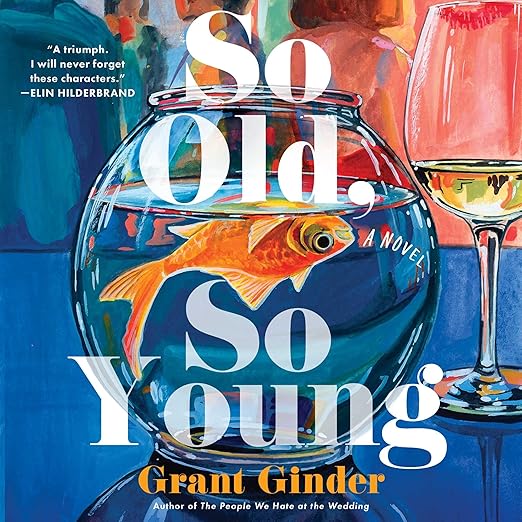
Quick Take
- Narration: Jill Paice handles the ensemble cast with clean differentiation across six characters over twenty years, and her ear for Ginder’s comedy is as reliable as her ear for the novel’s genuine grief.
- Themes: Millennial friendship across time, romantic love versus chosen family, the slow divergence of shared histories
- Mood: Warmly melancholic, funny and sad in alternating layers, with emotional undertow building across five structural movements
- Verdict: Ginder’s most ambitious novel to date, a generation-defining portrait of six friends across twenty years that earns both its comedy and its tears.
I came to So Old, So Young in the particular frame of mind that Elin Hilderbrand’s blurb was designed to produce: she called it The Big Chill of our times, possibly better, and I was constitutionally unable to resist that. I am in the exact demographic Grant Ginder is writing for, old enough to have noticed that friendships which once felt permanent have quietly become conditional, old enough to recognize the versions of myself that existed at parties I would now never attend. The novel landed accordingly. By the end of the second party section I had abandoned any pretense of critical distance.
Ginder’s previous novel, The People We Hate at the Wedding, established him as a writer of intelligent literary comedy with genuine emotional range. This book is more ambitious and, I think, better. Six college friends, Marco and Mia, Sasha and Theo, Richie and Adam, are followed across five parties over twenty years. New jobs. New cities. New spouses. New children. The structure is deceptively simple: each party is its own chapter, each chapter is its own small catastrophe, and the accumulation of small catastrophes is, it turns out, the shape of a life.
The Party Structure and What It Demands of the Listener
Jenny Jackson, in her blurb, notes that the novel is about romantic love, professional jealousy, misplaced longing, and the gift of lifelong friendship. That list is accurate but it undersells the structural ingenuity of how Ginder delivers it. Each party is a closed environment, a pressure cooker, where everything that has happened to these people in the years between gatherings is visible in how they speak to each other, what they avoid, what they cannot stop returning to. The gaps between parties are not narrative ellipses but deliberate white space. You feel the accumulated time. You fill in what you are not told. It is a demanding structure that trusts the listener to meet it, and Ginder’s writing is precise enough to justify that trust.
Jill Paice and the Six-Voice Challenge
Maintaining six distinct narrative perspectives across an eleven-hour audiobook is a significant technical challenge for any narrator, and Jill Paice handles it without apparent strain. The differentiation between Marco’s particular brand of self-awareness and Richie’s, between Mia’s emotional register and Sasha’s, is consistent across the full runtime. In a novel whose structural conceit depends on the listener tracking where each character is in their life at any given party, this clarity is not a luxury. Paice also finds the comedy in Ginder’s dialogue without sacrificing the emotional weight in the same scenes, which is the harder part of the performance.
What Makes This a Millennial Novel Rather Than Just a Novel About Millennials
One reviewer called it best for Millennials, which is partially true and partially limiting. The specific textures Ginder renders, the East Village apartment parties, the destination wedding disasters, the suburban backyard barbecues that feel like surrenders, are drawn with the precision of lived experience. The professional jealousy that complicates these friendships over time is also culturally specific: these are people who were promised that their professional and creative lives would be central to who they were, and some of them got that and most of them did not. That particular species of disappointment, and the way it warps friendships, is what makes this a generation-specific book. Though the grief underneath, and the love underneath the grief, belongs to anyone who has held a friendship long enough to watch it change.
Who Will Love This and Who Should Know What They Are Getting Into
If the phrase The Big Chill of our times makes you want to listen immediately, listen immediately. If you loved The People We Hate at the Wedding, this is the same author operating with greater ambition and deeper feeling. One reviewer accurately noted that the characters can be childish and foolish, they can, regularly, and Ginder does not protect them from themselves. Listeners who need their protagonists to be admirable will struggle. But if you can hold a character’s genuinely bad choices in one hand and your genuine affection for them in the other, this novel is built for you.
Frequently Asked Questions
Does So Old, So Young require reading The People We Hate at the Wedding first, or is it a completely standalone novel?
Completely standalone. The two novels share an author and a sensibility but no characters or plot connections. So Old, So Young works as an independent listening experience and is, by most assessments, the more ambitious of the two books.
Is the five-party structure disorienting, do the time jumps between sections make it hard to track where characters are in their lives?
The structure is designed to be legible rather than disorienting. Ginder establishes each party’s temporal location clearly, and Jill Paice’s consistent characterization across the audiobook helps listeners maintain their sense of where each person is emotionally and professionally at any given point.
Is this primarily a comedy or a serious literary novel, does it lean more toward the humor of The People We Hate at the Wedding or something heavier?
It is both, in roughly equal measure. The comedy is present throughout and genuinely funny. But the emotional undertow is heavier than Ginder’s previous work, and the novel earns real grief by its ending. Expect to laugh and also to feel something more complicated.
The synopsis lists this as a national bestseller, does the critical enthusiasm translate to an audiobook listening experience, or is this a book that works better on the page?
The structure, five discrete parties over twenty years, actually translates well to audio. Each section has a clear sense of occasion, and Paice’s performance gives the time-jumps emotional continuity that keeps the larger arc coherent. This is not a book that loses something in the transition from page to audio.