
The Short Version
- Read by: Andy Glaze self-narrates with the authenticity only a survivor can bring; less polished than professional narration but more emotionally immediate for this material.
- At its heart: Addiction and recovery, institutional abuse, endurance running as reclaimed agency
- Vibe: Raw and honest, with genuine warmth beneath the difficulty
- Short version: A memoir that earns its hopeful philosophy through unflinching honesty; Glaze narrating his own story is the right choice.
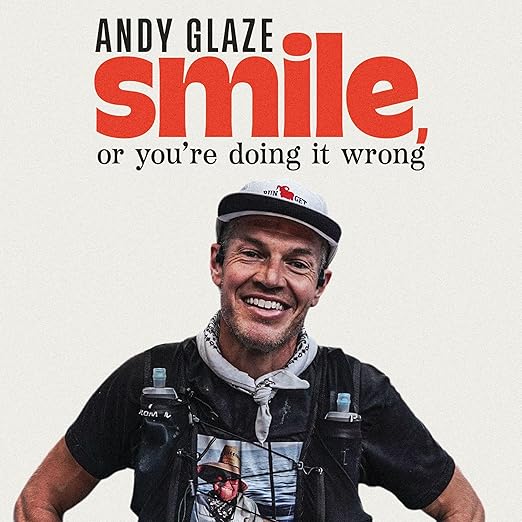
Andy Glaze narrates his own audiobook, and that choice matters enormously for Smile, or You're Doing it Wrong. This is a memoir of addiction, institutional abuse, ultrarunning, firefighting, and fatherhood, told by the man who survived all of it. Glaze's voice in audio carries the specific weight of self-disclosure: you are not listening to an actor interpret someone's trauma. You are listening to the person who lived it, choosing which words to use, choosing how to pace the difficult parts, choosing when to let silence work.
Running as a Way to Reclaim a Stolen Body
Glaze is an ultrarunner with a following built on showing up for hundred-mile races and multi-day marathons and making hard things look almost manageable. Reviewer Amazon Customer captures the dissonance well: 'It's one thing to see the man on instagram making hard things look easy, it's another to know the background as to what made the man that makes hard things.' The memoir exists to close that gap.
The childhood Glaze describes is not merely difficult. He went through a wilderness rehab program where kids hiked for days without food. He survived a 'therapeutic' boarding school that he describes as run by predators. These are not metaphorical abuses. They are documented categories of institutional harm that have since been widely reported and litigated. Glaze names them specifically and does not reach for euphemism. Reviewer J. Caudle notes his 'remarkable' ability to 'reframe pain and suffering again and again,' and that reframing is the emotional engine of the book. Glaze does not dwell. He processes and moves.
The transition from that damaged, institutionalized kid to a firefighter, ultrarunner, and father is the book's central arc. It is not a clean transformation narrative. Glaze is honest that the endurance sports framework he built his life around is not entirely separable from the damage that preceded it. Running a hundred miles is, among other things, a way of exerting control over a body that was once controlled by other people. The title captures the philosophy: you keep moving, and you smile, because the alternative is worse.
Only His Second Audiobook, and He's Hooked
Self-narrated memoirs succeed or fail on whether the author can sustain the emotional openness required without either shutting down or overperforming. Glaze does neither. Reviewer Chris Shanks, who describes this as only the second audiobook he has ever listened to, says he is 'absolutely hooked,' a response that speaks to the accessibility of Glaze's voice in audio. This is not polished professional narration. It is someone talking to you directly, with the particular authenticity that only comes from being the only person in the world who could tell this story from this vantage point.
The audiobook runs seven hours and fifteen minutes, which is the right length for this kind of memoir. Long enough to give the institutional abuse chapters the space they need without sensationalizing them, and paced well enough that the ultrarunning sequences, which could easily feel like a different book entirely, read as natural extensions of the same story. Running is where Glaze rebuilt agency. The race passages have urgency rather than detachment.
Glaze provides what his synopsis describes as 'an honest warning about the subject matter,' and J. Caudle specifically praises that warning. This is not a memoir that ambushes listeners with its darkness. It signals what is coming and then delivers it with honesty rather than voyeurism.
Ultrarunning as Both Literal Practice and Metaphor
The book's subtitle could easily be 'a memoir about endurance in its rawest form,' and that phrase from the synopsis is not marketing language. Glaze is not using ultrarunning as a metaphor. He is describing a literal practice of placing one foot in front of the other across distances that are physiologically absurd, and he is also describing how that practice translated into a metaphor for everything else in his life. The two registers, the literal and the symbolic, run alongside each other throughout the book and occasionally merge.
The fatherhood sections are among the memoir's quietest and most precise. Glaze is writing not just about his own survival but about what he wants to pass on to his children and, equally, what he wants to prevent. For listeners who came to Glaze through his running content and know him as a performance athlete, these passages provide the most unexpected texture.
The firefighting dimension of the book, which sits between the institutional abuse chapters and the ultrarunning narrative, is handled with the specificity of someone who has actually done the job. It is not a background detail. It is part of the broader pattern of Glaze finding structures that require his body to be useful and his focus to be absolute.
Not a Typical Audiobook Recommendation
Listeners should also know that Chris Shanks, in his review, mentions this was only the second audiobook he had ever listened to and describes himself as 'absolutely hooked.' That is not a typical audiobook recommendation. It speaks to the specific accessibility of Glaze's narration for listeners who are not habitual audio consumers. His voice does not presuppose an audience comfortable with long-form audio. He speaks as someone used to telling stories directly, in the way that athletes and coaches often do, with economy and purpose rather than performance. That quality makes the audiobook approachable across a range of listening experience levels.
Glaze Earns It Across Seven Hours of Cost
Listeners who follow Andy Glaze on social media and want to understand the full story behind the person they see on trails will find this essential. Readers of endurance memoirs who appreciate honesty about the psychological drivers underneath athletic achievement will find this one of the more honest in the genre. If you have experienced institutional abuse or know someone who has, Glaze's specificity about wilderness programs and therapeutic boarding schools is both validating and clarifying. The smile-through-it philosophy is not toxic positivity. Glaze earns it across seven hours of showing you what it cost.







