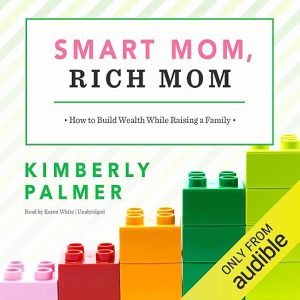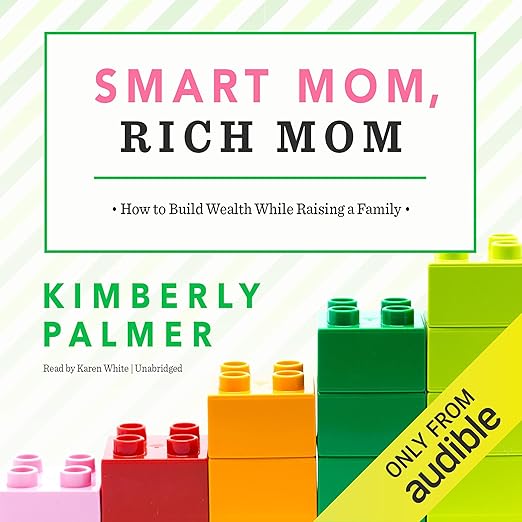
What does a personal finance audiobook recorded in 2016 still know about paying for a child? Quite a lot, and also noticeably less than its title implies. Smart Mom, Rich Mom opens on a figure that has since aged into a period detail, the claim that one child costs $250,000 to raise before college even starts, and builds an entire book out of the question that figure produces. Kimberly Palmer writes as a national money columnist and a mother of two, and the book collects the experiences of women who stayed in the workforce full time, freelance, self-employed or in some combination of the three, and emerged more prosperous for it. The Blackstone Audio recording lists Karen White as reader.
Useful Spine, Slightly Overheated Jacket
Money advice for parents usually arrives in one of two registers, thrift or hustle, and this book refuses to pick either. Catherine Collinson's September 2016 account identifies the gap it was written into, observing that women and mothers especially handle a great deal of money on a daily basis, make decisions that shape their families' lives, and play an enormous role in teaching children about money, and that almost no financial how-to book had been written specifically with mothers in mind. That is an accurate description of the shelf as it stood, and it explains the structure: stories from women who made something work, followed by the checklists and action steps that turn each story into something a listener could copy.
Useful spine, slightly overheated jacket: that is the book in five words. Smart Mom, Rich Mom is at its best on the unglamorous mechanics: preparing financially before a first or a third child arrives, protecting earning potential while negotiating for flexibility, saving for college and for retirement in the same decade when both got more expensive on the same day, planning for a layoff or an illness that has not happened yet. The listing shows 4.1 from sixty-five ratings, which is honest rather than inflated, and the five reviews on display are four five-star verdicts and one single star, which tells you the aggregate is carrying a body of moderate opinion the page never shows you.
Palmer's Narrative Profiles Carry Well in Audio
Checklists, action steps and planning tools are what the description promises, and they are simultaneously this format's central opportunity and its central problem. C Hirschman's July 2016 account describes exactly what makes the book work: Palmer takes an overwhelming subject and breaks it into manageable pieces, so a reader can tackle one suggestion at a time rather than feel overloaded and step away from the whole subject. That is a real argument for the book. Whether it survives this format is a separate question, because working through single steps out of a continuous file means either stopping to write things down or accepting that you will retain about a third of what you hear.
Much of this material is better heard than read, though, because it is narrative, and that is the counterweight. The strongest stretches are the profiles: women who scaled back, women who leaned in, women who left and built something, and what each of those choices cost and returned. Those read like reporting, and reporting carries well in audio. WMM's November 2016 account names the shift the book is really selling, describing it as moving the conversation away from clipping coupons and toward the more powerful question of how to create wealth and financial independence for a family, delivered with humor and real-life examples. That reframing is the book's actual contribution, and it has survived the decade better than the numbers have.
Recorded in 2016, the $250,000 Figure Has Aged
Recording date is the single most important thing to know before buying a personal finance title, and this one was made in 2016. That $250,000 sum opening the description is a 2016 number and should be read as one. PJo's June 2016 account, written before the audio edition existed, enthuses about the online personal finance tools and apps worth trying, which is precisely the material that ages fastest: apps get acquired, shut down or redesigned, and a decade-old list of them is closer to a historical document than a resource. That review and one other were both written before the July 2016 recording existed at all.
Ideology is the remaining concern, and one review states the objection better than a critic could. Amanda's one-star account, from February 2017, is happy to have paused paid work while young ones are at home, suspects the book is not aimed at readers in that position, and objects that a relentless pursuit of the almighty dollar is championed at all costs. That is a fair reading of the premise. The book is about staying in the game and building something out of it, and it treats reduced earning as a risk to be managed rather than as a choice with its own internal logic. Anyone who has made the other choice deliberately should expect a book that keeps gently suggesting they reconsider.
New Parents Will Find the Most Here
Parents in the first years of a child's life will find the most here, and the description is explicit that it does not matter whether it is a first child or a third. The person best served has just worked out that a household budget and a career plan are the same document and has no idea where to begin. The checklists supply a starting order, the profiles supply permission to choose differently from the person standing next to you at daycare, and the college-and-retirement material supplies the one thing that genuinely cannot be postponed. That combination is worth the six and a half hours on its own, and the profiles do something a checklist cannot, which is show you several people who solved the same problem in incompatible ways and were all correct.
Households where one parent has chosen to stop earning will find the framing unwelcome, and are better off knowing that before buying rather than forty minutes in. Anyone past the early-childhood years will find a good deal of the specific advice already spent or overtaken, since the whole book is organized around the moment when children are expensive and careers are fragile simultaneously. The dated figures are the last caution: treat every dollar amount and every named tool as a period illustration rather than as a current recommendation, and the underlying principles will still be standing long after the numbers have gone.
Quick Take
- Voice: Karen White is credited rather than Palmer, on a book whose checklists want a notebook nearby more than they want a voice.
- Big ideas: The cost of a first child, career flexibility against earning potential, college and retirement at once, planning for a layoff.
- Atmosphere: Practical, encouraging, and unmistakably 2016.
- Worth it?: The strategy has held up; the dollar figures and the app lists have not.
Frequently Asked Questions
Is this audiobook still current, given it was recorded in 2016?
Partly. The strategic material on protecting earning potential, negotiating flexibility and saving for college and retirement at the same time has aged well. The specific sums and the recommended apps have not. Treat any number or product name you hear as a snapshot of 2016 rather than as live advice.
Who narrates the Smart Mom, Rich Mom audiobook?
Karen White is credited with the reading for Blackstone Audio. Palmer does not read her own book, which is worth knowing on a title built partly out of first-person columns, though the bulk of the material is reported profiles and practical steps rather than personal confession, so the distance matters less than it might.