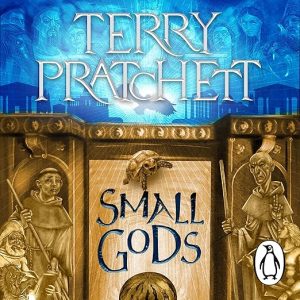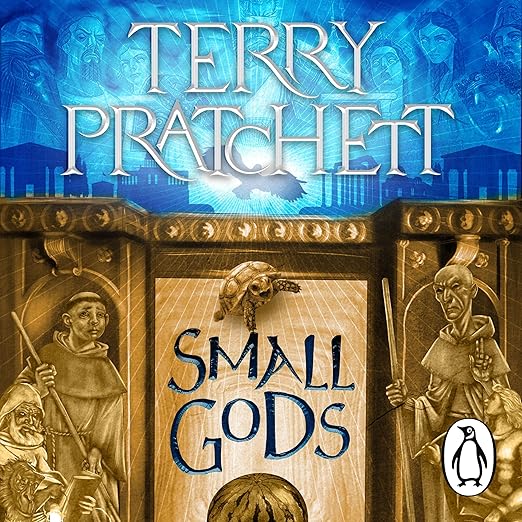
- Narration: Andy Serkis narrates with remarkable tonal range; Bill Nighy on footnotes and Peter Serafinowicz as Death make this a full ensemble production that elevates the already exceptional source material.
- Themes: Institutional religion versus genuine faith, the nature of power, moral courage
- Mood: Darkly funny and philosophically serious, with a warmth underneath the satire
- Verdict: The finest audiobook production Discworld has received, and one of Pratchett's strongest novels, an ideal entry point for newcomers and essential for fans.
I have listened to a lot of Discworld in my time, and I want to be honest about something: not all Pratchett adaptations are created equal. The earlier productions are perfectly serviceable, but they were working against the grain of what the books actually require. Pratchett's footnotes are not asides. They are structural. They are where some of his best thinking lives. So when I started the Penguin Audio production of Small Gods and heard Bill Nighy's voice slide in for the first footnote, something close to relief settled in. This is the production the novel deserved.
I finished it on a Friday evening in February, the kind of night where the wind is doing something theatrical outside and you are glad to be indoors. Small Gods is a book about a great god reduced to a tortoise because almost no one truly believes in him anymore, and about a young man named Brutha who does believe, genuinely and simply, in a way that turns out to be rarer and more dangerous than it sounds. It is also a book about inquisitors, about institutional cruelty dressed up as doctrinal purity, and about what happens when the apparatus of religion loses contact with whatever it was originally for. It is, in short, extremely relevant to almost every historical era including this one.
The Verdict, Briefly
Small Gods stands apart from most of the Discworld series because it is, at its core, a genuine philosophical argument. Pratchett is not primarily parodying religion here. He is dissecting it with the precision of someone who has thought very carefully about the difference between belief and institution, between the god and the church, between Brutha's unassuming faith and the Omnian Quisition's calculated terror. The humor is present throughout, but it is in service of something that bites.
One reviewer described this as the first Discworld novel where Pratchett moves from parody to satire in a sustained way, and I think that is right. Rincewind running from things is funny. Om the tortoise being ignored by the very pilgrims traveling to worship him is something else. It is funny and it is sad and it is making a specific point about how power structures hollow out the things they claim to represent. That combination of registers is what makes Small Gods one of those rare books that improves on reread, or in this case, relisten.
Why Small Gods Works as an Audiobook
The casting in this production is extraordinary. Andy Serkis is doing work here that goes well beyond competent narration. He gives Brutha a quality of genuine guilelessness that never tips into foolishness, which is a difficult calibration to maintain over nearly twelve hours. Om the tortoise gets a separate voice that is imperious and frustrated and occasionally bewildered, and Serkis handles that register with comic precision. The novel's philosophical dialogues between Om and Brutha, which on the page are some of Pratchett's best writing, are given room to breathe in the audio format in a way that rewards attention.
Peter Serafinowicz as Death is a cameo, but it lands perfectly. Death in Discworld is always funny and always serious simultaneously, and Serafinowicz finds that tone immediately. Bill Nighy's footnotes deserve particular mention: his delivery is unhurried and slightly wry, as though he is sharing observations he finds genuinely interesting, which is exactly the right tone for content that includes Pratchett's asides on the nature of time, the economics of divine belief, and the history of religious persecution.
Points to Consider
This is listed as book thirteen in the Discworld series, but the novel itself explicitly tells you that it can be read in any order and that it is a standalone. That is true. There are no dangling threads from earlier books, no characters requiring prior introduction. Brutha and Om are new, and the Omnian Empire is its own contained world within the Disc. This means it is a strong entry point for first-time Discworld listeners who want to understand what the fuss is about without committing to twelve predecessors.
The one thing to prepare for is tonal density. Small Gods is funnier than most novels about religious persecution, but it is still a novel about religious persecution. The scenes involving the Omnian Quisition are not played lightly. Pratchett does not soften the cruelty of institutional dogma even as he satirizes it, and the book's central moral argument, that you should do things because they are right, not because a god says so, arrives with genuine weight. Listeners who come expecting Rincewind-style absurdist comedy may take a chapter or two to adjust to the different register.
Who Should Listen to Small Gods
Essential for Discworld fans who have not yet reached book thirteen, and an ideal starting point for the curious newcomer who wants to understand why Pratchett's reputation endures. Philosophy readers who enjoyed Karen Armstrong's A History of God or Christopher Hitchens' Letters to a Young Contrarian will find Pratchett operating in recognizable territory here, just with more talking tortoises. This production specifically is one of the finest audiobook releases of recent years. Avoid it only if you have an existing relationship with a different narrator's reading that you are unwilling to displace.
Common Questions
Do I need to have read any other Discworld books before starting Small Gods?
No. Pratchett himself noted it is a standalone, and the Penguin Audio production is a self-contained listening experience. There are no significant characters carried over from other Discworld novels, and no prior knowledge of the series is required.
How does Andy Serkis handle the distinction between Om's voice as a great god versus Om as a frustrated tortoise?
Serkis gives Om a distinct register that carries the character's divine arrogance even in diminished physical form. The comedy of Om being a tortoise who believes he is still commanding respect works largely because Serkis plays it straight rather than broad.
Is Small Gods primarily funny or primarily philosophical, and how does this production balance those two things?
Both, simultaneously. Pratchett's satire functions by being genuinely funny and genuinely serious about the same idea at the same time. The production handles this well: Serkis does not undercut the philosophical passages with comedic delivery, and he does not play the funny scenes as straight drama. The balance is close to ideal.