Quick Take
- Narration: James Bryce delivers Newby’s dry, observational prose with exactly the kind of patient, understated British wit the material requires, an excellent match for a book about moving slowly and noticing everything.
- Themes: colonial-era travel and cultural dissonance, marriage as adventure partnership, the comedy of logistical failure
- Mood: Unhurried and wryly affectionate, with flashes of genuine discomfort
- Verdict: For anyone who loves travel writing that earns its observations through genuine hardship and honest frustration, this 1,200-mile journey remains a benchmark of the genre.
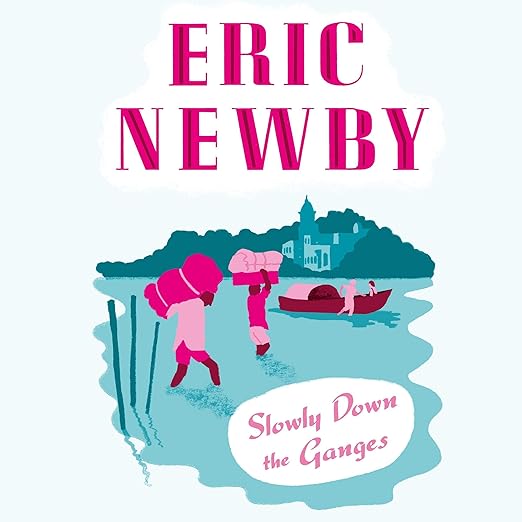
I came to Eric Newby’s Slowly Down the Ganges through a roundabout path. A reader emailed to ask whether I had covered any of the classic British travel writers, and the name Newby came up twice in that exchange. I had read A Short Walk in the Hindu Kush years ago and loved it, but somehow this Ganges book had stayed on my list unpurchased. I finally listened to it over four evenings in early spring, and I found myself doing something unusual: slowing down my own pace to match the book’s rhythm. Newby seems to do that to people.
The premise is deceptively simple. On his forty-fourth birthday, Eric Newby decides to travel the full 1,200-mile length of the Ganges, from the great plain of Hardwar to the Bay of Bengal. His wife Wanda, described throughout with a mixture of exasperation and deep admiration, comes along as fellow boatwoman. They run aground sixty-three times in the first six days. This detail, which Newby delivers with the same equanimity he applies to everything else, corpses in the water, the non-existence of usable maps, locals who are themselves uncertain where they are, sets the book’s entire tone.
Our Take on Slowly Down the Ganges
Newby belongs to a specific tradition of British travel writing that has largely passed out of fashion: self-deprecating, meticulous, deeply curious without being sentimental. He is not trying to understand India in the sweeping, meaning-seeking way of later travel writers. He is trying, and frequently failing, to navigate it. The distinction matters enormously for how the book reads. There is no thesis here, no moment of revelation where the Ganges unlocks something universal. There is instead a series of precise, often very funny observations about the particular difficulty of traveling a long river in an era before reliable infrastructure, in a country with its own specific logic about how information flows between strangers.
One reviewer here called him “the ultimate travel writer” for his ability to hold “the rejoicing, the disgusting, the revealing” with equal care. That is accurate. Newby records corpses and body parts drifting in the current with the same careful attention he gives to a memorable meal or a particularly impenetrable bureaucratic encounter. This evenhandedness will feel honest to some readers and uncomfortably detached to others. It is, in any case, entirely consistent.
Why Listen to Slowly Down the Ganges
James Bryce’s narration is a significant part of what makes this audiobook work. Newby’s prose relies on timing, on the pause before a comic observation lands, and Bryce has the technique to honor that. He reads slowly enough to give the writing room without ever becoming ponderous. The long stretches of the book where very little happens except observation and minor disaster benefit enormously from a narrator who understands that forward momentum is not the point. This is a journey measured in sensory detail rather than miles covered.
The fourteen-hour duration feels appropriate rather than excessive. This is not a book to rush. One reviewer noted that you find yourself wishing the journey slower, that the difficulties multiplying only give Newby more material to work with. There is something almost perverse about how the problems become pleasures when filtered through his prose.
What to Watch For in Slowly Down the Ganges
The most honest criticism in the reviews is that the book can be repetitive. Newby’s method is journalistic, he records, he describes, he moves on, and over fourteen hours the accumulation of detail occasionally tips into monotony. This is especially true in the middle sections of the journey, where the landscape flattens and the logistical challenges start to rhyme with each other. If you go in expecting a narrative arc with a clean emotional payoff, you will be disappointed. The book does not build toward anything so tidy. It simply ends when the river reaches the sea, which is its own kind of satisfaction.
It is also worth knowing that this is a document of the 1960s. The India Newby describes is not the India that exists now, and some of his observations about local character and custom carry the cultural assumptions of their era. That historical context enriches the reading for some listeners and creates friction for others.
Who Should Listen to Slowly Down the Ganges
This is travel writing for people who read travel writing. If Redmond O’Hanlon, Patrick Leigh Fermor, or Jan Morris occupy honored spots on your shelf, Newby belongs there too. Listeners who want pace and plot will struggle with a book that cheerfully announces its slowness in the title. But for anyone who finds pleasure in a writer who knows exactly what he is doing with a sentence, who uses self-deprecation as a precision instrument rather than a tic, this remains an irreplaceable account of a journey that could never be replicated in exactly the same form again.
Frequently Asked Questions
Do I need to read A Short Walk in the Hindu Kush first to appreciate this book?
Not at all. The books are set in completely different locations and share only Newby’s sensibility and his marriage to Wanda as common threads. This is a self-contained account of a single journey, and first-time Newby readers will find it as accessible as any of his other work.
Is the Ganges journey depicted here still possible to replicate today?
Portions of it are, though the logistics have changed enormously since the 1960s. Newby’s account is partly valuable precisely because it documents a mode of travel, by local boats, bullock cart, and rail, with almost no reliable maps, that has been largely transformed by infrastructure development and increased tourism.
How does James Bryce handle the Indian names and Sanskrit terms in the narration?
Bryce navigates the Indian geography and cultural references with care and apparent preparation. Occasional mispronunciations surface, as they do in most English-language narrations of South Asian material, but they are infrequent enough not to disrupt the listening experience.
Is Wanda Newby a significant presence in the book, or largely background?
She is a vivid and essential presence. Newby writes about her with a combination of bemused appreciation and genuine respect for her resilience, she endures conditions that would have sent most travel companions home within the first week. The marriage dynamic is one of the book’s quiet pleasures.