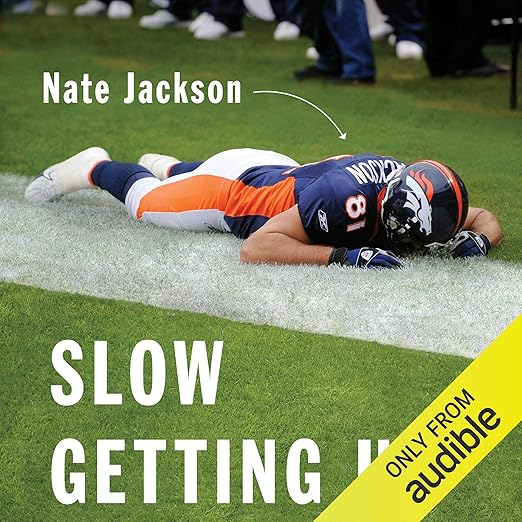
Six seasons, says the description. Eight years, says one of the people who wrote about it. Both numbers sit on the same audiobook page a few inches apart, and the listing makes no attempt to reconcile them. The copy counts "six seasons in the NFL as a Bronco"; a five-star response counts a career that "ends eight years later." Neither is necessarily wrong, since the San Francisco stretch sits outside the Denver count, but a memoir advertising itself as unvarnished and uncensored ought to be able to say how long it lasted.
The 99% Who Aren't NFL Superstars
Jackson signed as a free agent out of a tiny Division III program, went to San Francisco, moved to Denver, and spent his NFL years alternating between the practice squad and the active roster before finally winning a starting spot. That is the whole arc, and the book's argument is that it is the normal one. The description calls it "a short, tenuous career emblematic of the average pro player," and the subject is the hundreds of men living that career rather than the handful of names you know.
DACHokie gets closest to explaining why the book works. That response opens by asking whether you have ever wondered about "the 99% of NFL Players That Aren't Superstars," then reaches for a comparison: if the league were the Fortune 500, these unknown players "would reside in the 50-500 slots as they too represent the upper-crust of their sport." Being the four hundredth best in the world at something and still being disposable is the tension the memoir runs on.
Liebo, at four stars, raises the objection that usually sinks this genre and then withdraws it. Athlete memoirs, that response argues, get written as cash-outs, and "The player's voice is generally diluted by a co-author who invariably has a penchant for lame cliches and generic athlete platitudes." The sentence that clears this book of the charge breaks off before it finishes, but the direction is unmistakable, and it points at the most important line on the listing.
No Ghost Between the Sentence and Your Ear
Nate Jackson's name occupies the author field and the narrator field. For a memoir whose credibility rests on an unfiltered first person, that duplication is the strongest argument the record makes. The complaint Liebo raises about diluted voices is structurally impossible here: no ghost between the experience and the sentence, and no third party between the sentence and your ear. Eight hours and nineteen minutes of a former player telling it in the voice that lived it.
Look closely at the star line before you weigh it. The badge reads 4.2 over a counter that says two votes, and 4.2 cannot come from two whole-star grades under any rounding rule anyone uses. Five written responses sit underneath, which is three more than the counter admits exist. Whatever the badge is measuring, it is not the column below it, and the sensible move is to read the five accounts and ignore the number entirely.
Just over eight hours is short for a whole career, and the column treats the compression as a virtue. Cavannaro notes that Jackson "doesn't go overboard with detail, so the seasons fly by in what is a relatively short book," which in audio terms means a listener gets the shape of six or eight years without the week-by-week grind that sinks most sports memoirs. This is a book you can finish in a couple of sittings and still be turning over a month later.
The One Thing Worth Sampling First
Some of the best specifics in this record are not in the description at all. The copy says Jackson played "college ball at a tiny Division III school" and leaves the school unnamed; a reviewer names it, and adds that Bill Walsh was the one who spotted him and recommended him for a job in the league. The column also calls him a tight end while the description calls him a receiver. None of this is scandalous. All of it means the summary you are buying from is thinner than the reviews below it.
Details of the damage are the other thing to prepare for. The description lists debilitating physical injuries, degenerative brain conditions, poor pensions and financial distress in a single sentence, and promises a look at "the young men who risk their health and even their lives to play the game." Nobody who wrote here found the book grim, but the material is genuinely bleak in places, and a listener who follows the sport for pleasure should know the memoir is not a celebration. Tris O'Kane supplies the counterweight, describing someone "lucky to live a dream that was hardwired to his psyche from the time he was a kid: Play Football." Both things are true at once, and holding them together is the whole job.
Football knowledge is not required, and one response filed from the United Kingdom makes the point directly, reporting a better grasp of a game the writer already loved. That same entry praises the insight into life "on the fringes of the NFL, sometimes in, sometimes out." The reverse also holds: a listener who follows the league closely will recognize the world at once and may find the scouting-combine material familiar. What nobody addresses is the recording itself, which on a self-narrated memoir is the one thing worth sampling before you commit.
The Right Person to Narrate This Gap
Anyone who watches football and has wondered what happens to the players whose names never appear on a jersey in a store should start here. The memoir also works for readers with no sporting interest at all, since the underlying story is about contingent employment, a body used as equipment, and what a person does when the one thing they trained for stops. Audible Studios published it in March 2014, and the perspective it takes has not been crowded out since.
Give it a miss if a highlight reel is what you came for, because the whole point is the absence of one. Give it a miss if degenerative brain injury is a subject you would rather not spend an evening inside. And give it a miss if you need a star rating you can trust, since this one cannot be reconciled with the responses printed beneath it, and no amount of squinting will make two votes explain five opinions. That gap is the book's actual subject, and Jackson is the right person to read it aloud.