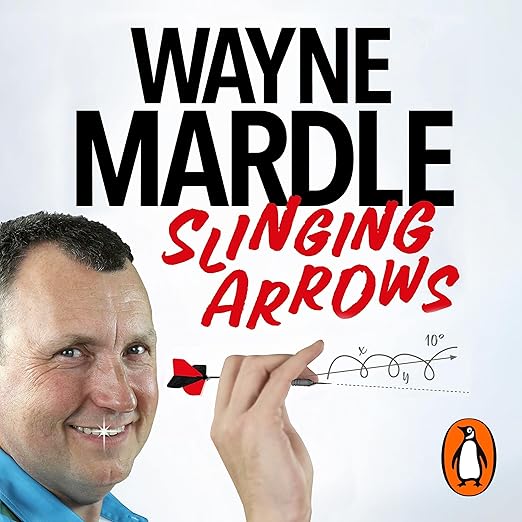
Darts legend Wayne Mardle opens this audiobook the way he played most of his career - with maximum color and minimum pretension. Hawaii 501, the man famous across the darts world for his colourful Hawaiian shirts, arrives on the page as exactly the kind of host you want for a tour of professional darts' wildest decades: chaotic, self-aware, and constitutionally incapable of taking himself seriously. At just over seven hours, Slinging Arrows moves at the pace of good pub conversation, and Mardle's own narration - delivered in his unmistakable Essex register - makes the whole thing feel less like a memoir and more like being cornered by your funniest mate at closing time. That is, without qualification, a compliment.
Witty Frequently, Honest Largely, Poignant Twice
What makes this memoir work beyond the obvious entertainment value is Mardle's absolute refusal to polish himself up for the page. He does not arrive with retrospective wisdom neatly packaged into lessons learned. He arrives as a man who went on a two-day Vegas booze bender before a major PDC final, who once went live on European television with a string of expletives so outrageous that clips are still replayed on Belgian television years later, and who narrowly avoided a lawsuit from a well-known biscuit manufacturer under circumstances he recounts with gleeful specificity. The book promises to be witty (frequently), honest (largely), and poignant (twice) - and it delivers precisely on those bracketed qualifications. The honesty is the real gift here.
Mardle is candid about losing to most of the greats of his era. He is candid about the drinking culture that saturated the sport for much of his career. He is candid about the gap between the performer the crowd sees at the oche and the person standing in the hotel corridor afterward. Green-room gossip spanning decades populates these pages with genuine affection for a world that is simultaneously absurd and deeply human. The darts world that Mardle depicts is one of extraordinary talent operating in conditions of magnificent excess, and he renders it with the authority of someone who was present for all of it, often creating the chaos himself.
The self-deprecation never collapses into false modesty, which is the correct calibration. Mardle knows he was genuinely good - good enough to stand on the world stage, good enough to be recognizable globally. The humor comes from his willingness to admit that being good enough was not always enough, and that some of the obstacles to his career were entirely of his own construction.
Mardle Describing Paint Drying for Eight Hours
The case for the audio version over the print is straightforward: Wayne Mardle's voice is the performance. Listeners who know him from television commentary will immediately recognize the timing, the pauses for effect, the sudden dip into sincerity before the joke reasserts itself. One reviewer captured it precisely - they could listen to Mardle describing paint drying for eight hours. That is not hyperbole so much as an accurate description of how compelling a natural raconteur sounds when handed their own material and given a recording studio.
The darts context is rich and consistent throughout. Mardle traces the sport from its working-class pub origins through the Sky Sports era that turned certain players into genuine cultural celebrities, and he does so with the authority of someone who lived every phase of that transformation, usually in a shirt that cost forty-five quid from a very specific garage. You do not need to follow darts to enjoy this book. You need only to appreciate a man who has genuinely made peace with a career full of spectacular failures alongside his genuine achievements, and who tells stories about both with equal pleasure.
The production quality suits the material. This is a self-read memoir that benefits from author narration in almost every way - the material is personal, the humor is timing-dependent, and Mardle's performance makes the text come alive in ways that a professional narrator reading the same words could not replicate.
Personality Over Chronology as Organizing Principle
A few things to note before pressing play. This is not a conventional sports autobiography with a clean narrative arc moving from struggle to triumph. It meanders, particularly in the final sections - a quality several listeners have flagged, and Mardle would likely agree is accurate. The organizing principle is personality rather than chronology, and readers who prefer linear memoir structure may find the associative storytelling occasionally frustrating.
The tone is predominantly comedic throughout, which means the more reflective moments can arrive without warning. Listeners who come to the book for inside knowledge of darts tactics or a detailed analysis of the PDC's political evolution will find fragments of both but not a systematic treatment. This is primarily a character memoir, and Mardle's character is what holds it together. For deep darts history, additional sources would supplement this well. For an extended session with one of the sport's most entertaining personalities, this delivers precisely what it promises.
The humor is British in register - dry, self-deprecating, and comfortable with bathos. Listeners unfamiliar with that comic tradition may need a brief adjustment period before the rhythm clicks.
Genuine Archive Material as Much as Entertainment
Darts fans come first, and for them this is close to essential listening. Mardle played the greats of his era and his ringside perspective on the personalities who defined professional darts across multiple decades is genuine archive material as much as entertainment. Beyond the dedicated darts community, this works for anyone who enjoys British sports memoirs in the tradition of self-aware comedy writing: funny, rooted in a specific subculture, rendered universal through good storytelling and genuine character.
Comedy memoir listeners who enjoy performers reading their own work will find this among the more satisfying examples of the format. The overlap with stand-up comedy sensibility is real - Mardle constructs his stories with a comedian's attention to setup and payoff. Parents considering this for family listening should note the frank discussion of alcohol culture and some colorful language throughout, making it better suited to adult listeners. For anyone who wants their sports autobiography honest and their humor earned, Slinging Arrows is exactly the book Mardle clearly had in him all along.
Before You Press Play
- Narrator: Wayne Mardle reads his own memoir with infectious energy and natural comic timing that no studio narrator could replicate
- Subjects: Behind-the-scenes darts culture, self-deprecating honesty, the chaos of professional sport and the people who make it memorable
- Tone: Raucously funny with occasional pockets of genuine warmth and unexpected candor
- Bottom line: A hugely entertaining backstage pass to the world of professional darts from one of its most colorful and recognizable characters
Questions Listeners Ask
Does the audiobook version of Slinging Arrows differ significantly from the print edition?
The audiobook is narrated by Wayne Mardle himself, which adds enormous value. His comic timing and natural delivery turn the written material into something closer to a live performance, and listeners consistently rate the audio as the definitive version of this memoir.
How much does the audiobook focus on technical darts versus off-stage stories?
The balance leans heavily toward off-stage stories, character sketches, and behind-the-scenes darts culture. Technical content is present but the book is a personality memoir first and a sport analysis book never.