Quick Take
- Narration: William Hughes reads a demanding collection of academic essays with clarity and appropriate gravitas, he does not simplify, but he paces the material so that listeners can follow arguments across chapters.
- Themes: slavery as the foundation of American capitalism, finance and accounting under bondage, the mythology of the free market
- Mood: Rigorous and unsettling, intellectually demanding
- Verdict: Anyone who wants to understand the actual economic history of American capitalism, rather than its mythology, will find this collection essential, if not easy.
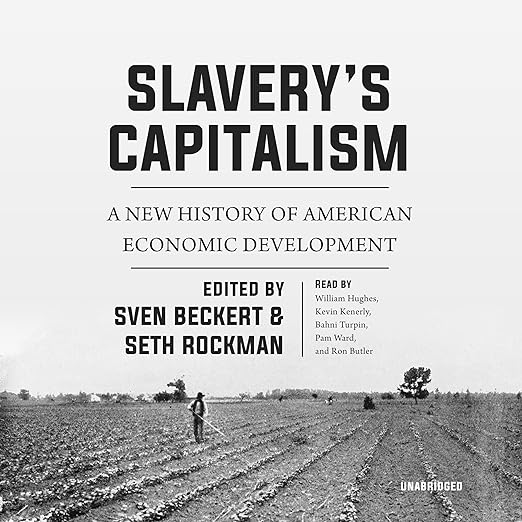
I came to Slavery’s Capitalism with some background in economic history and came away with my understanding of it substantially revised. That is not a small thing to say about an academic essay collection. This is not a narrative history or a memoir, it is exactly what it announces itself to be: sixteen scholars making a coordinated argument that the spectacular pattern of American economic development in the antebellum period cannot be understood without placing slavery at its center. The argument is made carefully, with evidence, and it is convincing.
Sven Beckert and Seth Rockman edited this collection as part of a broader scholarly movement to reintegrate slavery into American economic history after generations in which it was treated as peripheral, a regional peculiarity rather than a structural foundation. The essays they assembled approach the question from multiple angles: credit markets, management practices, the cotton trade’s relationship to industrialization in Britain and New England, insurance and finance, land speculation, and human capital accounting.
Our Take on Slavery’s Capitalism
The central argument, that American capitalism, so often celebrated for market competition, private property, and individual enterprise, has its origins in a system predicated on the legal ownership and forced labor of human beings, is stated clearly in Beckert and Rockman’s introduction and then demonstrated rather than asserted across the following essays. This is what distinguishes serious scholarship from polemic. The contributors are not arguing from a political position; they are following evidence about how capital actually moved in the antebellum United States.
Some of the most striking material involves the key innovations in entrepreneurship, finance, accounting, management, and political economy that are too often attributed to the free market. The treatment of enslaved people as financial assets, collateralized in loans, insured against loss, traded in speculative markets, produced accounting and management innovations that then migrated into supposedly free-labor enterprises. The line from cotton plantation management to modern corporate practice is not a metaphor; it is a documented historical relationship.
Why Listen to Slavery’s Capitalism
William Hughes brings genuine authority to this material. Reading sixteen essays by different authors across nearly fourteen hours is a demanding task, and Hughes maintains consistency of tone and clarity of argument throughout. He does not flatten the differences in style between contributors, but he gives each essay enough pacing and emphasis that listeners can track the individual arguments within the collection’s larger frame.
The audiobook format is not the natural home for essay collections, and listeners should be aware that this is dense academic prose. There are no narrative concessions. But for listeners who engage regularly with long-form nonfiction and policy or history podcasts, the experience is not fundamentally different, it is rigorous, serious, and rewarding.
What to Watch For in Slavery’s Capitalism
This is not an introductory text. Listeners who are new to American economic history, or who want a narrative account of slavery’s economic dimensions, should read Edward Baptist’s The Half Has Never Been Told first, Baptist is one of the contributors here, and his essay reflects the same research base as that book. Slavery’s Capitalism assumes a level of familiarity with economic concepts and historiographical debates that will challenge listeners without that background.
The essay format also means that the experience is uneven. Some contributions are more accessible than others, and the tonal shift between a literary essay on sugar and a technical analysis of mortgage markets is real. Beckert and Rockman’s introduction and conclusion provide the scaffolding that holds it together, and returning to those sections when a middle essay feels dense can help reorient the listener.
Who Should Listen to Slavery’s Capitalism
This collection is best suited to readers who already have some background in American history and economic thought, and who are willing to engage with academic prose at length. It is essential for anyone trying to understand the foundations of American capitalism in honest historical terms rather than mythological ones. Listeners looking for a more narrative account of slavery’s economic dimensions should start with The Half Has Never Been Told. Those who want the scholarly apparatus and the full range of argument will find this collection worth the effort.
Frequently Asked Questions
Is Slavery’s Capitalism arguing that slavery was a form of capitalism, or something different?
The editors make this distinction explicit: the question is not whether slavery itself was capitalist but whether American capitalism can be understood without slavery at its center. The answer the essays give is no.
How does this compare to Edward Baptist’s The Half Has Never Been Told?
Baptist is a contributor to this collection, and the two books complement each other. Baptist’s book is a narrative history; Slavery’s Capitalism is a scholarly essay collection with a wider range of contributors and a more technical economic focus. The Half Has Never Been Told is the better entry point for general readers.
Is the audiobook format effective for an academic essay collection of this density?
It works, but it requires active listening. William Hughes narrates with clarity and appropriate pacing, and the introduction provides a framework that helps listeners track individual arguments. It is most effective for listeners comfortable with long-form nonfiction at an academic register.
Does the book address the relationship between slavery and Northern economic institutions, or only the Southern economy?
Yes, several essays specifically address Northern complicity, including New England textile manufacturing’s dependence on slave-produced cotton and the role of Northern banks and insurance markets in financing slaveholding.