Quick Take
- Narration: Christopher Lane delivers academic content with measured authority, clear and unhurried, appropriate for material that rewards careful attention rather than passive listening.
- Themes: The moral challenge of historical religious authority, the definition and practice of slavery across Islamic civilization, the politics of abolitionist arguments within faith traditions
- Mood: Dense and demanding but never dry, a piece of serious scholarship with the integrity to follow its questions wherever they lead
- Verdict: The most rigorous audiobook treatment of this subject available in English, and one that trusts its listeners to handle complexity without comfortable simplifications.
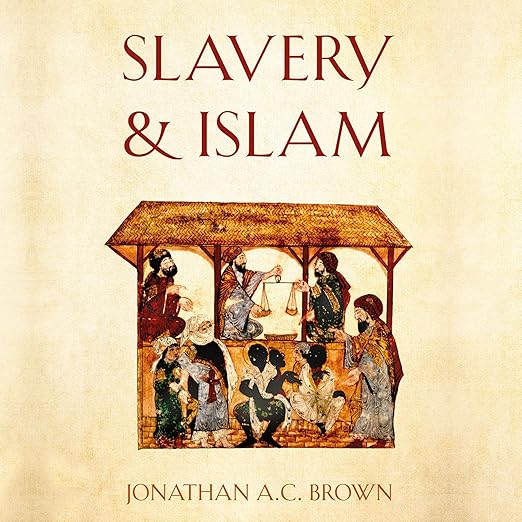
I came to Slavery and Islam with some knowledge of Jonathan Brown’s work and expecting the kind of careful, academically grounded treatment he brings to Islamic intellectual history. What I found was a book that exceeds those expectations significantly, not because it is comfortable, but because it refuses to be. Brown’s central question is genuinely difficult: what do you do when the authorities you venerate condoned something you know is wrong? This is not an abstract philosophical puzzle. It is the lived crisis of contemporary Muslims confronting ISIS’s revival of sex-slavery with Quranic citations, and of Americans confronting Founding Fathers who owned people. Brown takes both crises seriously, and his method is to refuse easy exits from either.
The book opens by doing something that immediately earns trust: it questions the definition of slavery itself. What Brown demonstrates, through careful analysis of historical and legal sources, is that the category we call slavery encompassed a much wider and more varied set of relationships than the Atlantic chattel slavery that dominates Western moral intuition on the subject. This does not excuse anything. Brown is explicit that he is not writing an apology. But it does complicate the comparison in ways that matter for honest historical analysis, and the reviewer who noted that Brown fractures the dichotomy we typically envision while replacing it with a multidimensional spectrum is describing this opening move accurately.
Our Take on Slavery and Islam
The book’s organization is its strength. Brown moves through three distinct inquiries: what slavery looked like in Islamic legal and theological theory, how it was actually practiced across fourteen centuries of Islamic civilization, and how Muslim abolitionists have constructed their arguments in the modern period. The final section is the most politically fraught, and Brown is honest about why: he asks whether the abolitionist arguments advanced by contemporary Muslim scholars are sincere, consistent, and convincing, or whether they represent a kind of motivated reasoning that adopts the moral conclusions of modernity without engaging the intellectual work those conclusions require. His answer is nuanced but not evasive. This is scholarship that respects its audience enough to give them real answers even when those answers are uncomfortable.
Why Listen to Slavery and Islam
Christopher Lane’s narration handles the academic register with appropriate authority. The Arabic transliterations and historical names that run throughout the text are managed with care, and Lane does not rush through the dense theological and legal passages. At nearly fifteen hours, this is a long listen that rewards sustained attention rather than background playback. The payoff is substantial. Reviewers consistently described the book as addictive, a word that might seem surprising for a work of academic history, but which reflects Brown’s genuine storytelling instinct. He understands that the questions he is asking are intrinsically dramatic, and he writes toward that drama rather than away from it. The reviewer who described it as the most comprehensive academic work on this topic is not overstating the case; there is nothing else in English that covers this ground with comparable rigor.
What to Watch For in Slavery and Islam
This is a demanding listen. Brown is writing for an educated general audience rather than for specialists alone, but he does not water down the intellectual content in the process. The sections on Islamic legal theory require patience and some willingness to sit with concepts that do not resolve cleanly. One reviewer noted that Brown’s framework for why slavery came to be seen as immoral, drawing parallels to how other practices like child marriage became morally impermissible through historical changes rather than through absolute moral reasoning, raises uncomfortable implications that the book does not fully pursue. That is an honest critique. Brown opens a door that his scholarly rigor prevents him from walking through completely, and some readers will find that frustrating. He is also a scholar with a clear position, and readers sensitive to the bias question should read the critical responses to his work alongside the book itself.
Who Should Listen to Slavery and Islam
Essential for anyone who wants to think seriously about how religious traditions handle the collision between historical authority and contemporary moral consensus. This applies to Muslim readers confronting the ISIS citations, to scholars of religious ethics, to people whose understanding of slavery’s history is primarily shaped by the American context, and to anyone interested in how the definition of a practice shapes its moral evaluation. Skip it if you want confirmation of a position you already hold, Brown will challenge readers across the political and religious spectrum. If you want to emerge from a listening experience with a genuinely more sophisticated understanding of a genuinely hard problem, Slavery and Islam is worth every one of its fourteen hours.
Frequently Asked Questions
Is Slavery and Islam written from a perspective that defends or apologizes for slavery in Islamic history?
Explicitly not. Brown states clearly that his intention is to describe and analyze, not to excuse. Multiple reviewers from across the ideological spectrum noted that the book is admirably frank about uncomfortable historical realities rather than distorting them to satisfy any contemporary audience. That honesty is precisely why some readers have criticized it, the conclusions follow the evidence rather than the desired outcome.
Does the book require prior knowledge of Islamic theology or history to be understood?
Brown writes for educated general readers and explains Islamic legal concepts and historical context as he introduces them. Familiarity with basic Islamic history helps, but is not required. Listeners who come entirely new to the subject will likely want to pause and revisit some sections, this is not passive-listening material, but the conceptual architecture is built accessibly.
Christopher Lane narrates a book with extensive Arabic terminology and historical names. How does he handle that material?
Carefully and consistently. Lane does not appear to have been coached on native Arabic pronunciation, but his rendering of the transliterations is consistent throughout, which matters more than perfect phonetics in an academic context. Specialists will notice imprecisions; general listeners will follow the text without difficulty.
The book addresses the ISIS revival of sex-slavery as a contemporary event. Is that material central to the argument, or is it an introduction to a primarily historical text?
It functions as the entry wound, the crisis that makes the historical and theological questions urgent rather than academic. Brown uses the ISIS case to establish why the definition of slavery and the logic of Islamic legal authority matter now, then moves into the historical analysis. The contemporary question haunts the entire book even when the text is focused on medieval jurisprudence.