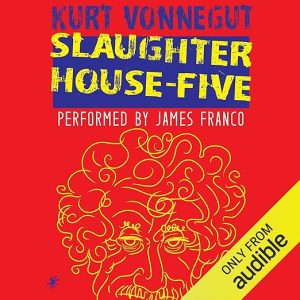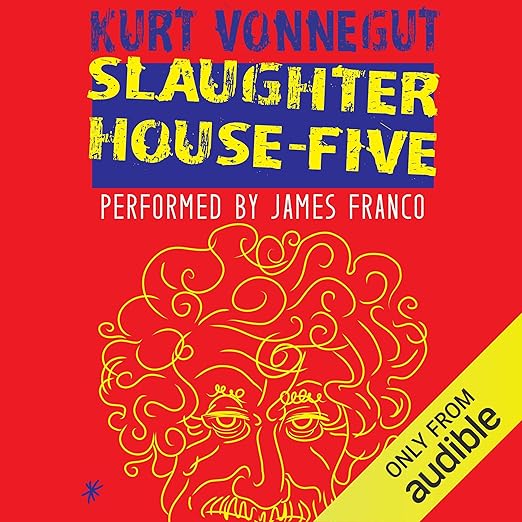
Billy Pilgrim becomes unstuck in time, and Vonnegut uses that unmooring to write one of the strangest, most devastating anti-war novels in American fiction, dark comedy wrapped tightly around the real firebombing of Dresden that Vonnegut himself survived as a prisoner of war. Calling this audiobook lighthearted would be badly misleading; the humor here is gallows humor, the kind that exists because straight tragedy would be unbearable to sit with for five hours, not because the material is cheerful. James Franco narrates this Modern Library 100 Best Novels edition, and the casting itself, a film actor known for literary adaptations taking on one of the twentieth century's most structurally unusual novels, is worth discussing on its own terms.
A Closer Look at Slaughterhouse-Five
The novel's fractured chronology, Billy experiencing his own life out of order, sometimes on Tralfamadore with alien captors, sometimes back in the POW camp, sometimes decades later as an aging optometrist, asks a lot of a narrator's pacing. Conventional scene-to-scene momentum is nowhere to be found; instead the audiobook has to make abrupt time jumps feel purposeful rather than disorienting, trusting repetition, that famous refrain so it goes, to land correctly each time rather than leaning on plot logic. Franco's flatter, understated delivery actually suits this structure better than a more theatrical reading would, since Vonnegut's prose style itself favors plain, almost deadpan sentences even when describing atrocity.
Kilgore Trout, Vonnegut's recurring hack science-fiction writer, and Montana Wildhack, the actress Billy is eventually paired with inside a Tralfamadorian zoo exhibit, both require a narrator who can hold absurdist science-fiction framing and genuine historical horror in the same breath without either one undercutting the other. That balancing act is the whole book in miniature, and it's the single hardest thing for any performer to get right with this particular text.
Vonnegut's own history sits directly underneath the fiction: he was a young American POW held in Dresden during the Allied firebombing in February 1945, and survived by sheltering in an underground meat locker below a slaughterhouse, the literal source of the novel's title. It took him roughly two decades to figure out how to write about it directly, and the novel's fractured, evasive structure reads as the formal solution to that struggle, a story that keeps circling an atrocity it cannot approach head-on.
The novel's famous closing image, a bird's nonsensical call, arriving after Vonnegut has spent the whole book insisting nothing intelligent can be said about a massacre, is the kind of moment that either lands as a perfect, deliberately anticlimactic final note or falls oddly flat depending entirely on how the preceding hours have been paced. A narrator who has built genuine trust with the listener across the earlier fragmented chapters earns that ending; one who hasn't leaves it feeling like a non-sequitur rather than the quiet gut-punch it's meant to be.
What Makes Slaughterhouse-Five Worth Hearing
This is a genuinely short audiobook for how much ground it covers, just over five hours for a novel that was a finalist for the National Book Award and has stood alongside Catch-22 as one of the defining war novels of its decade. That brevity is part of the point; Vonnegut wrote short, clipped chapters on purpose, famously describing the book itself as jumbled and jangled, structured that way because a massacre resists any tidier, more coherent-sounding account. A listener can genuinely absorb the whole thing in an evening or two, unusual for a novel this frequently taught and this heavily analyzed in academic settings.
One longtime reader, revisiting the book decades after first encountering it as required high school reading, described it as making even more unsettling sense on a return listen, and more clearly humorous in places too, than it had the first time around. That kind of durability, a book that reveals different things depending on a reader's own accumulated life experience, is a strong argument for treating this as a book worth returning to rather than a one-and-done classic to check off a list.
This title's inclusion in the Modern Library 100 Best Novels list places it alongside a canon assembled by a board that included Vonnegut's own literary peers, and its persistence on required-reading lists decades after publication says something about how durable its specific formal experiment has proven to be. Not every novel from that era mixing genre elements with literary ambition has aged as well; this one still gets assigned in classrooms specifically because its questions about memory, trauma, and free will have not resolved themselves with time.
Things to Know Before Starting Slaughterhouse-Five
Listeners expecting a conventional or chronological war narrative will need to recalibrate almost immediately; the entire structure resists linear storytelling by design, and Vonnegut is not interested in building traditional suspense around whether Billy survives the war, the book reveals almost immediately that he does, and what happens after. This is a novel about the shape of trauma and memory more than about plot mechanics, and listeners who need forward momentum to stay engaged may find the repeated time jumps genuinely disorienting rather than purposefully so.
The Tralfamadorian sections, aliens who perceive all of time simultaneously and reject the human concept of free will, are where the book divides its own readers; some find them the novel's philosophical engine, others read them as a coping mechanism Billy invents to survive unspeakable trauma, closer to what would later be recognized as post-traumatic stress than to literal science fiction. Neither reading is wrong, and the book deliberately never resolves which one is correct.
Franco's own literary interests outside acting are worth knowing as context for this casting: he holds an MFA in writing and has directed film adaptations of difficult, formally unconventional American novels, including work by Cormac McCarthy and William Faulkner. That background suggests a narrator who came to this project with genuine interest in the text's structure, not just a recognizable name attached for marketing purposes, though listeners should judge the actual performance on its own terms rather than the resume behind it.
Who Kurt Vonnegut Is Writing For
This belongs on the list for anyone building a serious classics collection in audio, especially listeners who already know Catch-22 and want its natural companion piece from the same literary moment. It also rewards revisiting for anyone who read it once under duress in a high school classroom and suspects, correctly, that it lands differently as an adult with more context for what the Dresden bombing actually was.
Listeners who want their war fiction straightforward and chronological, or who find fragmented, nonlinear structure frustrating rather than purposeful, should be prepared for a genuinely unconventional listen. This is not comfort listening, and anyone hoping for a gentler, more purely comic Vonnegut entry point might do better starting with Cat's Cradle instead.
Quick Take
- Performance: James Franco's understated delivery matches Vonnegut's deadpan, ironic prose register.
- What it covers: war trauma, nonlinear time, the absurdity of mass violence
- Feel: Darkly comic and genuinely unsettling
- Our call: An essential, unconventional classic that rewards listeners willing to sit with its fractured structure.
Good to Know
Does James Franco's narration suit Vonnegut's flat, ironic prose style?
Yes, his understated delivery matches the deadpan register Vonnegut's writing depends on rather than overplaying the material's dark comedy.
Is this audiobook edition abridged given its relatively short five-hour runtime?
No, the novel itself is genuinely short and fragmented by design; five hours reflects Vonnegut's own famously clipped chapter structure, not an abridgment.
Do I need to have read Catch-22 before listening to this audiobook?
No, though fans of that novel's blend of absurdist humor and war trauma will recognize a kindred sensibility here.
How does this audiobook handle the novel's non-chronological structure?
The narration leans on Vonnegut's own repeated phrases and plain delivery to keep the time jumps legible rather than smoothing them into conventional chronology.