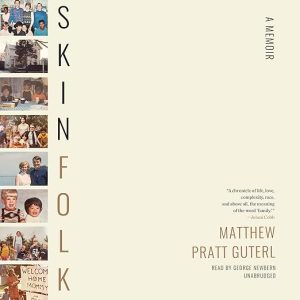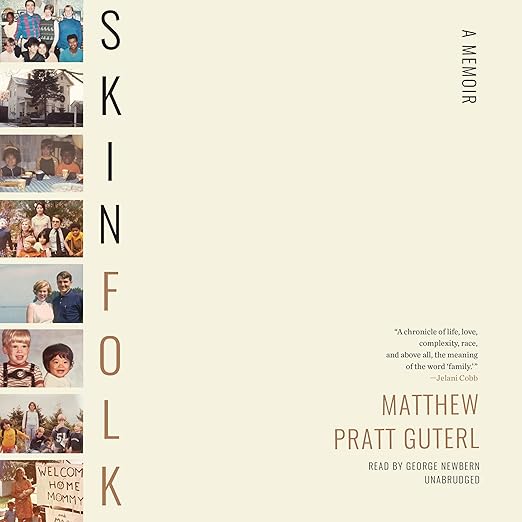
White clapboard, white picket fence, small-town New Jersey: the setting of this memoir is so tidy that the audiobook keeps having to break through it to reach what actually happened. Matthew Pratt Guterl grew up inside a deliberate experiment. His parents, a judge the copy calls magnanimous and charming and his resolute wife Sheryl, raised two biological sons alongside four children adopted from Korea, Vietnam and the South Bronx, in a town that was otherwise entirely white. George Newbern reads the ten hours it takes to tell what came of that.
Children From the So-Called War Zones of a Century
Bob and Sheryl Guterl believed they could solve something. The copy is unusually direct about the scale of the ambition: they thought they could address the racial problems bedeviling postwar America and stave off an impending global catastrophe, and the household they built was the demonstration. Their children came from what the description calls, in quotation marks, the so-called war zones of the American century, a phrase that tells you the book is going to interrogate its own family's language as carefully as anything else.
Calling it a reflection on a loving but complicated family formation, a response filed on the day of release identifies the balance the book strikes: Guterl captures both the loving, utopian impulse in his parents and the difficulties their unique family arrangement created, along with how the surrounding community answered it. That reader also thinks it deserves cinematic treatment, which is a fair instinct given the setting, though what makes the book work is precisely the interior material a film would struggle with.
Its subject, finally, is the distance between intention and outcome. Nobody in this house is a villain. The parents are idealists who acted on their idealism at real cost to themselves, and the book's discomfort comes from watching children absorb the consequences of an experiment they did not design.
Newbern's Casting Choice Nobody Has Commented On
One reader puts the achievement in a single sentence: Guterl combines the skills of a historian and a novelist to tell a true story that prods you to think more deeply about the meaning of race and family in the United States. That is exactly the split the book runs on. He is a scholar of race by profession, and he applies that apparatus to his own dinner table, which produces something neither a family memoir nor an academic account could manage alone, and the double vision is what makes the ordinary scenes land.
Period specificity is the second strength. This is New Jersey in the 1970s and 1980s, with a defined suburb, defined schools and neighbors whose responses the book records rather than summarizes. Transracial adoption is usually discussed in the abstract, in policy language or in the language of therapy. Here it takes place on one street, with named siblings, over years, and the accumulation of small local incidents does more argumentative work than any framework would.
Casting deserves a paragraph of its own. This is a first-person memoir about racial identity, written by the third-eldest child of the family it describes, and the reading is credited to George Newbern rather than to the author. That is a defensible choice, since a trained reader can shape ten hours in ways a writer often cannot, but it is a choice, and nobody on this page has commented on how it turned out.
A Lot Left Unsaid, and a Charge of Saviorism
The page's most skeptical entry raises the objection the book invites. It reads the parents' project as smacking of white saviorism while admitting it does not know what the better alternative would have been, and its central complaint is that a lot was left unsaid. That is a real limitation. Guterl is writing about siblings who are still living, whose experiences were not his, and the discretion that requires leaves gaps a reader can feel. The same response goes to the trouble of enumerating each adoption individually, which suggests it wanted more of each story than it got.
Notice how the description frames things, too. It calls the family story ultimately troubling and the parents' vision miragelike, so if you arrive expecting a warm account of a family that worked, the copy has already warned you otherwise. What the book is not, and cannot be, is the account those four children would write. It is one brother's version, researched carefully and offered as such.
Ten hours also asks something specific of you here. Six children, two parents, several decades and a shifting set of neighbors and institutions have to be held in your head without a family tree to consult, and the narrative moves back and forth in time as a historian's would. Listeners who lose track of names in large-cast nonfiction should plan on longer sessions rather than short ones, because the connections between episodes carry most of the meaning.
Assuming the Author Was Black, Pleasantly Mistaken
One four-star arrived expecting something else entirely, assuming from the title that the author was African American, and describes being pleasantly mistaken. That reaction points at the real audience: listeners who want the mechanics of race in an American family examined from an angle they have not heard, including the adoption-related trauma that entry names directly. Readers of adoption literature, family history or postwar American race relations will find this substantial rather than anecdotal, and the copy's invocation of The Color of Water sets a fair expectation of register.
Sit this one out if you want an uplifting adoption story, because the book's honesty runs in the other direction, or if you are looking for policy analysis rather than a family's interior history. Prospective adoptive parents should approach it knowing it will complicate rather than reassure, which may be exactly the reason to listen. Listeners hoping to hear from the adopted siblings themselves should note that this is not that book, a limit the author names himself and never pretends to have crossed.