Quick Take
- Narration: Will Damron brings intellectual enthusiasm to the material without letting it tip into lecturing – he’s a natural fit for science writing that wants to be fun.
- Themes: Evolutionary biology, the cultural meaning of death, the body as document
- Mood: Curious and wide-ranging, like a very good natural history museum visit
- Verdict: A brisk, engaging natural and cultural history of bone that earns its place on the shelf between Neil Shubin’s Your Inner Fish and Bill Bryson’s The Body.
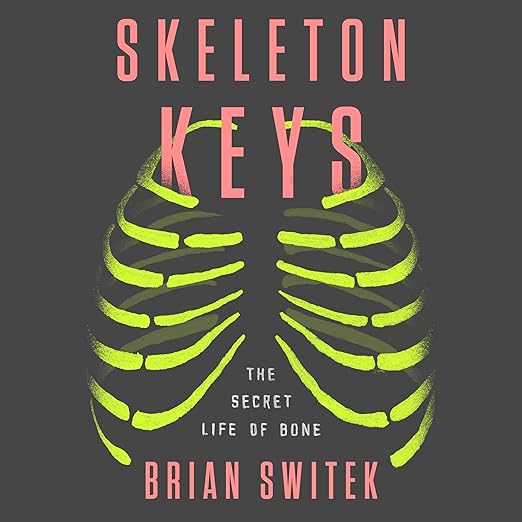
I came across Skeleton Keys on a week when I had been thinking about mortality – not morbidly, but in the abstract way that happens when you spend too much time reading medical history. Riley Black (writing here under the name Brian Switek) turned out to be exactly the right guide for that mood. This is a book that takes bones seriously as objects of scientific inquiry and cultural meaning simultaneously, and the combination is more compelling than either thread would be alone.
The Wall Street Journal called it a provocative and entertaining magical mineral tour through the life and afterlife of bone, and that framing captures the book’s dual ambition. Switek wants to explain where bone came from evolutionarily – a journey he dates back over 400 million years – and also to explore what humans have done with bones culturally: instruments and jewelry, phrenological pseudoscience, macabre ecclesiastical decoration, forensic evidence. The fact that he manages both agendas in under seven hours of audio is a real structural achievement.
Our Take on Skeleton Keys
The section on bone’s evolutionary origins is where some readers have found Switek slightly more speculative than satisfying. One professor reviewer noted that the question of how bone evolved from cartilage is raised but not fully resolved, with Aspidin posited as an intermediate substance without the full mechanistic story. That’s a fair observation. Switek is at his best when working with paleontological narrative – the identification of King Richard III’s remains, the cultural history of skull bump reading, the use of bone in forensic reconstruction – rather than the deepest evolutionary biology. A different reviewer compared the book favorably to Shubin’s Your Inner Fish and Bryson’s The Body, which is accurate positioning: this is popular science that delights in curiosity rather than primary research.
Why Listen to Skeleton Keys
Will Damron is one of the better narrators working in popular science. He conveys genuine interest in the material – a quality that sounds obvious but is rarer than it should be – and keeps the tone warm without being cutesy. The book moves quickly across disciplines (paleontology, anthropology, medicine, forensics), and Damron manages those transitions smoothly. He doesn’t over-emphasize the book’s more macabre moments, which is the right call: Switek uses the grotesque historically rather than sensationally, and Damron follows that lead. The runtime of under seven hours makes this ideal for a week of commutes or a long weekend afternoon.
What to Watch For in Skeleton Keys
The book’s breadth is also its occasional limitation. Skeleton Keys covers a very wide canvas in a relatively short runtime, which means some subjects receive genuinely illuminating treatment while others feel compressed. Listeners who are already well-read in popular science – who have spent time with Shubin, Bryson, or Sam Kean – will find some familiar territory here. The book doesn’t always push past what’s already been well-covered. For general audiences coming to this material fresh, the comprehensiveness is a feature. For specialists or heavy popular-science readers, it lands closer to a good introduction than a revelation.
The Richard III section is where Skeleton Keys most vividly demonstrates its thesis that bones are documents. The identification of the king’s remains under a Leicester parking lot in 2012 – confirmed through skeletal evidence including the famous curvature of the spine, and then through DNA matching – is one of the more remarkable forensic history stories of recent decades. Switek handles it with appropriate excitement and places it within a longer history of what bone can tell us about who a person was.
Switek’s discussion of phrenology – the 19th-century pseudoscience that read personality and intelligence from skull measurements – is both fascinating and sobering. It’s a case study in how scientific methodology can be applied to deeply unscientific premises, producing authoritative-seeming conclusions that were used to justify real harm. The book doesn’t belabor the point, but it doesn’t let it pass either. That balance between curiosity and reckoning is one of Skeleton Keys’ more mature qualities.
Who Should Listen to Skeleton Keys
Skeleton Keys is for curious generalists – people who find both natural history and cultural history interesting and want a book that takes both seriously at once. It works well for medical humanities readers, for anyone with a passing interest in forensic anthropology or paleontology, and for listeners who enjoyed Your Inner Fish or The Body and want something adjacent. It’s not a book for specialists in any of the individual fields it touches, and it doesn’t try to be. Think of it as an invitation to look at the thing you’re carrying around inside you with more appreciation and more strangeness.
Frequently Asked Questions
How does Skeleton Keys compare to Your Inner Fish by Neil Shubin or The Body by Bill Bryson?
Multiple reviewers draw that comparison directly, and it’s apt. All three books operate in the popular science mode of using a single biological subject to explore human origins, cultural history, and scientific method simultaneously. Skeleton Keys is narrower in scope than Bryson’s encyclopedic The Body and somewhat lighter on primary scientific argument than Shubin’s fish-to-limb narrative. It sits comfortably alongside both as complementary reading rather than a replacement.
Does Will Damron’s narration work for the book’s more technical paleontology and forensics sections?
Yes. Damron has a warm, engaged delivery that keeps technical passages from becoming lectures. He reads as someone genuinely interested in the subject, which is the right quality for material that bridges multiple disciplines. The forensics and cultural history sections particularly benefit from his pacing, which allows strange or disturbing details to register without being overplayed.
Is Skeleton Keys suitable for listeners with a medical or scientific background, or is it aimed at general audiences?
It’s firmly in the general audience category. Readers with medical or anthropology backgrounds may find some sections familiar or under-developed – one professor reviewer noted gaps in the evolutionary biology sections specifically. The book is an excellent entry point for general listeners and a pleasant refresher for those with scientific backgrounds, but it isn’t written to satisfy specialists.
Does the book address forensic applications of bone analysis – crime scene investigation, identification of remains?
Yes, forensics is one of the four main disciplines Switek bridges. The book covers how bones are read forensically – age, sex, health history, cause of death – and includes discussion of historical identification cases. Listeners drawn by the forensic angle will find it meaningfully addressed, though not at the depth of a book specifically dedicated to forensic anthropology.