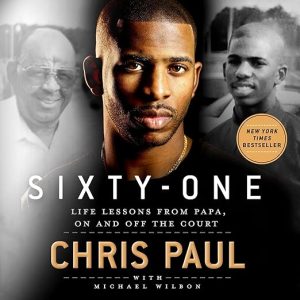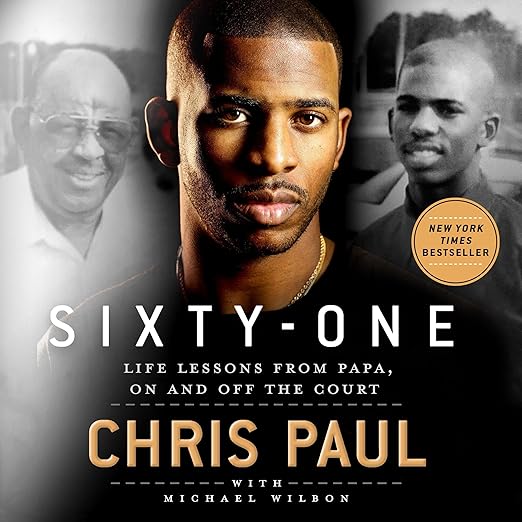
The airball was deliberate, and it is the reason this memoir carries the title it does. The day after burying his grandfather, Chris Paul played for his high school team and put up sixty-one points, one for each year Nathaniel Jones had lived, then flung his final attempt out of bounds from the foul line on purpose and walked off the court. Local headlines the next morning reported that he had fallen six points short of the state single-game scoring record. He had done precisely what he set out to do. That decision is the whole audiobook in miniature: a public act with a private arithmetic underneath it that nobody watching could read.
The book belongs to Nathaniel Jones more than to the man reading it. PaPa Chili, as the description calls him, owned and operated the first Black-owned service station in North Carolina and stood as a pillar of the Winston-Salem community; his funeral filled the largest church in the county, which holds more than a thousand people. He was sixty-one when he was mugged and died of a heart attack that followed the assault, one day after his grandson signed a letter of intent to play college basketball at Wake Forest. Everything in the memoir routes back through that week, and the subject is less basketball than what a man leaves inside the people he raised.
Family, faith, tragedy and lessons is what the description promises, and the written responses confirm it delivers on that register rather than on sport. One calls it a story of family love and community. Another, a self-described fan since the Lob City years who reels off the Rookie of the Year award and twelve All-Star selections before getting near the book, arrived expecting an athlete's book and came away talking about life lessons. A third describes honesty and care for others coming through in the writing, and a fourth simply calls it a feel good book that reads easily. Nobody in this pool discusses basketball. For a memoir by a player of that standing, remarkable. I went in braced for a sports book and spent most of it thinking about a service station in Winston-Salem.
No Third Party Stands Between Loss and Voice
Macmillan Audio leads with the voice, which is unusual enough to notice. The very first sentence of the description does not describe the book at all. It establishes that Chris Paul narrates this memoir himself, ahead of any mention of the story inside it. When a house puts the reading credit before the plot, it is telling you which edition it considers the real one, and on a memoir about a grandfather delivered by the grandson that judgment is easy to agree with. No third party stands between the loss and the account of it.
Two people on this page state plainly that they do not follow sports, and both arrived by hearing him talk. One had been listening to a podcast on which he appeared as a guest, was struck by what he said about his upbringing, his dedication to family and community and the grandfather he lost too soon, and bought the book on the strength of it. The other saw a television interview and came away impressed by the character, the logic and the sincerity rather than by the career. Two out of five is a real proportion, and it points somewhere specific: the route into this book runs through his voice, which is exactly what this edition hands you.
PaPa Chili in One Sentence, Papa in Another
This listing has aged around the book. The description names Chris Paul as the current point guard for the Phoenix Suns, while the two most recent notices on the page, both filed in late 2025, mention a return to the Clippers as a bonus. That is a harmless artifact of copy written in 2023 and left in place, and it is also a useful reminder of what a sports memoir is: fixed at the moment of writing, inside a career that keeps moving. The book itself is not about a roster, so nothing important is lost, though anyone hoping for the current chapter of his playing life should not expect to find it.
Two smaller notes. The description renders the grandfather's nickname two different ways in the same passage, PaPa Chili in one sentence and Papa in another, which reaches a listener as a genuine question about what the family actually called him. And at under six hours this is a compact memoir, so anyone hoping for a full career retrospective should recalibrate before buying. The description is honest about the scope: Chris opens up about life beyond basketball, which means the basketball functions as context rather than as content, and the proportions never shift.
A Grandson Reading in His Own Voice
People who do not follow basketball are, on this page's own evidence, among the ideal listeners, which almost never happens with an athlete's memoir. The reasons that pair give for recommending it have nothing to do with the game: character, community, and what children absorb from the adults around them. If you have been avoiding this shelf because you cannot tell a point guard from a power forward, the objection simply does not apply here.
A second natural audience is anyone still carrying a grandparent around. The book's organizing act, scoring one point for every year of a life, is a grief ritual that happens to have been performed in public, and Paul spends the rest of the memoir working out what that man's example obliges him to do with his own. Readers who came to this kind of book through faith and family writing rather than through sport will recognize the shape immediately, and the specificity is what lifts it. The description names Winston-Salem repeatedly as the thing Paul most wants to talk about, ahead of the league and ahead of the trophies, and a memoir that puts a hometown above a career is a particular kind of book.
The career is not what this is. Seasons, trades and statistics stay off the page, and a listener hunting analysis of how he plays will finish frustrated. Readers who hear a press release in this much warmth and this little edge should also pass, because the book has no interest in complicating its subject. What is here instead is a grandson reading, in his own voice, the story of the sixty-one years his grandfather was given and the sixty-one points that answered them.
Questions Listeners Ask
Does Chris Paul narrate the Sixty-One audiobook himself?
He does, and the publisher treats that as the headline. The description opens by establishing that Paul narrates the memoir before it mentions the story at all, which is a strong signal about which edition the house considers definitive for a book this personal.
Is Sixty-One a basketball book?
Barely. The sport supplies the setting and the sixty-one-point game supplies the title, but the subject is a grandfather, a family and a North Carolina community. Not one written response on this page discusses basketball itself, which is telling for a book written by someone of his standing in the game.
How long is the Sixty-One audiobook?
Five hours and forty-six minutes, which is compact for a memoir and suits the tight focus. The book covers one relationship and its consequences rather than a full career, so the runtime reflects the scope rather than any sense of the story being cut short.