At a Glance
- Read by: Traber Burns delivers the memoir with appropriate gravity, never melodramatic, letting Shively's actual words from journals and recordings carry the emotional weight.
- At its heart: Survival and will, the forgotten veterans of Vietnam, love interrupted and reclaimed
- Vibe: Quietly devastating, with hard-won moments of grace
- Short version: A necessary account of a war American culture has consistently underprocessed, told through a specific human story that makes the abstraction concrete.
I came to Six Years in the Hanoi Hilton through an unexpected route. A colleague mentioned that she had, years ago, worn a POW bracelet with the name James Shively, and that she had found this book while researching what had become of him. One of the Audible reviewers tells almost exactly the same story. There is something particular about that detail, the POW bracelet as a tactile connection across decades to a man's imprisonment, and the book honors that kind of personal reckoning with history without ever becoming sentimental about it.
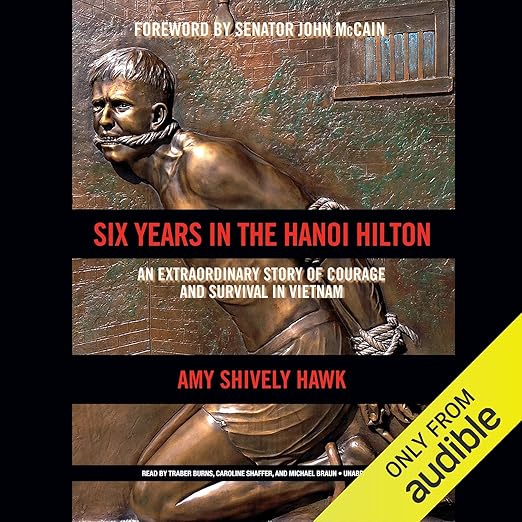
The story belongs to US Air Force fighter pilot James Shively, shot down over North Vietnam in 1967 while flying an F-105 Thunderchief. He landed in a rice paddy, was captured by the North Vietnamese Army, and spent the next six years in Hanoi prison camps, including the facility American POWs grimly nicknamed the Hanoi Hilton. Author Amy Shively Hawk is his stepdaughter, and she wrote the book from audio recordings Shively made of his own recollections and from his journals, supplemented by her mother Nancy's perspective. Nancy was Shively's girlfriend when he was shot down; she eventually married another man during his imprisonment, then reunited with and married Shively after his release. That love story, which sounds improbable on paper, is woven through the survival narrative and gives the book a human scale that pure military memoir sometimes lacks.
A Closer Look at Six Years in the Hanoi Hilton
What Hawk has constructed here is not a triumphalist account. Shively was tortured. He contemplated suicide. He describes his capture as "an extremely humiliating experience" and his time under interrogation with a directness that does not flinch. The book earns its emotional moments because it does not manufacture them; it simply reports, with Hawk's careful editorial hand, what Shively recorded and what he wrote. One reviewer who served in a VA hospital describes meeting Vietnam POWs who never recovered from the experience, and notes that Shively's ability to function afterward was not universal. That context matters, and the book does not pretend otherwise.
Traber Burns narrates with a steady, unadorned delivery that suits the material. He does not reach for emotion; he trusts the content to supply it, which is the right instinct for testimony like this. The passages drawn directly from Shively's journals have a slightly more interior quality, and Burns calibrates to that without overstating it.
What Makes Six Years in the Hanoi Hilton Worth Hearing
The Vietnam War remains, as one reviewer puts it, "the war no one talks about." The cultural processing of that conflict has been partial and politically complicated from the beginning, and the experience of American POWs in particular has been marginalized in the broader national conversation. This book exists in the same space as books like Everett Alvarez's Chained Eagle or Admiral James Stockdale's writing on his years at the Hanoi Hilton, and it does not pretend to cover new historiographical ground. What it does is bring one specific man's experience to life with the intimacy that only recorded testimony and personal journals can provide.
Things to Know Before Starting Six Years in the Hanoi Hilton
At five and a half hours, the book is relatively compressed for the amount of ground it covers. The years in captivity are treated with more depth than the post-release period, which is where the psychological aftermath would be richest. Readers interested in PTSD and the long aftermath of captivity will find the book's later sections less developed than they might hope. The love story element, while genuine, can feel slightly telescoped in the audio pacing.
The book is also, as a reviewer notes, "like other prisoner of war books" in its basic structure. If you have read extensively in the POW memoir genre, you will recognize the rhythms. But within that genre, the combination of Shively's direct voice and Hawk's careful synthesis makes this a particularly clean and affecting example.
Who Amy Shively Hawk Is Writing For
Essential for anyone interested in the Vietnam War at a human rather than strategic level, and for readers drawn to military memoir and survival narratives. History teachers who work with twentieth-century American history will find it accessible enough for student recommendation. People who find war memoir too graphically violent will be relieved that the book, while honest about torture and hardship, is not gratuitous. Those looking for extended psychological analysis of PTSD or detailed military history of the war's conduct will need to look elsewhere.