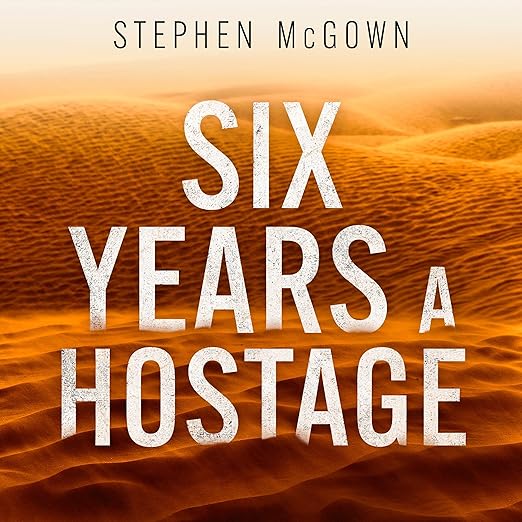
Quick Take
- Narration: Byron Mondahl’s South African-inflected delivery brings authenticity to McGown’s voice, sustaining nearly eleven hours of testimony without ever melodramatizing the ordeal.
- Themes: Captivity and psychological adaptation, the paradox of intimacy with captors, family resilience at a distance
- Mood: Unflinching and quietly astonishing
- Verdict: Among the most honest and nuanced hostage memoirs you’ll find in audio, and Mondahl’s narration makes it feel like a conversation rather than a deposition.
I listened to this one over two evenings on my back porch, which felt both right and wrong. Right because the stillness and the open sky made space for a story that takes place under the enormous, indifferent sky of the Sahara. Wrong because my particular discomfort, swatting at mosquitoes and finishing a cold coffee, felt obscene as counterpoint to six years of captivity in the desert with an Al Qaeda cell. Stephen McGown’s story is the kind that recalibrates your sense of scale.
McGown was en route from London to Johannesburg by motorbike, a once-in-a-lifetime journey, when he was seized at gunpoint in Timbuktu, Mali, along with two other Western travelers. He was taken because he held a British passport. He was subsequently held at various camps across the Saharan northwest for nearly six years. What the synopsis calls “the greatest chess game of his life” is not a metaphor for any kind of intellectual exercise. It’s what McGown, with characteristic understatement, calls his survival strategy: learning Arabic, learning French, converting to Islam, taking the name Lot, making himself useful, making himself known, making himself human to people who had every ideological reason to see him as expendable.
Our Take on Six Years a Hostage
What separates this memoir from most hostage accounts is the absence of dehumanization in the telling. McGown does not describe his captors as monsters. He describes them as he found them: violent when violence served a purpose, sometimes kind, operating within a theological and political framework that he spent six years learning to navigate from the inside. The reviewers who note that this is “a unique and nuanced perspective on one of the world’s most feared terrorist groups” are not overstating the case. By the end, McGown has given you an account of Al Qaeda in the Sahara that no journalist working from the outside could have written.
The parallel narrative of McGown’s wife Cath and his family working through diplomatic channels back in Johannesburg is one of the memoir’s structural strengths. The decision to give them genuine page time means the book never allows the reader to forget that captivity doesn’t only happen to the captive. Cath’s experience of years of uncertainty, of irregular contact, of maintaining a life while her husband is somewhere in the desert is its own kind of ordeal, and the memoir takes it seriously.
Why Listen to Six Years a Hostage
Byron Mondahl’s narration is exactly right. His South African cadence fits McGown’s origins and gives the material an authenticity that a neutral mid-Atlantic voice couldn’t have managed. More importantly, Mondahl understands that this is a story that must not be overplayed. The moments of greatest extremity, of despair, of fear, of the strange adaptations McGown made to survive, are narrated with a steady, measured delivery that makes them land harder, not softer. There is no score, no artificial build; the events carry their own weight.
At just under eleven hours, the pacing is consistent and the material never overstays its welcome. Tudor Caradoc-Davies, who helped shape the manuscript, has an editorial journalist’s instinct for what to leave in and what to cut, and the book benefits from that discipline. Listeners who ranked it as “one of my best summer reads” and noted that the perspectives of Steve’s wife and father “make it all very real” are responding to that structural intelligence.
What to Watch For in Six Years a Hostage
McGown’s decision to convert to Islam during his captivity and retain the faith afterward is handled with honesty and without apology, but listeners who expect either a straightforward critique of Islamist militants or a redemption-through-faith narrative will find the book more complicated than either template. McGown resists neat conclusions about what his captivity meant, which is one of the memoir’s most valuable qualities and also the one that is likely to frustrate readers looking for catharsis.
The book is also, necessarily, limited by what McGown could observe and understand from within a single cell’s worth of perspective. He is clear about what he knows and what he infers, and Caradoc-Davies preserves that epistemic honesty in the prose. But readers wanting a comprehensive account of Al Qaeda’s Saharan operations will find this impressionistic rather than definitive.
Who Should Listen to Six Years a Hostage
This is for listeners who want their true crime and survival narratives to challenge as well as absorb them. If you’ve read books like In the Kingdom of Ice or Alive and found yourself drawn to the psychological dimension of extreme survival as much as the physical, McGown’s account will give you something rare: a hostage memoir with real moral complexity and a narrator who refuses to be a simple victim in his own story.
Skip it if you want resolution and triumph in clearly labeled packages. McGown’s story ends in release, but the six years leave marks he doesn’t pretend to have processed neatly. This is an honest account, and honesty in extremis is not always comfortable.
Frequently Asked Questions
Does Six Years a Hostage take a position on Al Qaeda or Islam, or does McGown remain neutral?
McGown’s perspective is deliberately nuanced. He describes his captors with specificity rather than abstraction, converted to Islam during his captivity, and retains a complicated relationship with the faith afterward. The book avoids both apology and demonization.
How does the audio format handle the parallel narrative structure involving McGown’s family back in South Africa?
Mondahl manages the shifts between Steve’s desert experience and the family’s diplomatic efforts in Johannesburg smoothly. The transitions are well-marked in the writing, and the narration treats both threads with equal weight.
Is this audiobook appropriate for listeners who are sensitive to depictions of political violence and prolonged captivity?
The book is honest about the fear and hardship of McGown’s situation, but it is not graphic or gratuitous. The tone is reflective rather than visceral. Listeners who are sensitive to discussions of terrorism or religious extremism should be aware of the subject matter.
At nearly 11 hours, does the pacing hold throughout, or are there sections where the memoir loses momentum?
The pacing is consistent throughout. The co-author’s journalistic background shows in the editing: sections that might have drifted into repetition or abstraction are kept tight, and the parallel family narrative provides enough variation in perspective to sustain the runtime.