Quick Take
- Narration: Phil Steward reads the investigative content with appropriate gravity and clarity, a neutral, professional delivery that keeps the listener focused on the documented evidence rather than on theatrical flourishes.
- Themes: Municipal corruption and institutional failure, investigative accountability, the personal cost of whistleblowing
- Mood: Methodical and accumulating, this is the listening equivalent of watching a case file fill in, with growing disbelief
- Verdict: A seriously documented exposé of local government corruption that works both as true crime and as a genuine civics lesson, the QR code evidence access is a meaningful innovation in the nonfiction audiobook format.
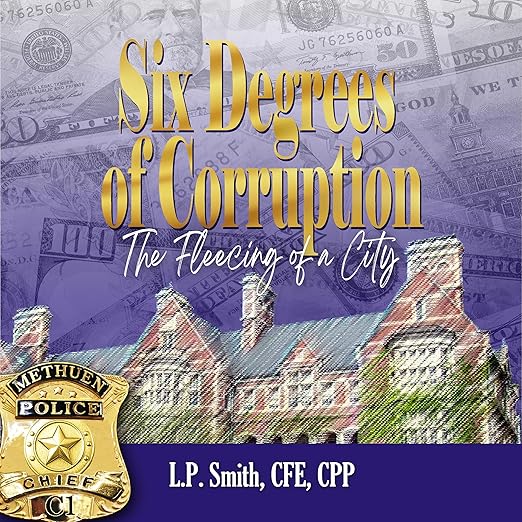
I started Six Degrees of Corruption on a Sunday night expecting two or three hours before sleep and was still listening, increasingly unsettled, well past midnight. L.P. Smith’s investigative account of what he found when he was hired to verify a single police officer’s credentials in Methuen, Massachusetts, is one of those books that keeps expanding as you listen, each new layer of what was concealed or obstructed revealing yet another layer beneath it. By the time the full shape of the scandal is clear, the sheer administrative scale of the failure is more alarming than any single act within it.
Smith is a Desert Storm veteran and investigator who was brought in for what should have been a routine credential verification. What he found was a forged police certification, and that single forgery, when he began pulling on the thread, led to systemic misconduct reaching from city hall to state offices, and eleven separate instances of prosecutors collectively declining to act on the documented evidence. The book is built on a 203-page investigative report Smith authored himself, validated by forensic testing, which means the audio is drawing on a foundation of documented fact rather than narrative reconstruction.
Our Take on Six Degrees of Corruption – The Fleecing of a City
What distinguishes this book from the crowded true crime space is its evidentiary architecture. The 100 embedded QR codes, linking listeners directly to original documents, recordings, and forensic exhibits, are not a gimmick. They represent a genuine innovation in nonfiction transparency. Smith is not asking you to take his word for the pattern of corruption he describes; he is showing you the receipts in real time. A retired police chief and internal affairs instructor who reviewed the book called it both “a cautionary tale to all police officers and a training manual” for those serious about law enforcement oversight. That dual function, narrative and documentary, is exactly what the QR code architecture enables.
Phil Steward’s narration serves the material well by staying out of its way. This is not the kind of true crime that benefits from dramatic performance; it benefits from clarity and credibility. Steward reads with the measured pace that complex investigative content requires, giving listeners time to absorb the significance of each documented failure before moving to the next.
Why Listen to Six Degrees of Corruption – The Fleecing of a City
The book’s subtitle positions it as a local story, the fleecing of a specific city, Methuen, Massachusetts. But Smith is explicit that the conditions he uncovered are not unique to Methuen; they are endemic to any municipal system where political relationships protect bad actors from accountability. The eleven refusals by prosecutors to act on documented evidence is the figure that stays with you. Not one or two; eleven. That number describes not a series of individual failures but a system operating as designed to protect something.
One reviewer described the QR code access as enabling readers to “pick and choose which outside documents to review”, a design choice that respects listener agency rather than forcing sequential disclosure. For listeners engaging with the audiobook during commutes or exercise, the documents are available to examine at leisure on a phone or tablet between sessions, which makes the archival depth of the project genuinely accessible rather than theoretical.
What to Watch For in Six Degrees of Corruption – The Fleecing of a City
The synopsis invokes All the President’s Men as a reference point, and the comparison has merit in one specific sense: both are accounts of institutional corruption documented by someone who had access most investigators would not, supported by evidence that was almost suppressed. But Smith’s account is local rather than national, which in some ways makes it more disturbing. The Watergate scandal required the White House to be involved in the cover-up. Smith’s case was buried by prosecutors at the municipal and state level, a reminder that corruption does not require grand scale to be devastating to the communities it operates within.
The reviewer who noted she is Smith’s mother deserves context: she discloses the relationship explicitly and her review is about what it felt like to watch a family member investigate entrenched power. It is a separate kind of testimony to the book’s stakes, and it is worth taking at face value, fear for a whistleblower is a real response to what Smith documents.
Who Should Listen to Six Degrees of Corruption – The Fleecing of a City
True crime listeners who have grown tired of sensationalism and want documentary rigor will find this exactly what they are looking for. Readers interested in investigative journalism, criminal justice reform, and municipal accountability will find the QR code evidence architecture particularly valuable. Law enforcement professionals and public policy students may find it useful as a case study in institutional failure. Those who prefer true crime as entertainment rather than civic document may find the methodical pace less gripping than more theatrically constructed accounts.
Frequently Asked Questions
How do the QR codes in this audiobook work and what do they link to?
The 100 QR codes embedded throughout the audiobook link to original documents, forensic reports, recordings, and exhibits that form the evidentiary basis of Smith’s investigation. They can be accessed via phone or tablet at any point during or after listening, and allow listeners to review the same evidence Smith used to build his case.
Is this book specifically about Methuen, Massachusetts, or does it have broader relevance?
Smith explicitly argues that the conditions enabling the corruption he uncovered are systemic rather than unique to Methuen, the pattern of political protection, prosecutorial refusal to act, and official obstruction he documents can occur in any municipality without adequate oversight mechanisms.
What makes this different from typical true crime audiobooks?
The evidentiary foundation is the key distinction. Smith built this account on a 203-page investigative report validated by forensic testing, and the QR code access allows listeners to verify the evidence themselves rather than simply accepting the author’s account. This is documentary journalism as much as true crime narrative.
Is the author’s credibility as an investigator established in the audiobook?
Yes. Smith’s background as a Desert Storm veteran and professional investigator is established early, and his methodology, the document trail, forensic validation, and systematic reporting of findings, is detailed throughout. A retired police chief who reviewed the book specifically endorsed its credibility and usefulness as a reference for law enforcement professionals.