Jacob Tobia narrates their own memoir Sissy, and there is simply no other version of this audiobook that would work. Over eleven hours and twenty-one minutes, Tobia takes listeners from a childhood in North Carolina where wanting both the Barbies and the bug-catching constituted a social crime, through Duke University, the United Nations, Methodist church podiums, and the parlors of the White House. The New York Times Book Review invoked David Sedaris and Mindy Kaling in assessing where Tobia stands among comic memoirists, and the self-narration makes that comparison land in audio in ways it might only approximate on the page. Tobia is performing this book, not reading it, and the difference is enormous.
The memoir's premise is deceptively simple: as a child, Tobia didn't believe they were the wrong gender, they just wanted too much of it. The social enforcement that followed that excess, and the years it took to recognize that the problem was the enforcement and not the wanting, is the engine of the book. But Tobia refuses to let that engine run on grief alone.
The Clip-On Earrings That Explain Everything
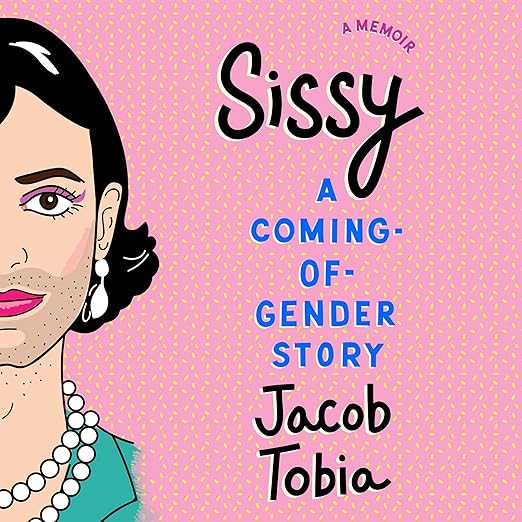
The craft in this memoir is the management of tone. Tobia is documenting bullying, isolation, spiritual crisis, and the long negotiation between identity and institution, the Methodist church, Duke's social landscape, the formal structures of international advocacy, without ever letting the book become a litany of pain. The comedic sensibility is not a defense mechanism applied over the darkness; it is woven into the way Tobia perceives and describes experience. The clip-on earrings in the subtitle are not incidental, they represent Tobia's actual relationship to glamour: impractical, impermanent, and worn with complete conviction.
The section at Duke is particularly well-handled. Tobia was navigating a social environment with its own rigid hierarchies at exactly the moment they were trying to understand what gender meant for them specifically, and the friction between institutional expectations and personal becoming is rendered with both precision and absurdity. The UN and White House episodes later in the memoir perform a similar function at a larger scale: the formal authority of those spaces versus the radical informality of showing up as yourself, tacky accessories and all.
The memoir's treatment of the Methodist church deserves particular attention. Tobia was raised in a faith tradition that provided genuine community alongside genuine harm, and the book does not simplify that complexity into a straightforward rejection narrative. The church gave Tobia language for spiritual longing and a community of belonging, even as it enforced gender norms that caused real damage. Holding both of those truths simultaneously, without collapsing one into the other, is some of the most sophisticated emotional work the memoir does, and Tobia's own voice in the narration makes the ambivalence audible in ways the text alone cannot fully carry.
Eleven Hours That Never Feel Like Eleven
Tobia's voice is the primary reason to choose the audiobook over the print edition. They modulate between registers, earnest, sardonic, theatrical, vulnerable, with the ease of someone who has given a lot of speeches and knows exactly how long a pause should last. When they are describing a moment of genuine pain, the shift in vocal quality is unmistakable. When they are building to a joke, the timing is precise. The audiobook is eleven hours long, and it doesn't feel like eleven hours because Tobia is genuinely entertaining company for the entire duration.
The memoir has been praised by Trevor Noah and Tyler Oakley, and compared to "a trans Nora Ephron" by OUT Magazine. Those comparisons are relevant in audio because they all signal a writer whose intelligence and wit are inseparable from their candor. Tobia doesn't perform vulnerability; they deploy it with the confidence of someone who has decided that being fully seen is better than being strategically legible. That choice reads differently when delivered in Tobia's own voice than it does as text.
Deeply Personal, Not a Comprehensive Survey
The memoir's central framing around binary gender, which Tobia explicitly complicates throughout, may feel slightly more circumscribed than some readers expect given the scope of the book's ambitions. Tobia is documenting their specific experience as a gender-nonconforming person raised in a particular Southern Christian context, they are not writing a comprehensive account of nonbinary identity broadly. The book is deeply personal and makes no claim to be representative, which is the right choice but worth knowing going in.
Some listeners may find the pace of the middle section, which covers the Duke years in considerable detail, slightly longer than it needs to be. The institutional critique is sharp, but the social dynamics of a particular elite university environment require a certain familiarity to fully resonate. The book accelerates again in the final third, which is where Tobia's public advocacy work gives the personal narrative political weight, and those chapters benefit from the emotional investment the earlier sections built.
Humor and Pain in the Same Sentence
This audiobook is for anyone who wants a first-person account of gender nonconformity delivered with wit and without sentimentality, for fans of comic memoir in the Sedaris and Ephron tradition who also want political substance, and for listeners in LGBTQ+ communities who are looking for a voice that holds humor and pain in the same sentence without collapsing one into the other. It works for listeners outside those communities who want to understand what it actually costs to be different in ways that social systems are designed to punish. Those who need their memoirists politically neutral will not find that here; Tobia has a view, and the memoir is inseparable from it. That is, genuinely, a feature.
- Performance: Jacob Tobia narrating their own memoir is the only acceptable version of this audiobook; the performance is funny, raw, and deeply inhabited in ways no other narrator could replicate.
- What it covers: Gender nonconformity, self-acceptance, the cost of belonging
- Feel: Hilarious, tender, and periodically devastating
- Our call: Jacob Tobia's memoir earns its praise by being genuinely funny about things that are genuinely hard, and the self-narration transforms it into something closer to a live performance than a book.
Good to Know
Does Jacob Tobia narrate this audiobook themselves, and does that significantly change the experience?
Yes, Tobia narrates throughout, and it changes the experience substantially. Their comic timing, their vocal shifts between earnest and sardonic, and the moments where genuine emotion surfaces in their voice make this far more like a live performance than a conventional audiobook reading. It is worth choosing over the print edition specifically for that reason.
Is Sissy primarily a political book about trans rights, or is it more of a personal memoir?
It is primarily a personal memoir that develops political dimension through lived experience. Tobia traces their individual childhood, education, and early advocacy work rather than arguing a political position. The politics emerge from the personal narrative rather than being imposed on it.
Do you need to know who Jacob Tobia is before starting this audiobook?
No prior familiarity is required. The memoir is self-contained and establishes Tobia's background, the context of their childhood in North Carolina, and the institutions they moved through over the course of the narrative.
How does the Sissy audiobook compare to Laura Jane Grace's Tranny in terms of subject and tone?
Both are first-person accounts of gender nonconformity narrated by the author, but they cover different experiences and use different registers. Tobia's memoir is more consistently comedic and covers a broader institutional range. Grace's account is more embedded in the music industry and punk subculture. They complement each other rather than cover the same ground.