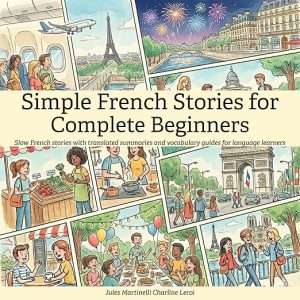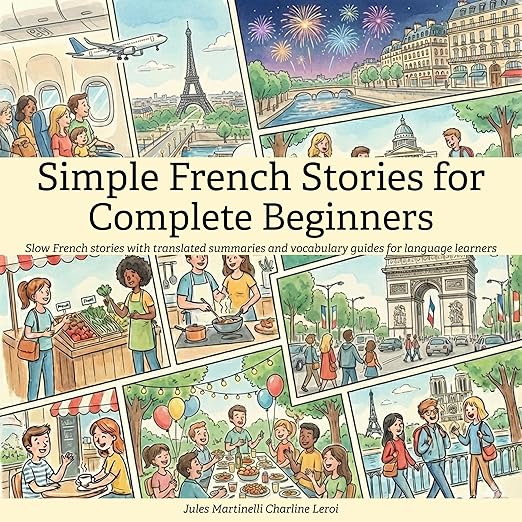
Ten hours and eight minutes of graded French, credited to Charline Leroi, makes an odd thing to review, because this audiobook is not asking to be judged the way a novel or a memoir would be. Jules Martinelli has built a teaching device and dressed it in short stories. Scenes in Parisian cafés and Provençal markets exist to carry vocabulary and sentence patterns rather than to move anybody, and holding them to a literary standard would be like grading a driving-school car on its cornering.
So the useful question is whether the device is well built, and on that point the description is unusually forthcoming. Every story arrives with an English translation summary, an explanation of key vocabulary, comprehension questions with the answers supplied, and then a second pass through the French story itself. Four stages, repeated across the whole run, followed by a closing block that replays the stories in French alone with no translation and no commentary. Anyone deciding whether to buy should be deciding about that loop, not about the plots.
Real Situations Replace Invented Adventure Plots
Martinelli pitches the collection at A1 to A2, the stretch where a learner knows some words and no rhythm at all. The scenarios match that level honestly: ordering in a restaurant, shopping at a market, hunting for an apartment, sitting inside a cultural tradition without quite understanding it. These are the situations a beginner actually meets, and they are also where a textbook sentence collapses on contact with a real French speaker. Choosing them over invented adventure plots is the single best decision on display.
Vocabulary is spread across food, family relationships, shopping, travel and daily routines, which sounds unremarkable until you notice how many beginner courses cover three of those and call it a syllabus. Breadth matters at this level, because a learner with two hundred words in one domain still cannot hold a conversation that wanders. Martinelli seems to understand that wandering is what a story does, and the collection uses narrative mainly to smuggle a wider word list past a learner's boredom threshold.
Twice Through, Then Once Without Support
One structural detail deserves more attention than the description gives it. The stories run twice, once wrapped in explanation and once bare. That second unaccompanied pass is a comprehension test disguised as a repeat listen, and it is the closest this format comes to the moment a language starts working, when the scaffolding comes off and the sentences still stand. A good part of the ten-hour length is the same material presented at two different levels of support.
Leroi's Narration Puts Sound Before Spelling
Audio is the right format for the specific problem this book addresses, and the claim is worth defending rather than assuming. French orthography lies to English speakers constantly, and a learner who meets a word on the page first will encode a wrong pronunciation and keep it for years. Meeting the sentence as sound, with meaning attached afterward through the translation summary, inverts that order. The narrator credit is the whole delivery mechanism here, which makes the pronunciation model the product rather than a feature.
Bite-sized episodes make the design work in the places learners actually study. The description calls the stories ideal for practice in short sessions, and the structure supports that literally, since one story with its explanation and its questions is a self-contained unit you can finish while waiting for something else. Language study fails more often from broken habits than from bad material, and a format that survives being picked up for a few minutes at a time has solved a problem thicker courses ignore.
Nothing in the description promises a grammar syllabus, and the omission looks deliberate rather than careless. Martinelli states that the narratives keep grammatical complications limited, which is a way of admitting that this is comprehensible-input practice and not a course in conjugation. Learners who already accept that model will find the design coherent. Learners hunting for tables of verb endings should understand that no such table is on offer in any format here, and that the gap is a choice about method.
One Perfect Rating, Zero Written Reviews
Nobody has written a word about this listing. A single rating carries the perfect score at the top of the page, and no reviewer has left so much as a sentence about the stories, the pacing or the recording. That silence deserves stating plainly rather than dressing up, because a buyer here has the description, the runtime, the narrator credit and nothing else. Hearing the voice before committing matters more in this situation than it usually would, and the unaccompanied French block is the passage worth testing yourself against.
Publisher credit on this listing reads Historical Audiobooks, which has nothing evident to do with beginner French. Metadata like that usually signals an imprint used across unrelated projects rather than an error in the file, and it is no reason to distrust the content. It does remove one shortcut, though: checking a publisher's other language courses will tell you nothing useful about this one. Judge it on the sample and the structure, because the surrounding labels carry no signal at all.
Written support is the real limitation. A learner working purely from audio hears the vocabulary explanations and the comprehension answers but never sees a spelling, and French spelling is precisely what most beginners eventually have to negotiate. The description mentions no accompanying document. Anyone planning to use this as a sole French resource should pair it with something on paper, while anyone who already owns a textbook will find it fills the gap textbooks leave, which is the sound of the language moving at speed.
Beginners With a Trip Get the Most
Beginners with a specific destination will get the most from this. Somebody with a trip to France booked, a school course to survive, or a stalled year of app-based study behind them will recognize the scenarios immediately and can measure progress story by story. The A1 to A2 framing is honest, and a learner sitting squarely in that band gets ten hours of level-appropriate input, which is more than most beginner audio offers at any price.
Intermediate learners should look elsewhere, and so should anyone who has already worked through a graded reader series. The whole design assumes limited grammar and a small working vocabulary, so a B1 listener will find the translation summaries and comprehension questions slowing down material they could handle bare. The closing French-only block might interest them, but buying ten hours for its last stretch makes little sense when unadapted fiction and native speech are available at that level.
Learners who need to see a word to learn it have the strongest reason to skip, and so does anyone wanting a story for its own sake, since these narratives are frankly instrumental and were built that way on purpose. For a genuine A1 learner the calculation runs simpler than that. The structure is sound, the scenario choices are smart, and the one real unknown is a voice nobody has publicly commented on, which a single sample settles in five minutes.