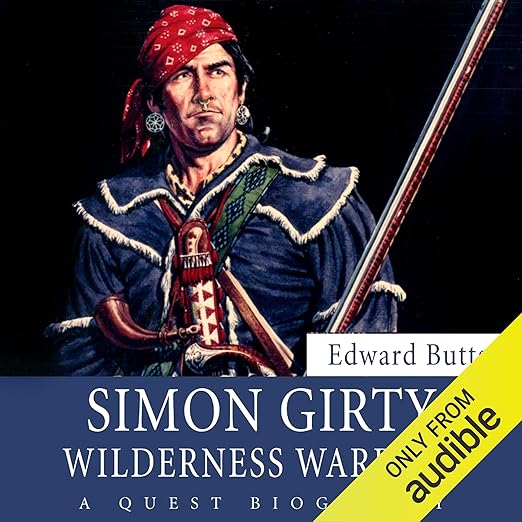
Edward Butts had a problem no biographer solves by picking a side. Simon Girty is a villain in American schoolbooks, a Loyalist hero on the Ontario bank of the Detroit River where a historic plaque still marks his homestead, and one of the very few white men Native history credits with arguing its case against American expansion. One life, three verdicts, all of them in circulation by the time he died in 1818. The audiobook runs six hours and two minutes, which is lean for a life this contested, and the description makes no attempt at neutrality about the stakes. It asks outright whether Girty was the White Savage of legend or a man whose story was twisted by his foes.
Reads Like Fiction, Built From Scenes Not Citations
The most detailed response on this page belongs to a self-described local history buff from Pittsburgh, writing under the handle TothFamily, who lives along Girty's Run and came to the book for the man behind the street names. That notice pays Butts a compliment shaped like an accusation: the book does not read like a History book; it reads like Fiction. A second notice, also at five stars, arrives at the same conclusion by another route, calling the work well researched and very readable, not a long list of dates. Both describe one construction decision: Butts builds scenes where an academic would build citations, and that choice governs how the recording plays.
The life earns that treatment. Girty was born in 1741 and lived among Native communities for most of it, which made him an object of contempt to his fellow white frontiersmen long before the Revolution handed him a formal side to take. He became an Indian agent for the British, accompanied Native raids against Americans, spied deep into enemy territory, and was influential enough in bringing the tribes into the British alliance that the Americans declared him an outlaw. A five-star notice from 2024 repeats the phrase the settlements used, race traitor, then supplies the turn that gives the book its shape. The British betrayed him in the end, and he had risked his own life to save American captives along the way.
Jones Allen's Steady Voice, No Sidebar to Help
Jones Allen reads the whole thing on a single credit, and the casting question worth naming is what a steady voice does to a subject who keeps changing shape. Butts asks you to revise your opinion of Girty repeatedly across six hours, and a recording offers no typographic help with that. No sidebar sets the Canadian view against the American one. No chapter epigraph flags which side of the border you are standing on. What you get instead is one voice moving through the material in order, which is exactly why the scene-driven construction those reviewers noticed matters so much in this format. A citation-heavy history would fight it. This one does not.
How Far Down the Ledger Girty Was Filed
Corrective is the word two written responses reach for, in almost the same breath. A four-star account calls it a different angle from the details it had read and heard about before. The 2024 notice frames it as a different view of the story than you usually get from histories written about our own national heroes. That is the honest pitch. Anyone who has taken the Ohio Valley and Kentucky border war through American eyes will find the geography familiar and the moral arrangement inverted, and the Benedict Arnold comparison the description reaches for is not decoration. It is the measure of how far down the American ledger Girty was filed.
Geography is the second argument. That plaque on the Ontario side of the Detroit River marks the homestead of a man the country on the opposite bank had outlawed, and that one geographic fact does more work than a chapter of analysis. Books about the Revolution rarely spend much time on the western frontier, and fewer still follow a subject into Canadian and Native memory and treat both as evidence. Butts treats them as evidence, which is the whole reason the book exists. Two hundred and twenty-six ratings have settled at 4.4, a comfortable score for a work that asks its audience to root against the founding story.
A Dissent Backed by Fort Pitt's Own Papers
Dissent arrives exactly once, and it is the most useful thing on the page. A three-star notice filed under the handle Tearlacha contests one specific claim, that Girty was returned after his captivity in the French and Indian War through the goodwill of the Senecas, and cites a document against it: the list of prisoners returned to Fort Pitt in Col. Bouquet's papers to General Gage. The recommendation attached is to supplement this book with others for a better understanding. Take that seriously, and notice what it costs in this format. Listening, you cannot glance at a footnote, check a source note or scan a bibliography. You get the assertion in Butts's confident prose and nothing beside it.
Smaller things are worth knowing before you buy. The listing files this under sports and outdoors, with the tag Adventurers, Explorers and Survival, which puts it in front of people expecting a wilderness survival story and hides it from the political and military history readers who actually want it. And every written response here describes the experience of reading: pages taken straight through, a claim checked against another document, a local subject recognized street by street. That is a reading audience, and what you are buying moves in one direction at a fixed speed.
Political Danger Rather Than Physical Danger
Come to this if the western border of the Revolution interests you more than the eastern campaign, and if you are drawn to people whose reputations were written by their enemies. Girty is a genuinely hard case rather than a misunderstood innocent. He accompanied raids that terrified the settlements, and Butts does not soften it. What the book adds is the reasoning underneath: the alliance, the contempt he faced from his own side, the betrayal that closed the account. Readers of Canadian history will meet a Loyalist they were never taught to look for, and readers of Native history will meet one of the few white figures the record treats as an ally. I came out of it unable to settle the question the description opens with, which I suspect was always the intention.
Anyone who needs the apparatus should buy elsewhere. If you plan to cite this material, argue with it or teach from it, the printed edition is the one to own, because the contested passages can be checked there against the sources that three-star notice names. Nor is this a survival narrative, whatever the shelving suggests: the danger here is political rather than physical. Everyone else gets a compact, unusually well-told account of a man three countries could not agree about, delivered at a length that never once feels padded.
Common Questions
Does the Simon Girty audiobook take the American side or the Canadian one?
Neither, deliberately. Butts sets the American outlaw, the Canadian Loyalist hero with a plaque on the Detroit River and the Native ally against one another and lets the contradiction stand. The description closes on the question rather than answering it, and the book holds that posture the whole way through.
How long is the Simon Girty audiobook, and does it cover his whole life?
Six hours and two minutes, covering a life that ran from 1741 to 1818. That is compact for a full biography, and it works because Butts moves in scenes rather than through documents. What you trade away is depth of citation rather than coverage of the years.
Is this a sympathetic portrait of Simon Girty?
Sympathetic to his reasoning, not to his conduct. The raids, the spying and the terror his name carried in the settlements all stay on the page. What it adds is the scorn his own side aimed at him first and the way the British discarded him afterward, which together make his choices legible without making them comfortable.
Which narrator reads Simon Girty, and is it a single-voice recording?
Jones Allen carries the entire audiobook alone. That is the standard shape for a biography this length, and it suits a text built from scenes rather than documents, since nothing in the writing needs a second reader or a shift in register to land properly.