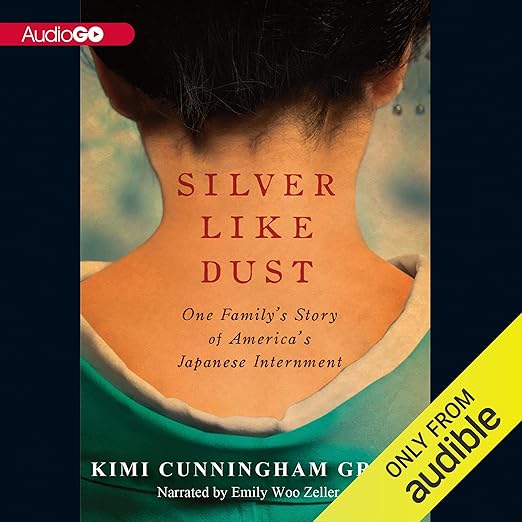
Silver Like Dust audiobook opens in the quiet of Kimi Cunningham Grant's grandmother's presence: a woman who sat by fires and prepared sushi for the family and listened to her husband's stories without ever telling her own. Obaachan's silence was not incidental or merely private. She was one of 112,000 Japanese Americans imprisoned during World War II, and in the Japanese-American community that shaped her, haji, the deep concept of shame, meant that silence was both self-protection and an inheritance passed down without words. Grant grew up in rural Pennsylvania, wanting to fit in, rejecting the Japanese cuisine and language her grandfather offered, and haunted since age eleven by the knowledge that the gentle woman pouring tea had once been a prisoner held for more than five years of her life. This memoir is the record of Grant finally asking the questions she had spent a lifetime not asking.
The structure Grant uses is quietly intelligent and one of the book's distinguishing choices. She does not present her grandmother's story as received testimony in a straightforward oral history format. She weaves it together with her own evolving understanding of what it meant to grow up half-Japanese in rural Pennsylvania, to want to assimilate fully and to feel the cost of that wanting only decades later. The dual thread gives Silver Like Dust an emotional complexity that a more conventional approach cannot achieve: it is simultaneously a portrait of Obaachan and a sustained examination of how cultural inheritance gets buried, misrecognized, and transformed across generations.
Zeller Gets the Japanese Honorifics Right
Emily Woo Zeller is an excellent narrator for this audiobook and her performance is one of its genuine and lasting strengths. Zeller brings both cultural fluency and emotional precision to Grant's prose, which moves between the intimacy of family memory and the documentary record of Heart Mountain, the Wyoming internment camp where Obaachan's world contracted to barracks and wire for years. The Japanese honorifics, including Obaachan and Ojichan, and the concept of haji receive the respect of accurate pronunciation rather than the flattening approximation that signals a narrator unfamiliar with the cultural material they are performing.
Where Zeller excels particularly is in the passages that depend on subtext: the moments when Obaachan's silence speaks more clearly than Grant's attempts to break through it, the scenes of ordinary domestic life at Heart Mountain that carry the weight of everything that brought people to that specific place against their will. Zeller does not oversell these moments or push for the emotional effect. She trusts the writing and the listener to do the work together, which is the right instinct for a memoir that earns its impact through restraint rather than pressure. The seven-plus-hour runtime feels entirely earned rather than padded.
When V-J Day Brought No Real Liberation
The specific details of Obaachan's history are what give Silver Like Dust its staying power beyond the general subject of Japanese-American internment, which has been written about at length. Obaachan met her husband in the camps. She watched her mother die there. She arrived by a terrifying train journey to Heart Mountain and she emerged from the camps to a V-J Day that proved a false promise rather than a genuine liberation for the Japanese-American community. These are not representative data points in a demographic study: they are the specific experiences of one woman, and Grant's commitment to their particularity is what makes the memoir feel essential rather than merely illustrative of a historical injustice.
One reviewer noted the book's remarkable quality of not reducing itself simply to a criticism of the government decision to imprison Japanese Americans, and that is the precisely correct observation about its politics and purpose. Grant is making a larger argument about how families carry history, how individual lives contain the weight of historical violence without being reducible to that violence, and how understanding a grandparent's silences can change what you understand about yourself. Obaachan is not a symbol or a representative figure. She is a specific, irreplaceable person, and the memoir insists on that specificity from the first page to the last.
A Dual Strand Between Urgency and Reflection
The dual-strand structure, alternating between Obaachan's wartime story and Grant's own negotiations with her Japanese-American identity across decades, means the pacing shifts between the historical urgency of the internment narrative and the quieter, more reflective register of Grant's contemporary Pennsylvania scenes. Listeners who are primarily drawn to the WWII history may find the shifts to Grant's childhood and adult life occasionally interrupt the forward momentum of the historical narrative. The memoir is not built for readers who want pure documentary: it is built for readers who want to understand how historical trauma shapes the people who did not directly experience it and who carry it nonetheless.
The book also does not resolve the questions it raises about assimilation and identity in the tidy way that memoir conventions sometimes encourage writers to provide. Grant ends the book having finally learned her grandmother's story without fully answering the larger questions that story generates about her own sense of self and inheritance. That open-endedness is true to the lived experience the memoir describes rather than a structural failure, but listeners expecting neat closure should know it is not what the book is reaching for.
Zeller Makes This the Format of Choice
Readers drawn to memoirs that work at the intersection of personal and political history will find Silver Like Dust one of the more carefully crafted examples in its specific territory. Those with an interest in Japanese-American history and the WWII internment camps will find the personal texture of Grant's account a valuable complement to more documentary or political histories of the period. Emily Woo Zeller's narration makes the audiobook the format of choice for this title, and her performance gives the listening experience a quality that rewards full attention rather than background play. Listeners who found sustained value in similar intergenerational memoirs exploring the legacy of historical displacement and silence will find this one deeply worth their time and attention.
Quick Take
- Narrator: Emily Woo Zeller brings cultural attunement and emotional precision to Kimi Cunningham Grant's intergenerational memoir, giving Obaachan's characteristic silence as much weight as the spoken words surrounding it.
- Subjects: Japanese-American internment, intergenerational memory, identity and assimilation
- Tone: Quietly devastating and ultimately tender
- Bottom line: Silver Like Dust is the kind of memoir that earns its emotional impact through specificity rather than sentiment, and Emily Woo Zeller's narration makes the listening experience its definitive form.
Frequently Asked Questions
Is Silver Like Dust audiobook primarily a WWII history or does it focus on the family memoir elements?
Both threads are equally weighted and woven together throughout. Obaachan's internment at Heart Mountain forms the historical spine, but Grant structures the narrative around her own process of asking questions she had avoided for years, making the memoir as much about how families carry and suppress historical memory as about the internment experience itself.
Why is Emily Woo Zeller a particularly well-suited narrator for this audiobook?
Zeller brings cultural fluency to the Japanese-American material, including accurate pronunciation of family honorifics like Obaachan and Ojichan and the concept of haji, alongside emotional precision that suits the memoir's dependence on subtext and restraint. The narration respects both the cultural specificity and the emotional weight of the material rather than flattening either.
Is this audiobook appropriate for listeners outside the Japanese-American community?
Yes. One reviewer who identified as a non-Black woman noted the book opened their eyes to experiences and costs previously invisible to them, a response that translates across the book's specific cultural context. Silver Like Dust is written to make Obaachan's story accessible and meaningful to readers from any background, which is part of what makes it an important rather than merely a niche memoir.