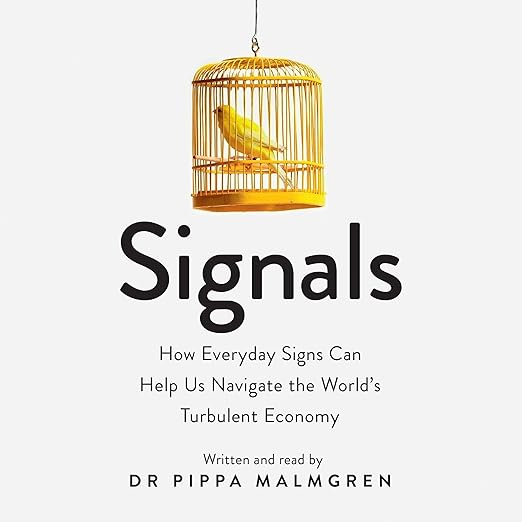
Quick Take
- Narration: Dr. Malmgren reads her own work with the authority of someone who has briefed presidents and central bankers, which is exactly the credential this material needs, though her academic cadence can slow the pace in denser chapters.
- Themes: Everyday economic signals, inflation vs. deflation, geopolitical power and ordinary life
- Mood: Intellectually engaged and occasionally alarming, like a calm expert explaining why the building is on fire
- Verdict: For anyone who has stared at a shrinking chocolate bar or a rising grocery bill and sensed something systemic was happening, Signals gives that intuition a rigorous framework.
I came to Signals during a stretch when I was trying to make sense of what felt like a gap between official economic narratives and what I was actually observing around me, restaurants quietly shrinking their portions, apartments getting smaller, the cost of everything outpacing what the numbers were supposedly showing. Pippa Malmgren had written the book I wanted to exist.
Signals is built on a deceptively simple premise: the global economy tells its story not primarily through data and mathematical models, but through the physical world we inhabit every day. The size of a steak. The price of a magazine subscription. The near-misses between spy planes in international airspace. Malmgren, who served as a financial markets adviser to President George W. Bush and has spent decades reading the signals that official channels obscure or misrepresent, argues that ordinary attention to ordinary things is a more reliable economic compass than most people realize.
Our Take on Signals
What distinguishes this book from other accessible economics writing is that Malmgren is not dumbing anything down. She is genuinely arguing that the traditional approach to economic communication, quantitative, technical, abstracted from physical reality, is itself a distortion. The insights here are substantive, even as they are expressed through examples that do not require any economics training to follow. The section on why governments report deflation while citizens feel their purchasing power shrinking is one of the clearest explanations I have encountered of a phenomenon that has frustrated economic observers for years.
The book was published in 2015, and some of its specific examples have dated in the years since. The geopolitical flashpoints she identifies as signals have evolved, and some of her predictions about the direction of emerging markets have been complicated by subsequent events. A critical reader flagged this in an early review, noting that interesting concepts were sometimes introduced without being fully resolved. That is a fair critique: Malmgren’s scope is broad, and she occasionally moves on before fully landing an argument. But the structural insight, that the battle between inflation and deflation is reshaping ordinary life in ways that official data systematically misrepresents, has only gained relevance in the years since publication.
Why Listen to Signals
The audio experience here has a particular advantage: Malmgren narrates her own book, and her voice carries the weight of someone who has spent decades in rooms where these decisions were made. She references Vogue magazine covers and Tibetan monk protests with equal fluency, and the confidence with which she moves between contexts is itself part of the argument. This is not someone who has learned economics from textbooks and is explaining it secondhand. The authority is lived, and the narration communicates that in a way that a different reader would not.
At nearly thirteen hours, this is a substantive listen, and it rewards active engagement more than passive absorption. The ideas build on each other, and the middle sections on currency dynamics and emerging market pressures pay off more fully if you have been tracking the argument from the beginning.
What to Watch For in Signals
The book’s main limitation is the one embedded in its ambition. Malmgren covers a tremendous amount of ground, and some threads feel more developed than others. The concept of “edgework” she introduces is compelling but exits the frame before it is fully examined. Readers who come looking for systematic, exhaustive treatment of each topic will occasionally feel the author has moved on too quickly. Think of it less as a comprehensive textbook and more as a guided tour from someone who knows where all the interesting things are hidden.
The 2016 publication date also matters for calibration. The signals Malmgren identifies as early indicators of political instability, antiestablishment voting, mass immigration pressure, manufacturing reshoring, had already begun materializing by the time the audiobook was released, and the subsequent decade turned out to be even more volatile than the book anticipated. Listening now, some sections have the eerie quality of hindsight disguised as foresight.
Who Should Listen to Signals
Signals is well-suited for listeners who find standard economics writing either too technical or too superficial, and who want to understand the physical texture of global economic forces without having to learn the underlying mathematics. It works as a companion to more technical reading, but also holds up independently. Non-economists with an interest in geopolitics, business, and the everyday pressures shaping modern life will find it genuinely illuminating.
Those looking for a more current or more rigorously referenced treatment of the same territory may want to supplement with recent writing. But as an introduction to the idea that ordinary things around us are constantly broadcasting economic information, Signals remains a clear and confident entry point.
Frequently Asked Questions
Is Signals still relevant given it was published in 2015?
More relevant than it should be, honestly. The framework Malmgren builds around inflation, deflation, and the gap between official data and lived experience has gained rather than lost resonance since publication. Specific examples have dated, but the core argument reads like a preview of the decade that followed.
Does Pippa Malmgren’s self-narration help or hurt the listening experience?
It helps significantly. Her background as an economic adviser to heads of state gives her narration an authority that a professional audiobook reader could not replicate. The academic cadence slows in denser sections, but the firsthand quality of her delivery is part of what makes the book work.
How technical is this book, do I need an economics background to follow it?
No economics training required. Malmgren specifically designed the book to communicate through everyday examples rather than mathematical models. She explicitly argues that over-reliance on quantitative thinking is itself a problem with mainstream economics communication.
What does Malmgren mean by ‘signals,’ and how practical is the framework she describes?
Signals are the physical, observable indicators of economic conditions that official data either lags or misrepresents, things like portion sizes, real estate patterns, cross-border military posturing, and consumer behavior. The framework is practical in the sense of building observational habits, less so in giving specific investment or policy recommendations.