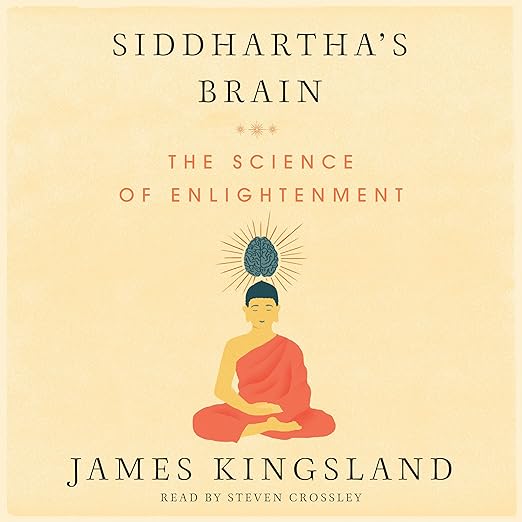
Quick Take
- Narration: Steven Crossley reads with a scholarly composure that suits the scientific framing, keeping the material grounded without becoming dry.
- Themes: Neuroscience of meditation, Buddhist history and practice, mindfulness as clinical tool
- Mood: Intellectually engaged and measured, with moments of genuine wonder at the intersection of ancient and modern knowledge
- Verdict: A rigorously researched and accessibly written bridge between Buddhist practice and contemporary neuroscience, valuable both for skeptics and for practitioners seeking scientific grounding.
I came to Siddhartha’s Brain expecting something in the broad mindfulness-science genre that has proliferated since Jon Kabat-Zinn brought MBSR into clinical vocabulary. I found something considerably more ambitious. James Kingsland is the science editor of The Guardian, not a mindfulness practitioner writing about his personal journey, and the distinction matters. He approaches the Buddha as a figure worth taking seriously as an empiricist operating under the research conditions available to him four centuries before Christ in northern India, and that framing changes what the book is able to do.
The structure moves from the historical Siddhartha Gautama, seated beneath a fig tree on the banks of the Neranjara, through an account of what he was likely discovering about the human mind’s capacity for sustained attention, and then outward into contemporary neuroscience’s corroboration of those discoveries. The arc is elegant: ancient practice anticipated modern findings not because Buddhism is mystically prescient but because the brain was the same brain four hundred years BCE, and careful observation of its behavior under meditative conditions yielded real data about how it works.
Our Take on Siddhartha’s Brain
Kingsland’s most important structural decision is what he does not include. He does not attempt to prove or defend the metaphysical claims of Buddhism, the rebirth doctrine, karma in its cosmological sense, the more elaborate elements of traditional practice. One reviewer praised this directly: the focus is on mindfulness meditation and non-attachment using scientific evidence without presupposing as true much of what seems like the superstition aspects of Buddhism. This is not reductive of Buddhism but honest about the book’s scope. Kingsland is making a specific and defensible argument about what meditation does to the brain, not a comprehensive argument about what Buddhism is.
The evolutionary history section of the book, which situates the human brain’s vulnerabilities, its susceptibility to rumination, distraction, and anxiety, in evolutionary rather than moral terms, is where Kingsland’s scientific training is most evident. The technology-driven world’s impact on attention capacity is discussed not as moral complaint but as a description of a mismatch between an evolved system and an environment that evolved much faster. This framing makes the argument for meditative practice feel less like a self-help pitch and more like a reasonable engineering response to a genuine systems problem.
Why Listen to Siddhartha’s Brain
Steven Crossley’s narration is calibrated for the material’s dual registers, historical narrative and scientific argument, and he transitions between them cleanly. The sections recounting Siddhartha’s journey and the Buddhist lore that Kingsland uses to frame the neuroscience are read with appropriate narrative warmth. The clinical study citations and neurological mechanism descriptions are handled with enough precision to be accurate and enough pacing to be followable by non-specialist listeners. One reviewer described the book as lucidly combining ancient techniques and wisdom with current scientific understanding of the brain, and the lucidity is partly Kingsland’s and partly Crossley’s contribution to the delivery.
Multiple reviewers came to this book as people who did not think meditation was for them, and their experience of it reflects what Kingsland seems to be reaching for: a reader who has been skeptical of meditation’s benefits, who finds the language of mindfulness slightly precious, and who needs a scientific argument before they are willing to consider the practice. One noted they are not the kind of person who can relax at will. Kingsland writes toward that reader directly without condescending to them, which is a genuine skill.
What to Watch For in Siddhartha’s Brain
The book does not tackle what one reviewer called the hard problem of consciousness, acknowledging this is probably the most difficult conceptual problem in the field. This is an honest limitation rather than a flaw, but readers who are looking for a comprehensive philosophical engagement with Buddhist metaphysics alongside the neuroscience will need to supplement here. Kingsland is deliberate about the scope of his argument. The book is also pitched at a general reader rather than a specialist, and readers with deep backgrounds in either Buddhist studies or cognitive neuroscience may find the coverage of their respective domains somewhat introductory.
Who Should Listen to Siddhartha’s Brain
This is an ideal entry point for scientifically minded readers who are curious about meditation but skeptical of the wellness-industrial framing that surrounds it. It is also an excellent recommendation for practitioners who want scientific grounding for a practice they have already found valuable. A Buddhist studies scholar described it as the single book they had searched for to introduce the subject to friends and family without boring them with cosmology or alienating them with mysticism, and that endorsement is about as targeted a recommendation as a book can get. Readers who have already done substantial reading in both Buddhist philosophy and neuroscience will find the territory familiar, but the synthesis is well-executed enough to remain worthwhile.
Frequently Asked Questions
Does Siddhartha’s Brain require prior knowledge of Buddhism or neuroscience?
Neither. Kingsland writes for a general reader with no assumed background in either field. The historical Buddhist material is contextualized clearly, and the neuroscience is explained without assuming specialist knowledge. Readers with backgrounds in either area will find some sections introductory, but the synthesis Kingsland offers has value independent of the individual fields’ depth.
Does the book address the metaphysical claims of Buddhism, such as rebirth and karma, or focus solely on the scientific evidence?
Firmly the latter. Kingsland explicitly does not attempt to prove or defend the metaphysical elements of Buddhist cosmology. His scope is confined to what mindfulness meditation does to the brain under measurable conditions, and he is transparent about this limitation from the outset. Readers seeking engagement with traditional Buddhist metaphysics will need to look elsewhere.
How does Steven Crossley’s narration handle the dual registers of historical narrative and scientific argument?
Well. He transitions cleanly between the Buddhist historical narrative passages and the clinical study descriptions, reading the former with appropriate warmth and the latter with enough precision to be accurate without losing general listeners. The 10-hour runtime requires sustained consistency, and Crossley maintains it.
Is this book useful for someone who already meditates and knows the basics, or is it primarily for beginners?
It is useful for both populations but for different reasons. Beginners get a principled framework for why meditation works before committing to practice. Existing practitioners get scientific grounding and historical depth that can reinforce and enrich an existing practice. The book is not a how-to guide, so neither group should come looking for technique instruction.