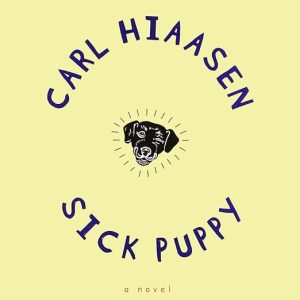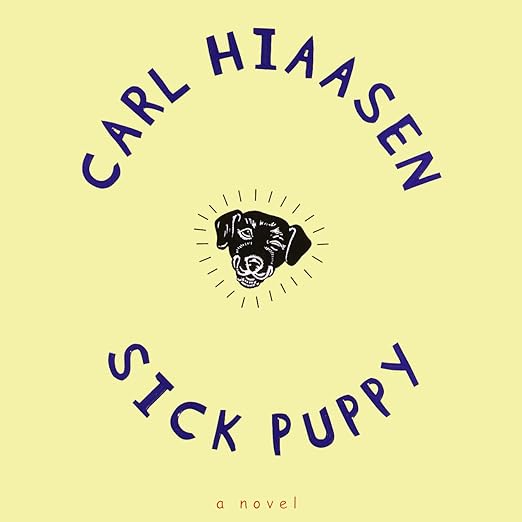
Carl Hiaasen builds his comedy the way a demolition crew builds a collapse: set the charges, step well back, let physics handle the rest. In this audiobook the first charge is a fast-food wrapper. Palmer Stoat throws his litter out of a Range Rover window on the highway, Twilly Spree is driving the black pickup behind him, and twelve hours and two minutes later the state of Florida has been substantially rearranged.
Twilly arrives in the publisher's copy as 'Idealistic, independently wealthy and pathologically short-tempered', which is both the character and the plot in a single line. His answer to the litter involves a quantity of dung beetles and the interior of that Range Rover. His answer to what he learns next involves a stolen Labrador, an ex-governor living wild in the swamp, and a Gulf Coast island. Random House Audio issued the recording in 2013, with George Newbern credited as narrator.
Is Sick Puppy Worth Your Time?
Underneath the farce sits a straightforwardly angry book about land. Stoat is a political fixer, and his current project is what the description calls the 'malling' of an unspoiled Gulf Coast island, which is the actual subject Hiaasen has been writing about for his whole career. The comedy is the delivery mechanism. The grievance is real, and it is the reason the novel has outlasted a great many funnier books with nothing underneath them.
The dog is the other thing everyone remembers. A five-star reviewer titled their notice around exactly that and singled out one paragraph in particular, saying Hiaasen 'writes one paragraph that perfectly describes Labradors, their personality and antics'. The animal is not a prop or a mascot. It is a full participant in the plot and, arguably, the only character in the book with functioning moral instincts.
Structure is where the risk sits, and one reviewer describes the experience honestly: alarmed two-thirds of the way through that the plot 'had become too tangled to ever find a successful resolution', then reporting that the ending worked anyway. My own reading matched that almost beat for beat. Hiaasen keeps adding people long past the point where a tidier writer would stop, and the resolution is more like a controlled detonation than an untangling.
The publisher's own summary signs off by calling this Hiaasen at his 'riotous and muckraking best', and the second half of that phrase is the part to hold on to. Muckraking is a journalist's word, and the novel behaves like one: it wants to know who profits, who signs the permits and what gets paved. The farce carries the argument rather than decorating it, which is why a book with a dung-beetle set piece in its opening act can still leave you irritated about zoning on the drive home. Anyone hoping for the comedy without the politics will find the two welded together.
I would put this in the upper half of his catalogue without hesitation. The satire is sharper here than the premise suggests, the escalation is genuinely inventive rather than merely loud, and Hiaasen resists the temptation to let Twilly be a straightforward hero. The man is a menace with correct opinions, and the book knows the difference.
The Best Parts of Sick Puppy
Comic prose benefits enormously from being read aloud, and this is comic prose of a specific kind: long sentences that accumulate absurd detail and then land on a single deadpan clause. The rhythm is built into the writing, and hearing it removes the small delay a reader's eye introduces before a punchline registers. Twelve hours is a lot of that rhythm, delivered by a writer who does not run out of ideas.
Series order is easily settled. This is the fourth title in the Skink sequence, named for the infamous ex-governor who recurs through it, and it works entirely on its own, though one five-star reader who calls it a personal favorite suggests newcomers begin with an earlier Hiaasen novel to recognize some of the recurring cast. That is a preference rather than a requirement. Nothing in the plot depends on prior reading.
A cast this large is also the central craft demand of the recording. Between the fixer, the eco-vigilante, the bodyguard, the developer, the swamp-dwelling former governor and the dog, a listener needs each of them separable within a line or two of dialogue, and comic timing has to survive alongside that separation. It is a harder assignment than a straight thriller of the same length.
Before You Commit to Sick Puppy
The star figure carries less information than the review dates do. A 4.4 average is generated from just two ratings, while the five written notices span December 2015 to March 2026, which is a decade of readers arriving at the same book and broadly agreeing about it. The spread of dates is the useful signal here, and the average is not.
One of those five notices, though, is a single line from somebody who had only just started the book. Discount it and you have four substantive responses, three enthusiastic and one qualified four-star reader who enjoyed it as humor while declining to call it good fiction. That is a small pool for a novel of this vintage, so weigh the description at least as heavily as the comments.
Then the content itself. Hiaasen's comedy is deliberately coarse, the ensemble includes a sex worker defined by her clientele's politics, and violence is played for laughs throughout. Twilly's methods run to arson and property destruction, presented as broadly sympathetic. None of that is hidden, but a listener expecting gentle environmental satire will be recalibrating inside the first hour, and probably deciding then whether the anger underneath justifies the delivery.
Should You Listen to Sick Puppy?
This suits readers who already enjoy Florida crime comedy, listeners who want satire with actual anger behind it, and anyone who likes an ensemble farce where the plot lines converge violently. Dog people will get more out of it than most, and readers of Elmore Leonard will recognize the pleasure of watching incompetent criminals meet worse ones.
It is a poor choice for listeners who want a plot that behaves, for anyone sensitive to crude humor or to animals in jeopardy, and for readers looking for a considered argument about development in Florida. Hiaasen is not arguing. He is settling scores in fiction, which is a different and much funnier activity.
Newcomers can start here perfectly well, whatever the completists say, provided they accept that a few faces have histories the book does not stop to explain. Twelve hours is a generous run of jokes with a real subject underneath, and the ending pulls together far better than the middle leads you to fear.
Before You Press Play
- Performance: George Newbern is credited on an ensemble farce whose large cast has to stay separable while the comic timing holds.
- What it covers: Florida land development, eco-vigilantism, political fixers, one exceptional Labrador
- Feel: Fast, crude, gleefully vindictive
- Our call: Prime Hiaasen if you want satire with teeth, and skippable if tidy plotting matters to you.
Do you need the earlier Skink novels before this audiobook?
No. Sick Puppy sits fourth in the Skink sequence and stands alone completely. One reviewer who names it a personal favorite still suggests newcomers try an earlier Hiaasen first to recognize some recurring faces, but that is about pleasure rather than comprehension. Nothing in the plot requires it.
How much of the story actually involves the dog?
A great deal, and reviewers consistently treat the Labrador as a main character rather than a device. One five-star notice is built entirely around the animal and praises a single paragraph describing Labrador behavior. The publisher's summary lists dognapping among the plot's engines, so expect the animal to drive several turns rather than to sit decoratively in the background.
Is this audiobook a bad fit for listeners who dislike crude comedy?
Probably. Hiaasen's humor here runs to bodily indignities, violence played for laughs and an ensemble that includes deliberately tasteless creations. The environmental argument underneath is sincere, but it arrives wrapped in material that is coarse by design. Sample ten minutes before committing twelve hours.
Does the plot hold together by the end?
Reviewers say it does, with one describing genuine alarm two-thirds through that the story had grown too tangled to resolve, followed by an admission of being wrong. The novel adds complications long past the point of comfort and then closes them in a rush. Expect a controlled crash rather than a neat unravelling.