Quick Take
- Narration: Fred Filbrich reads with steady, unaffected clarity suited to serious history.
- Themes: Mediterranean crossroads, cultural synthesis through conquest, immigration over emigration
- Mood: Methodical and illuminating, occasionally dense
- Verdict: A thorough and reliable history of Sicily’s remarkable past, best suited to listeners with genuine curiosity about Mediterranean and Norman history.
I started Sandra Benjamin’s Sicily on a long train journey through northern Italy, which felt appropriately thematic even if the geography was wrong. Sixteen and a half hours is a commitment for a single-subject history, and I went in with the mild skepticism I carry toward books that promise to cover “three thousand years” in any single volume. What I found was something more careful than that subtitle suggests: a layered, patient account of an island that has been continuously contested, absorbed, and reinvented across the full sweep of Mediterranean history.
Fred Filbrich narrates, and his delivery is steady and unaffected, which suits the material. This is not a dramatic biography or a thriller. It is a serious history, and Filbrich reads it like one: with clarity, controlled pace, and the sense that he respects the weight of the information he is conveying.
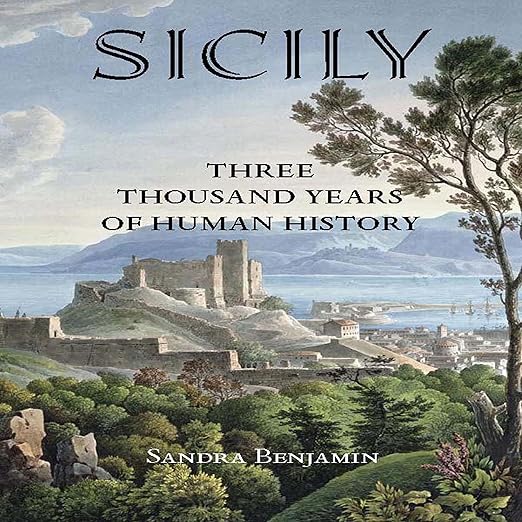
Our Take on Sicily: Three Thousand Years of Human History
Benjamin’s organising principle is the succession of rulers and populations who shaped the island, which sounds dry until you realise how extraordinary that succession actually is. Greeks, Romans, Vandals, Goths, Byzantines, Muslims, Normans, Hohenstaufens, Spaniards, Bourbons, and the Savoy Kingdom of Italy have all held sway over Sicily, and each left distinct traces in the island’s culture, architecture, language, and law. Benjamin does not simply catalogue these transitions. She examines what each group brought and what they encountered, how an island at the centre of the Mediterranean could absorb so much without losing its own character entirely.
One reviewer described the book as starting a little dry but developing genuine humor as Benjamin settled into the material. That tracks with my experience. The early chapters, covering the deep prehistory and the Greek colonial period, move at a deliberate pace. But Benjamin’s voice becomes increasingly confident as the narrative moves into the medieval period, where the Norman kingdom in particular becomes one of the book’s most vivid subjects. The 12th-century Norman court in Palermo, which supported Arabic scholars and Greek artists and Latin administrators simultaneously, is one of the more remarkable experiments in multicultural governance in medieval European history, and Benjamin gives it the space it deserves.
Why Listen to Sicily: Three Thousand Years of Human History
Benjamin makes a genuinely interesting structural choice that the synopsis highlights: she focuses on the people who came to Sicily as much as those who left it. The emigration narrative, the diaspora of Sicilians to the United States and elsewhere in the nineteenth and twentieth centuries, tends to dominate how the island is discussed in English-language popular culture. Benjamin deliberately reverses this emphasis, which produces a much richer picture of an island whose identity was forged through immigration and invasion rather than simply exported through departure.
The observation that the Crusades and Columbus’s discovery of the Americas had “remarkably little influence” on Sicily is one of the book’s most provocative contributions. Rather than treating the island as a participant in European historical movements, Benjamin shows how Sicily often stood apart from them, shaped by proximity to Africa and the Middle East as much as by connections to the European mainland. For anyone interested in Mediterranean history rather than just European history, this reframing is valuable.
What to Watch For in Sicily: Three Thousand Years of Human History
The book’s ambition occasionally outpaces its depth. One reviewer gave four stars while noting that the writing “lacks the mastery of style to be as entertaining as it is informative.” That is a fair observation. Benjamin is a reliable historian with a clear command of her sources, but the prose rarely elevates into the kind of writing you would quote. The book serves readers who want information over those who want literary experience, and if you come expecting the narrative energy of John Julius Norwich’s history of Norman Sicily, you will need to recalibrate. Another reviewer described it as “easy to read but not well written,” which captures the same tension: accessible and informative, but not quite the comprehensive stylistic achievement the subject might warrant.
There are also moments where the sheer volume of conquests and transitions can create a blur effect, particularly in the chapters covering the Spanish Bourbon and Savoy periods, which receive less attention than the earlier medieval sequences. A genealogy or timeline would have been welcome, though how that would translate to audio format presents an obvious challenge.
Who Should Listen to Sicily: Three Thousand Years of Human History
Travellers planning a trip to Sicily will find this invaluable for understanding why the island looks and feels the way it does. Listeners with an existing interest in Mediterranean history, Norman history, or the Arab-Norman synthesis in particular will get genuine depth here. Readers looking for literary history in the tradition of Fernand Braudel will find it solid but not luminous. It is best approached as a thorough, reliable companion rather than a transformative reading experience.
Frequently Asked Questions
Does the book cover modern Sicily or focus primarily on the ancient and medieval periods?
Benjamin covers the full span from ancient Greek colonisation through to the modern era, including 20th-century political developments, Mafia history, and contemporary Sicilian identity. The medieval period, particularly the Norman kingdom, receives especially detailed treatment, but the book does reach the present.
How does Fred Filbrich’s narration handle the many languages and cultures referenced in the text?
Filbrich maintains a consistent, clear delivery without attempting theatrical accents for the various cultures discussed. His approach prioritises intelligibility over performance, which is probably the right call for a scholarly history with considerable name and place vocabulary.
Is this a good starting point for someone with no background in Sicilian or Mediterranean history?
Yes, Benjamin writes for readers coming to the subject fresh, and one of the consistent compliments from reviewers is that the book is accessible without sacrificing accuracy. Some early chapters move slowly, but the cumulative picture she builds is accessible to a general audience.
The synopsis mentions the book can be ‘dipped into over time’ as a reference. Does it work better as a reference than a straight listen?
In print, yes. As an audiobook, the reference function is harder to use, since navigation is less precise. As a linear listen, the narrative structure holds together well enough, but listeners who want to return to specific periods may find the print or ebook format more practical.