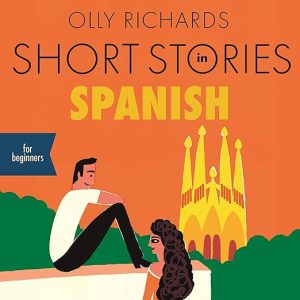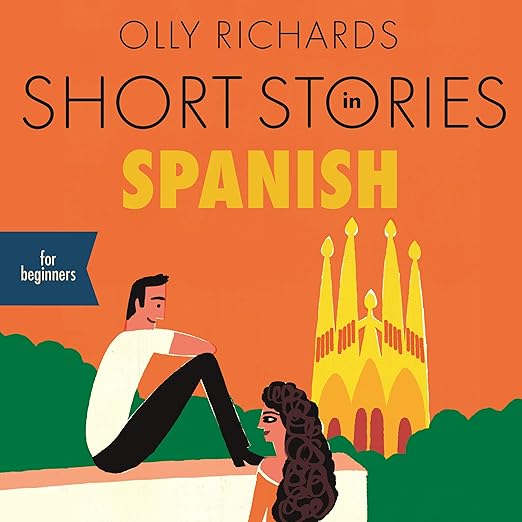
Eight short stories make up this audiobook from Olly Richards, each one pitched at the A2 to B1 range on the Common European Framework for language learners easing into Spanish rather than diving straight into native-speed content. The synopsis promises genre variety across those eight stories, science fiction, crime, history, thriller, built specifically around the most frequent one thousand words in the language, so listeners get real narrative variety without the vocabulary spiraling out of their current level. Barbara Oakley, the bestselling author of A Mind for Numbers, is quoted directly in the synopsis endorsing Richards's broader body of work, a notable endorsement given her own background in how people actually learn new skills. Only three ratings are attached to this specific listing so far, all landing at a strong 4.6 average, and the synopsis pitches the collection at both young and adult learners simultaneously, a dual audience that the genre variety across the eight stories seems designed to support.
Marzan's Casting Hits the Seventy-Five Percent Sweet Spot
Javier Marzan narrates, and language-learning audio lives or dies on exactly this kind of casting decision, a native Spanish speaker who can deliver controlled, level-appropriate vocabulary while still sounding like an actual person telling a story rather than a textbook recording read aloud. Krys's review offers the most useful data point here: testing at CEFR level A2 specifically, she found the material perfectly calibrated, understanding roughly seventy-five to eighty percent of what she heard while still encountering enough new words and genuine challenge to keep progressing steadily. That's close to the ideal comprehension ratio language-acquisition research generally points toward, familiar enough to follow the plot, unfamiliar enough to actually learn something new along the way through context. That balance echoes a broader principle in language acquisition research the synopsis itself gestures toward, that genuine enjoyment while listening in a foreign language reduces the frustration that usually derails self-directed learners, and Krys's concrete comprehension percentage gives that abstract claim real, testable specificity rather than leaving it as marketing language alone. J. Mckerracher's review, written from the perspective of a longtime Spanish learner only now taking the language seriously after years of casual study, frames the book as a genuine way back into consistent practice.
Eight Genres Built Around One Thousand Words
The structural decision to build eight genre-varied stories rather than one continuous narrative is smart design for a learning tool specifically. A listener who finds the crime story less engaging can still look forward to the thriller or the science fiction entry, and genre variety within a controlled vocabulary keeps the whole collection from feeling like a single long grammar exercise dressed up as fiction for young and adult learners alike. B.King's review specifically highlights the emphasis on practice built into the book's design, calling the stories engaging and well written even while acknowledging their instructional purpose underneath the entertainment value. That dual function, genuine narrative pleasure alongside deliberate pedagogical structure, is harder to pull off than it sounds, plenty of language-learning fiction reads as vocabulary lists wearing a thin plot disguise, and the reviews attached here suggest Richards avoids that particular trap fairly consistently. Building the entire collection around the thousand most frequent Spanish words is a meaningfully different constraint than simply writing easy sentences, frequency-based vocabulary selection is specifically designed to maximize how often a learner encounters and reinforces the same practical words across different stories, rather than teaching eight isolated, disconnected vocabulary sets that don't reinforce each other. The authentic spoken dialogue the synopsis promises also matters specifically for an audio format, since hearing natural conversational rhythm read aloud teaches listening comprehension in a way a printed page alone cannot replicate for a learner.
Test Your Level Before Trusting the Label
Krys's review directly addresses a complaint she'd seen elsewhere, that the book isn't truly suited to beginners despite its marketing, and her own testing at A2 pushes back against that specific critique, but it's still worth taking seriously as a signal that self-assessment matters here more than the label on the cover. If you've never taken a CEFR-style placement test, spend a few minutes finding your actual level before committing, since a true beginner with no prior exposure to Spanish may still find the pace faster than expected even at the lower end of the stated A2 to B1 range. J. Mckerracher's review, framed explicitly as being written by a longtime Spanish learner rather than a total beginner, is a useful reminder that the community of people drawn to this book skews toward returning or lapsed learners as much as genuine first-timers. And because the book comes bundled with a companion PDF, listeners who want the full reading-along benefit, especially useful for a language-learning product specifically, should plan to have that text available rather than relying on audio in isolation the whole way through. B.King's four-star review, the most measured of the three attached here, still calls the experience thoroughly enjoyable while specifically crediting the emphasis on practice, suggesting even listeners who don't rate it a perfect five find real instructional value in the repetition-through-story approach Richards builds the collection around.
Returning Learners Find Their Way Back In
Richards built this specifically for learners sitting right around the A2 to B1 mark, and that precision is exactly why it works as well as it does for its intended audience. Returning learners like J. Mckerracher, people with some classroom Spanish in their past who let it lapse and want a structured way back in, are especially well served by the genre variety and the manageable four-and-a-half-hour total runtime. Anyone who's tried and abandoned a more traditional grammar-drill course will likely find the story-first approach here a genuinely more sustainable way to keep showing up day after day, since narrative curiosity does a lot of the motivational work that willpower alone usually has to carry on its own. Younger learners are a real part of the intended audience too, not just adults easing back into a language they studied years ago, since the synopsis explicitly pitches the collection at young and adult listeners alike.
Test your own CEFR level before committing, since more than one reviewer found the difficulty didn't quite match their initial expectations, whether pleasantly or otherwise, and self-assessment upfront will save you from starting at the wrong entry point in the collection. True absolute beginners with zero prior Spanish exposure may still want an even gentler on-ramp before jumping into even the most controlled A2 material offered here.
- Voice: Javier Marzan delivers controlled, level-appropriate Spanish that still sounds like natural storytelling rather than a textbook recording, essential for a language-learning audiobook.
- Big ideas: language acquisition through narrative, genre variety within controlled vocabulary, the confidence-building value of comprehensible input
- Atmosphere: Encouraging and accessible, structured but never dry
- Worth it?: A well-calibrated language-learning audiobook for listeners genuinely at the A2 to B1 level, worth testing your level first before committing.
Good to Know
What Spanish level do I need before starting this audiobook?
It's mapped to A2 to B1 on the Common European Framework, and one reviewer who tested at A2 found the material perfectly calibrated, understanding most of it while still being challenged.
Does this audiobook include multiple stories or one continuous narrative?
It contains eight separate short stories spanning genres like science fiction, crime, history, and thriller, each built around the most frequent 1,000 Spanish words.
Is Javier Marzan's narration too fast for beginner Spanish learners?
Reviewers describe the pacing as appropriately challenging without being overwhelming for listeners near the A2-B1 range, though true absolute beginners may still find it brisk.
Do I need the companion PDF to benefit from this audiobook?
The audio works on its own, but the included PDF likely supports the reading-along benefit many language learners find useful alongside listening practice.