Quick Take
- Narration: Smári Gunn brings authentic Icelandic pronunciation and natural spoken rhythm that is genuinely invaluable for learners trying to train their ear, not just their vocabulary.
- Themes: Language acquisition through immersion, comprehensible input, Icelandic culture and landscape
- Mood: Focused and rewarding, designed for active listening rather than passive absorption
- Verdict: One of the very few dedicated listening resources for Icelandic learners at the A2-B1 level, and Smári Gunn’s narration makes it more valuable than the print edition alone.
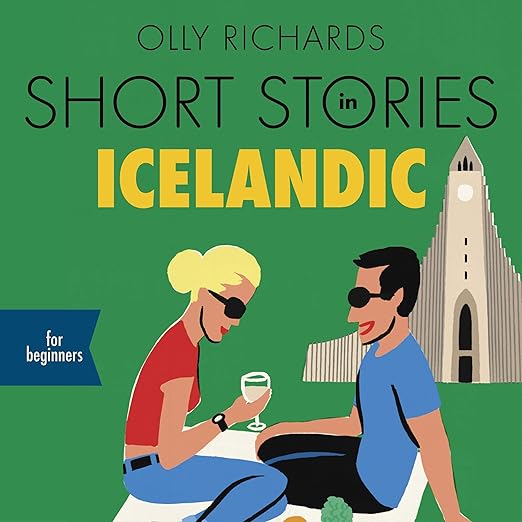
I have been dabbling with Icelandic on and off for about three years, and the resources problem is real in a way that learners of French or Spanish cannot quite imagine. Most language learning content for Icelandic tops out at textbook dialogues and basic phrasebook audio, which leaves a significant gap for anyone trying to push past tourist-level competency. When I found Olly Richards’s Short Stories in Icelandic for Beginners in audio format, I listened to the first story during a walk and immediately went back to the beginning to follow more carefully. That restart is the best compliment I can give a language learning audiobook.
Olly Richards has built a well-regarded series of these graded reader audiobooks across various languages, and the methodology behind them is rooted in Stephen Krashen’s comprehensible input theory: you learn a language not primarily through grammar drills but by encountering it in meaningful context, at a level just above your current ability. The Icelandic edition applies this approach to eight stories across genres including science fiction, crime, history, and thriller, all written with controlled vocabulary drawn from the most frequent 1,000 words in the language.
Our Take on Short Stories in Icelandic for Beginners
The listening experience is genuinely well-constructed. Each story unfolds at a pace that does not condescend, and the vocabulary control is visible once you know what to look for: the same words recur across chapters in different contexts, embedding them without the mechanical repetition of a drill. One reviewer who has reached A2-B1 level describes it as exactly what she needed to get past the plateau of limited adult-oriented material in that range, and that matches my experience precisely.
The accompanying PDF, which Audible includes in your library alongside the audio, provides glossaries for bolded vocabulary, full plot summaries, and comprehension questions after each chapter. This is not a passive listening experience. Richards and his collaborators design these books to be used actively, and the audio format works best when you return to passages you found difficult rather than treating it like a podcast you absorb on a single pass.
Why Listen to Short Stories in Icelandic for Beginners
The critical contribution of the audio version is Smári Gunn’s narration. Written Icelandic and spoken Icelandic diverge in ways that surprise even intermediate learners, and Gunn delivers the stories with natural spoken rhythm, authentic pronunciation of the more phonetically unusual Icelandic sounds, and the kind of expressive variation in dialogue that you need to hear if you ever intend to understand actual Icelanders. No amount of textbook study replicates this.
One reviewer who emigrated to Iceland and took eighty hours of classes describes the book as an excellent supplement for anyone past the absolute beginner stage, and that caveat matters. The title’s promise of being designed for beginners should be interpreted generously: you will get most from it at A2 to B1, not from zero. Listeners with no prior exposure to Icelandic will find it difficult without the companion print text and a vocabulary base already in place.
What to Watch For in Short Stories in Icelandic for Beginners
A reviewer flagged that the glossary included in the PDF is inadequate for all the vocabulary a true beginner would need, which rings true. You will encounter words outside the glossary, and the intention is for you to reason through them from context, which is a pedagogically sound approach but can feel frustrating during early listens. Expect to pause, consult a dictionary, and replay passages. This is not a flaw in the design so much as a feature of the method, but it does mean the audiobook requires more active engagement than typical language learning audio.
The genre variety across the eight stories is a genuine strength. Crime and science fiction bring different vocabulary registers, and moving between them mirrors the kind of exposure to varied contexts that real language acquisition requires. The stories are not literary masterpieces, but they are engaging enough to hold attention while the language work happens in the background.
Who Should Listen to Short Stories in Icelandic for Beginners
Listen if you have reached A2 or B1 level in Icelandic and are hungry for adult-oriented listening material at your level. The scarcity of alternatives in this language makes this audiobook close to essential for dedicated learners. Skip if you are starting from zero: you will need a vocabulary foundation and some familiarity with basic Icelandic grammar before the comprehensible input approach can take hold.
Frequently Asked Questions
Can I use this audiobook without the PDF companion?
Technically yes, but you will miss the glossaries, comprehension questions, and plot summaries that make the active-learning method work. Audible includes the PDF in your library alongside the audio, so there is no reason to skip it. Listening without it is a significantly thinner experience.
Is Smári Gunn a native Icelandic speaker?
The narrator is listed as Smári Gunn, an Icelandic name suggesting a native speaker, and the pronunciation quality throughout the recording reflects genuine fluency rather than a trained but non-native reader. For learners trying to calibrate their ear, this matters considerably.
How does this compare to other Icelandic learning resources at the same level?
One reviewer who has searched extensively notes there is essentially only one other comparable book for adults at the A2-B1 level. The market for Icelandic learning materials is extremely thin compared to major European languages, which makes this audiobook unusually significant for serious learners.
Do the eight stories have any thematic connection to Iceland as a place?
The stories are set in a range of contexts drawn from the genre mix: science fiction, crime, history, and thriller. They reflect Icelandic cultural reference points and use vocabulary associated with the country’s landscape and society, but they are not travel narratives or cultural primers. The language is the primary subject, not the geography.