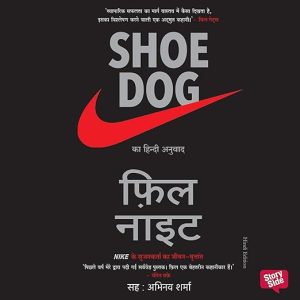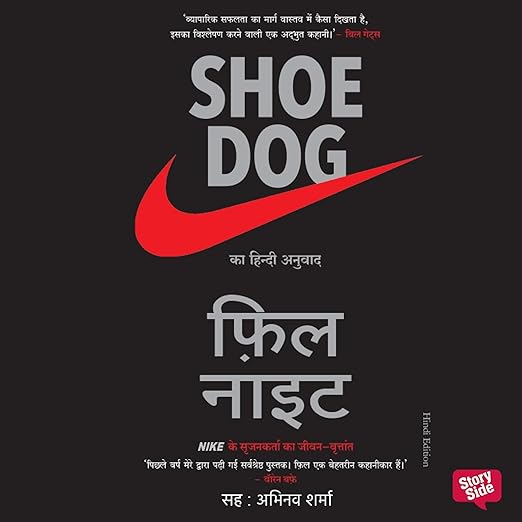
Phil Knight borrowed fifty dollars from his father in 1962 and turned it into Nike, and Shoe Dog remains one of the best-regarded business memoirs of the last decade regardless of which language you hear it in, which matters here because this particular audiobook edition is narrated entirely in Hindi. Abhinav Sharma reads Knight's account for Storyside IN at just over fourteen and a half hours, covering the same ground as the original English release: the boot of a Plymouth doubling as a warehouse, the first year's eight-thousand-dollar haul, the Onitsuka Tiger import deal, and the slow, chaotic build toward a company now doing more than thirty billion dollars in annual sales. English-only listeners searching for this exact title should stop here and look for the Simon & Schuster edition narrated by Norbert Leo Butz instead, since nothing about this specific recording will be intelligible without Hindi.
Sharma's Performance Has No Reviews to Confirm It
The book's own framing material, quoted directly in this edition's Hindi synopsis, includes a blurb from Andre Agassi calling it a beautiful, surprising book that is simple, fun, mysterious, and genuinely literary, an unusual endorsement for a book that could easily have been a dry founder's memoir instead. That literary ambition is a real, distinguishing feature of Knight's writing, not marketing gloss.
Knight's own crossroads moment, walking away from a conventional path at twenty-four to chase an import scheme most people around him thought was reckless, anchors the whole book, and the synopsis is explicit that the early partners who joined him, his University of Oregon track coach Bill Bowerman prominent among them, became something closer to a band of brothers than a conventional business team. That relationship-first framing is what elevates the book above a standard entrepreneurship case study.
Sharma's performance has to carry a memoir the source material itself describes as candid, humble, wry, and gutsy, a tonal range that asks for warmth and dry humor in roughly equal measure rather than either straight motivational energy or flat corporate narration. Without independent reviews of this specific Hindi recording available yet, that assessment rests on genre-fit reasoning rather than confirmed listener feedback, but the source material gives a clear target for what the performance needs to hit.
The Name Nike Came to Johnson in a Dream
Jeff Johnson, the company's first full-time employee, gets real credit in the book for a detail that has become part of American business folklore: the name Nike itself reportedly came to him in a dream, a small, human origin story for what became one of the most recognized brand names on the planet.
Onitsuka Tiger, the Japanese shoe manufacturer Knight originally partnered with to import running shoes into the United States, is itself a real company whose eventual falling-out with Knight's growing Blue Ribbon Sports operation forced the pivot toward manufacturing under Nike's own name, a turning point the book treats as one of its most tense passages.
The book's Hindi framing material calling it mysterious alongside simple and fun is an interesting descriptor for a memoir whose basic outline, fifty dollars, a startup, eventual billions, is broadly familiar; the mystery the blurb points to is less about outcome and more about how close failure came at nearly every step along the way.
A Rare First-Language Hindi Recording
The appeal here goes well beyond a standard business audience. Knight's own story is explicitly framed as an underdog's account of building something from nothing, complete with daunting setbacks and real risk of total failure at multiple points, which gives it the narrative shape of a survival story as much as a corporate origin tale.
For Hindi-speaking listeners specifically, this is a rare chance to experience one of the defining entrepreneurship memoirs of the past ten years in a first-language recording rather than through subtitles or a second-language read, and Storyside IN's full production treats the material with the same seriousness the English edition received.
Bill Gates Named It One of Five Favorite Books
Bill Gates named Shoe Dog one of his five favorite books the year it was released, calling it an honest reminder of what building a real business actually looks like rather than a sanitized success narrative; that kind of crossover endorsement from outside the sneaker or sports world is part of why the book transcended a niche business-memoir audience in the first place.
Storyside IN's growing catalog reflects a broader expansion of first-language audiobook production for Indian markets, moving beyond translated Western bestsellers toward fuller, dedicated productions like this one, treating Hindi-speaking listeners as a primary audience rather than an afterthought market.
The book's back half, tracking Nike's growth into a global brand, carries a very different energy from its scrappy opening chapters, and Knight keeps the same candid, occasionally rueful voice from the early pages rather than switching into a triumphant, look-how-far-we've-come register once the company's survival is no longer in doubt.
A Separate Listing Shows a Smaller Count
The language barrier is not a minor footnote here, it is the single most important purchase-decision fact about this specific listing. Nothing about the Hindi narration will be accessible to a listener who does not speak the language, and this bears repeating precisely because Shoe Dog's fame makes it easy to add to a cart without checking the edition first.
The attached rating, 4.9 stars across more than fifty-three thousand ratings, almost certainly reflects Shoe Dog's extraordinary popularity pooled across formats and editions generally rather than being specific evidence about this particular Hindi recording's reception; a separate listing for this same Hindi edition shows a far smaller, more edition-specific rating count. Treat the headline number as evidence of the book's overall reputation, not a guarantee about this specific audio production.
The company's early years included genuine near-collapses: cash crises with banks, supplier disputes, and a legal fight over import duties that nearly sank the business more than once. Knight does not smooth over how close Nike came to failing repeatedly, and that candor is central to why the book reads as a survival story rather than a victory lap.
Listeners should also know that Storyside IN's Hindi catalog spans multiple genres beyond business memoir, so this specific title's existence within that catalog reflects a broader, deliberate investment in first-language nonfiction rather than a one-off translation project.
Seek the Norbert Leo Butz Recording Instead
Listen if you are a Hindi-speaking listener interested in one of the strongest business memoirs of the past decade, delivered in a full, dedicated Hindi-language production rather than a translation afterthought. Skip it, and seek out the Norbert Leo Butz English recording instead, if you do not read or speak Hindi; this specific edition will not work for you regardless of how the book itself is rated.
For listeners who have already read the English edition and are simply curious about experiencing familiar material in a different language, this Hindi production offers a legitimate, well-produced second way into a story most business-book readers already know the broad strokes of.
Good to Know
Is the Shoe Dog audiobook narrated by Abhinav Sharma in English or Hindi?
This specific edition is narrated entirely in Hindi by Abhinav Sharma for Storyside IN; it is not an English-language recording.
Where can English-speaking listeners find the original Shoe Dog audiobook?
Look for the Simon & Schuster edition narrated by Norbert Leo Butz, which is a separate listing from this Hindi production.