Quick Take
- Narration: Danyel Smith narrates her own work, and the effect is transformative. Her voice carries the weight of personal testimony throughout.
- Themes: Black women’s contribution to American pop music, cultural erasure, memoir and criticism intertwined
- Mood: Intimate, passionate, and meticulously argued
- Verdict: One of the rare cultural history audiobooks where hearing the author’s own voice is not incidental but essential to the book’s meaning.
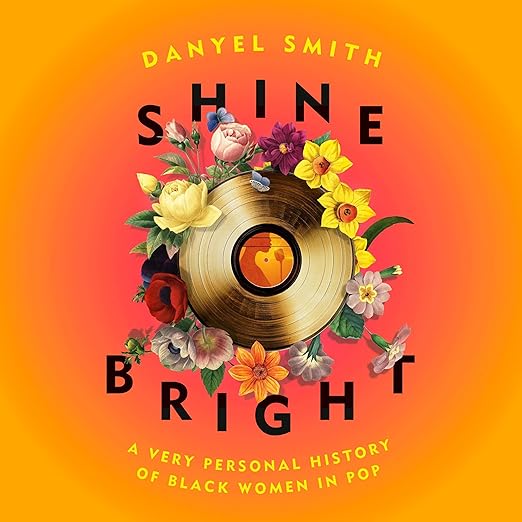
I was about forty minutes into Shine Bright when I pulled over to look up Marilyn McCoo on my phone. Not because I did not know who she was, but because Danyel Smith had just described the particular way her career had been shaped by forces that had nothing to do with her talent, and I needed to sit with that for a moment before continuing. That is the experience this book produces: it sends you into side rooms, makes you reexamine things you thought you understood, and then draws you back with something even more specific and more damning.
Smith’s thesis is stated plainly and early: American pop music’s singular voice was created by a continuous thread of Black women whose contributions have been systematically understated, misattributed, or simply forgotten. The history she traces begins with Phillis Wheatley, an enslaved woman who sang her poems, and moves through Mahalia Jackson, Dionne Warwick, Aretha Franklin, Gladys Knight, Mariah Carey, and toward the deliberately under-considered careers of Marilyn McCoo, Deniece Williams, and Jody Watley. Each chapter is a demonstration of both the talent and the structural conditions that shaped what was possible for each woman.
Our Take on Shine Bright
What makes this book unusual as cultural history is the way Smith refuses to separate her critical argument from her personal one. She was a latchkey kid listening to Midnight Train to Georgia on the family stereo. She later worked as an editor at Vibe and Billboard, positions from which she watched how decisions about coverage and attention were made in real time. That dual vantage point, as a fan and as an industry insider, gives her arguments a specificity that purely academic treatments cannot match. One reviewer described the book as a love letter to their soul, which captures something real about the emotional register without fully conveying the analytical rigor underneath it.
Smith narrating her own work matters enormously here. Her voice carries personal authority in passages that would feel different delivered by a professional narrator. When she describes what it was like to grow up with this music, or to watch certain careers stall at moments that should have been breakthroughs, the first-person register is not affectation. It is testimony. Multiple reviewers noted the seamless way personal experience and cultural criticism are woven together, and that effect is most fully realized in the audio format.
Why Listen to Shine Bright
The book has been recognized by a wide range of publications, from NPR to Pitchfork to Oprah Daily, and that range is telling. This is not a book that works only for readers already invested in music criticism or Black cultural history. It works for anyone who has ever had a song land with particular force and wondered why that was, and what it cost the person who made it.
The chapter on Dionne Warwick alone is worth the listening time. Smith frames Warwick’s career in terms of how her image was managed, what she was permitted to represent, and how the industry’s decisions about her positioning shaped what became possible for artists who came after her. That kind of structural argument, delivered with the intimacy of someone who has spent five years living inside this material, is what elevates the book beyond conventional music biography.
What to Watch For in Shine Bright
At nearly fourteen hours, the book rewards patient listening. It is not structured as a chronological march through decades. Smith moves associatively, linking artists across eras through shared dynamics rather than sequential history. Some listeners may find this approach less immediately navigable than a more conventional timeline. The memoir passages, while essential to the book’s texture, do shift the focus away from the central historical argument at points, and those transitions are not always smoothly signaled.
The book was shortlisted for the Porchlight Business Book Award, which is an unusual category for what is primarily a work of cultural criticism and memoir. That classification says something about how difficult this book is to categorize, which is one of its genuine strengths and occasionally a mild disorientation for listeners who come in expecting a single mode.
Who Should Listen to Shine Bright
For anyone who loves the music and wants to understand the full context of what produced it. For listeners interested in how cultural industries shape what becomes visible and what does not. For those who find music criticism more compelling when it is grounded in lived experience rather than purely analytical frameworks. Less suited to listeners who want a strictly chronological music history or a conventional biography of a single artist.
Frequently Asked Questions
Does Danyel Smith’s self-narration work if you are not already familiar with her voice from her podcast Black Girl Songbook?
Yes. Prior familiarity with her work is not required. Her narration style is immediately engaging, and the audio format makes the personal testimony passages more powerful than they might be on the page.
Is this a music history book, a memoir, or music criticism, and which mode dominates?
Smith describes it herself as a weave of biography, criticism, and memoir, and that description is accurate. No single mode dominates for long. Listeners who prefer one genre may find the shifting registers initially surprising.
The synopsis focuses heavily on well-known artists like Aretha Franklin. Does the book spend substantial time on the less-recognized figures like Deniece Williams and Jody Watley?
Yes. Smith deliberately spends significant time on under-considered careers alongside the famous ones, and those sections are often the most analytically interesting parts of the book.
At nearly fourteen hours, is Shine Bright a commitment for an average listener, and does it sustain its energy throughout?
It is a long listen, and the associative structure rather than strict chronology means some sections reward more active attention than others. Most reviewers found it sustained its energy, though the pacing varies chapter to chapter.