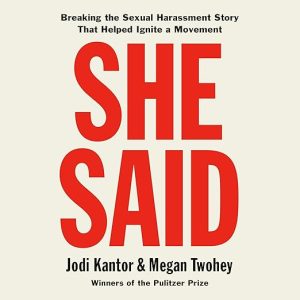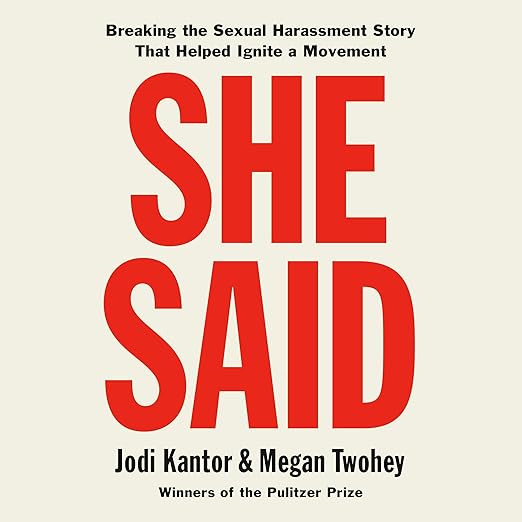
Jodi Kantor and Megan Twohey broke a story that reshaped a cultural moment, and the audiobook of She Said gives that story something the original New York Times article never could: time, texture, and the weight of every conversation that almost did not happen. Rebecca Lowman's narration is precisely calibrated to the material. She does not sensationalize, she does not editorialize, she simply reports, and in doing so mirrors exactly what the two journalists themselves were doing in the field.
Verdict first, because it matters: this is one of the most important works of narrative journalism of the past decade. Not because of the famous names involved, not because the world already knows the outcome, but because Kantor and Twohey make the process itself riveting. The months of confidential conversations with top actresses, former Weinstein employees, and sources who had been silenced by nondisclosure agreements form the spine of the book, and the authors are meticulous about showing how close the story came to collapsing at every turn.
Watching Journalists Build an Airtight Case
One reviewer compared this to "All the President's Men meets #MeToo," and that frame is apt. The book shares the same procedural fascination as the Woodward and Bernstein account: the pleasure of watching skilled journalists build an airtight case, one reluctant source at a time. But She Said goes further, because Kantor and Twohey do not simply reconstruct events after the fact. They bring readers into the newsroom during real-time decisions. What to publish, when to call Weinstein for comment, how to protect sources who had everything to lose.
The legal architecture of the cover-up, the onerous settlements and nondisclosure agreements that had kept this buried for decades, receives sustained, careful attention. It is not background noise; it is the mechanism the book is dedicated to dismantling. Understanding how those legal instruments worked, and how many people were bound by them, changes the shape of the story from a simple villain-and-victims narrative into something considerably more complicated and more true.
What makes the listening experience distinctive is Lowman's refusal to perform. She does not give Weinstein a sinister tone when he speaks. She does not soften the women who came forward with sentimentality. The effect is one of documentary seriousness, and it is deeply effective. You are left to form your own reactions, which, given the material, is more than sufficient.
The Kavanaugh Chapters Read Like a Dispatch
The book covers considerably more ground than the initial Weinstein article. The final substantial section shifts to the Brett Kavanaugh confirmation hearings, which one reviewer found slightly less gripping than the Weinstein chapters. That is a fair read. The Weinstein investigation is where Kantor and Twohey spent years and where their granular detail is most impressive. The Kavanaugh section feels more like a dispatch from the field than a fully assembled case. But the transition also serves a structural purpose: it argues that the Pandora's box opened in October 2017 did not close with any single verdict.
The question the book asks, whether too much changed or not enough, is not rhetorical. The authors return to it in a final phase of reporting that produced what they call their most startling findings yet. Lowman's delivery of those passages carries the same control she brings to the rest of the audiobook, and the cumulative effect by the end is considerable. This is not a story with a tidy resolution, and the narration honors that.
The bonus PDF of notes accompanies the audio edition, which is worth knowing for listeners who want to trace sourcing or follow the documentary thread. This is the kind of journalism that demands to be verifiable, and the notes underscore that commitment. For anyone who cares about the infrastructure behind accountability reporting, they are worth reviewing alongside the audio.
Lowman Stays Calm Through the Intimidation Scenes
Pay attention to the scenes involving Weinstein's private investigators and legal team. The book is at its most bracing when it details the intimidation apparatus that existed specifically to suppress sources and discredit journalists. Hearing Lowman narrate those passages with the same unhurried calm as the rest of the book is the right choice. The contrast between what the investigators were doing and the tone in which it is described is itself a kind of editorial statement about what professional journalism looks like under sustained pressure.
Also worth noting: the women who agreed to go on the record are not presented as uniformly heroic, nor are they flattened into victims. Some had complicated reasons for speaking. Some changed their minds. Some had made agreements that cost them dearly to break. The journalism here does what the best reporting does: it holds the complexity without resolving it prematurely. Listeners who come expecting a simple story will find something more nuanced and more true.
Readers of Farrow and Malcolm Will Recognize This
Anyone with an interest in investigative journalism or the mechanics of a major news story will find this essential. Readers of books like All the President's Men, Janet Malcolm's The Journalist and the Murderer, or Ronan Farrow's Catch and Kill, which covered overlapping ground from a different vantage point, will recognize the texture and appreciate the differences in approach. Listeners who followed the original coverage in 2017 and 2018 will find that the book fills in the gaps in ways that matter. Those who want a dramatic, voice-acted account should look elsewhere; Lowman's approach is controlled and journalistic. But for anyone who wants the real story, told by the reporters who lived it, this audiobook earns every hour of its nearly ten-hour running time.
Good to Know
Does the audiobook of She Said cover the Brett Kavanaugh hearings, or is it only about Harvey Weinstein?
Both. The majority of the audiobook focuses on the Weinstein investigation, but the final section shifts to the Kavanaugh confirmation hearings and what Kantor and Twohey call their most startling subsequent findings. Some listeners find this section slightly less detailed than the Weinstein chapters, but it is integral to the book's larger argument about institutional change.
Is She Said worth listening to as an audiobook if I already followed the original New York Times coverage?
Very much so. The published articles were necessarily compressed. The audiobook gives you the full procedural history, including the confidential conversations, the legal obstacles, and the near-collapses of the story, that could not fit in the original reporting. It is a substantially different experience.
Does the audiobook include the supplemental notes PDF?
Yes. A bonus PDF of the book's notes is included with the audio edition in your library, which allows you to trace sourcing and verify claims. For a work of this nature, that companion document is a meaningful addition.