Quick Take
- Narration: Gabra Zackman navigates a dense financial subject with clarity and appropriate urgency – her delivery makes the regulatory complexity feel like a story rather than a briefing document.
- Themes: Government-sponsored enterprise reform, political inertia, systemic financial risk
- Mood: Investigative and pressing, with occasional undertones of institutional despair
- Verdict: A compact, rigorously reported account of why Fannie Mae and Freddie Mac remain a ticking policy problem – essential for anyone working in real estate, finance, or housing policy.
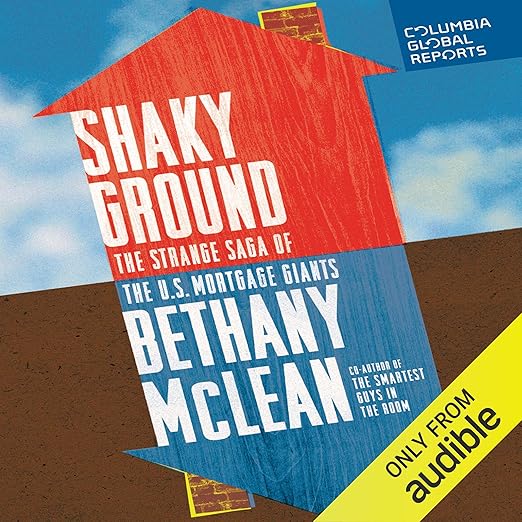
I listened to Shaky Ground during a week when mortgage rate news was dominating every financial conversation I was having. It was the kind of moment when something published in 2015 suddenly reads like it was written yesterday, and that unsettling feeling of policy stasis is exactly what Bethany McLean captures. I came to this having read The Smartest Guys in the Room years ago, and McLean’s voice carries the same quality here: sharp, patient, never alarmist, but relentlessly honest about the scale of what she’s describing.
At just over three and a half hours, this is a short audiobook by any measure. McLean herself, in interviews around the time of publication, described it as an extended piece of long-form journalism rather than a comprehensive book, and that framing is accurate. What it covers, it covers well. What it does not cover, it openly signals. That transparency is part of what makes McLean’s work reliable. She is not trying to give you more certainty than the material supports.
Our Take on Shaky Ground
The subject is genuinely strange when you step back from it. Fannie Mae and Freddie Mac were placed in government conservatorship in 2008, which was supposed to be a temporary stabilizing measure during the financial crisis. McLean’s book, written seven years after that decision, examines why they are still there and who benefits from keeping them in that limbo. The answer involves a web of political interest that cuts across party lines, international creditors including China and Japan, hedge funds that bought into the companies’ preferred stock after the conservatorship, and a federal housing finance system so complex that even the regulators responsible for it disagree about what the right outcome looks like.
McLean frames this as a question about political will and institutional inertia as much as about financial mechanics. One reviewer called it a compelling call to remedy our national tendency to prefer reactive over proactive approaches, which is accurate but undersells how structurally interesting the story is. The conservatorship created a situation where the Treasury is sweeping Fannie and Freddie’s profits to reduce the federal deficit rather than letting the companies rebuild capital buffers. That means any future shock finds them as exposed as ever. The political incentive to change this arrangement is low precisely because it currently serves so many competing interests.
Why Listen to Shaky Ground
The reason to listen to this rather than simply read a long-form article on the subject is Gabra Zackman’s narration, which imposes a narrative through-line that helps the listener track a genuinely complicated cast of regulatory actors and political interests. The audiobook format also gives McLean’s prose, which is economical and precise, room to land. She does not waste sentences, and Zackman does not waste inflection.
One reviewer who works as a realtor described picking this up specifically because Fannie and Freddie’s fate directly affects the mortgage market she operates in every day. That practical stake is worth naming: if you work in real estate finance, housing policy, or investment analysis, this is required background. McLean traces the GSE structure back to its congressional origins and explains why homeownership finance in the United States is architecturally dependent on these two entities in ways that make clean privatization nearly impossible without significant disruption.
What to Watch For in Shaky Ground
The main caveat reviewers raise is that McLean’s narrative does not always connect dots in the way a more linear storyteller would. One reader described the prose as worthy of Vanity Fair but not quite deep enough for serious scholarship, which points at something real. McLean is a journalist working at the edge of what journalism can do with this kind of interlocking institutional material. She is comprehensive within the scope she sets, but the scope is deliberately bounded.
The book does not resolve the question of what should happen to Fannie and Freddie. That is not a failure of the reporting; it is an accurate reflection of the situation. As of the book’s publication, the policy was genuinely unresolved, and a decade later it remains so. Listeners looking for a clean prescription will not find one. What they will find is a clear-eyed account of why the prescription has proven so politically impossible to write.
Who Should Listen to Shaky Ground
This audiobook is well-suited to readers with some familiarity with the 2008 financial crisis who want to understand the specific Fannie and Freddie component of it in greater depth. McLean’s prior books, particularly All the Devils Are Here, provide excellent context, though they are not prerequisites. The short runtime makes this ideal for a commute or a flight, though the density of the material rewards attentive listening rather than background play.
Those without any background in housing finance or government-sponsored enterprises may find the policy mechanics challenging without some additional context. Casual readers looking for a financial crisis narrative with the drama of a Margin Call or Too Big to Fail should note that Shaky Ground is deliberately journalistic and analytical rather than narrative-driven. It is more urgent than entertaining, which is precisely its value.
Frequently Asked Questions
Do I need to have read Bethany McLean’s earlier books to follow Shaky Ground?
No, though All the Devils Are Here and The Smartest Guys in the Room provide useful background on the 2008 financial crisis that preceded Fannie and Freddie’s conservatorship. Shaky Ground establishes its own context and can be followed as a standalone piece of reporting.
Is Shaky Ground still relevant given that it was published in 2015?
Very much so. The core problem McLean identifies, that Fannie Mae and Freddie Mac remain in conservatorship with no political resolution in sight, has continued to be true in the years since publication. The book is a foundational explanation of how the US ended up in a housing finance structure that no one fully endorses but no one has found a way to reform.
How technical is this audiobook – do I need a background in finance to follow it?
McLean writes for a general educated audience, not for finance specialists. The mechanics of mortgage-backed securities and government-sponsored enterprise regulation are explained rather than assumed. That said, listeners with some prior exposure to the 2008 crisis or US housing policy will absorb the material more quickly.
Does Gabra Zackman’s narration help with the density of the financial subject matter?
Yes. Zackman’s delivery is measured and clear, and she handles the regulatory terminology without making it feel like a lecture. The narration is one of this audiobook’s genuine strengths, making a legitimately complex policy story feel like a reported feature rather than a textbook.