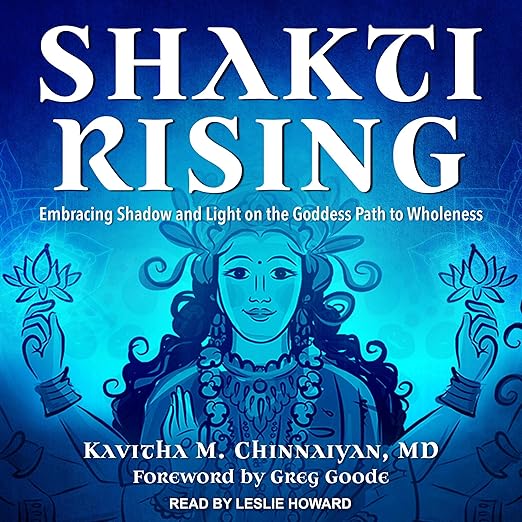
Quick Take
- Narration: Leslie Howard’s voice is well-suited to the contemplative pace this material requires; she reads the more technical philosophical passages without clinical detachment and keeps the meditative sections from feeling stiff.
- Themes: The Mahavidyas as internal mirrors, shadow work and integration, non-dual philosophy applied to daily emotional life
- Mood: Dense and inward-turning, with moments of unexpected practicality
- Verdict: A serious, uncommonly rigorous audiobook on the Mahavidyas that rewards listeners willing to sit with its difficulty; written by a cardiologist who found her way to tantra, it bridges clinical precision and genuine spiritual depth.
I approached Shakti Rising the way I approach most books about Hindu goddess traditions in an English-language spiritual market: with a degree of wariness about whether the material would be flattened into self-help approachability or rendered so esoteric as to be inaccessible. Kavitha M. Chinnaiyan does neither, which is the first genuinely surprising thing about this book. She is a cardiologist by training, and her writing has the methodical precision of someone who is used to mapping systems in their full complexity before prescribing action. That precision is unusual in this genre, and it is the book’s defining quality.
The book is organized around the ten Mahavidyas, the wisdom goddesses of the Tantric tradition: Kali, Tara, Tripurasundari, Bhuvaneshwari, Tripura Bhairavi, Chinnamasta, Dhumavati, Baglamukhi, Matangi, and Kamalatmika. Each has a chapter, and each chapter follows a consistent structure: an account of the goddess’s symbolism and mythology, an analysis of her shadow quality, the destructive pattern she represents when unintegrated, and her true face, the wisdom that becomes available when that shadow is honestly confronted rather than suppressed. Contemplative exercises follow each chapter, grounding the philosophical content in something you can actually do.
Shadow and Light as a Diagnostic System
The framework Chinnaiyan is working within is Advaita Vedanta and tantra, specifically the non-dual philosophical tradition that understands all apparent opposites as aspects of a single undivided reality. But she is not simply explaining a philosophical system; she is applying it to the specific psychological patterns that keep people caught in suffering. Each of the Mahavidyas functions in this book as a kind of diagnostic instrument: the shadow face illuminates a particular form of ignorance or contraction, and the light face describes the liberation available when that contraction is understood rather than fought.
Reviewer Caleigh noted that each chapter contains contemplative exercises as well as relevant anecdotes and examples, and that the information density was both the book’s primary asset and its biggest challenge. That is accurate. Chinnaiyan is not writing for casual browsing. This is a book that expects its readers to work with it, to return to chapters, to sit with the exercises rather than moving past them. Reviewer Integrated Living put it more dramatically: the description doesn’t nearly do this book justice. That claim carries a real kernel of truth, because a book that coherently combines yoga sutras, Advaita Vedanta, and the symbolism of ten goddesses into a usable framework is a more unusual achievement than the cover suggests.
The Cardiologist as Spiritual Guide
What gives Shakti Rising its credibility, and also its particular texture, is the fact that Chinnaiyan came to this material through her own spiritual search rather than through academic religious studies or marketing opportunity. Her cardiologist’s precision shows in how she structures the argument and how rigorously she follows through each chapter’s internal logic. But it also shows in a certain clinical confidence about what she doesn’t know: she is clear about what the tradition says and where her interpretation begins, which is more intellectual honesty than most books in this genre manage.
Reviewer Nonversation described the book as capturing the rich essence of the Mahavidyas while clearly identifying the shadows that hold us down and delivering approaches to target them. That summary is accurate but understates the book’s philosophical ambition. Chinnaiyan is not simply offering shadow work as self-help technique; she is arguing for a complete reorientation of how the self understands its own experience, from a dualistic framework in which darkness is a problem to be eliminated to a non-dual one in which darkness is a face of wisdom waiting to be recognized. That is a significant philosophical commitment, and she makes it clearly and without apology.
The Audio Experience and Leslie Howard’s Narration
Leslie Howard’s narration is measured and focused, which is what this material requires. The Mahavidyas’ Sanskrit names and attributes are handled with care and appropriate pronunciation, which matters more than it might seem: mispronounced names create a distance from the tradition that slowly undermines credibility over an eight-hour listen. The contemplative exercise sections could have become awkward in audio format, but Howard’s pacing allows them space without making them feel like interruptions to the main content.
The book won the Nautilus Gold Book Award in 2017, a recognition that reflects genuine achievement in a genre that ranges widely in quality. Shakti Rising is demanding but not obscure; rigorous but not cold. Reviewer Neo Sindhwani came to it searching for material on tantra sadhana and found it answered questions they hadn’t quite known how to formulate, which is the kind of reader experience that tells you something real about a book’s depth. It is doing work the reader couldn’t do alone before encountering it, and that is the appropriate measure of a serious spiritual text. At eight hours, the listen is long enough to develop the framework fully without becoming repetitive, and the consistent chapter structure means you always know where you are in the argument even when the ideas themselves are demanding.
The Right Listener for This Book
Listen if you have some existing familiarity with Hindu philosophy, yoga, or tantric tradition and want an unusually rigorous English-language engagement with the Mahavidyas. Listen also if you are interested in shadow work as a psychological practice and want a framework that goes deeper than most Western self-help treatments of the same territory. Skip if you want accessible spiritual inspiration rather than structural philosophical inquiry, or if Sanskrit terminology and non-dual concepts are entirely new to you and you would prefer a more introductory starting point before committing to this level of depth.
Frequently Asked Questions
Do listeners need prior knowledge of Hinduism or tantra to benefit from Shakti Rising?
Some background helps but is not strictly required. One reviewer had no prior exposure to Shiva/Shakti and found the book comprehensible and valuable. However, listeners with zero familiarity with yoga philosophy or non-dual traditions will have a steeper early learning curve than those with some existing context.
Is this a devotional or devotional-adjacent text, or is it primarily a philosophical and psychological framework?
It is primarily the latter. Chinnaiyan approaches the Mahavidyas as symbolic and philosophical frameworks for understanding psychological patterns, not as an invitation to religious devotion. The book bridges Hindu cosmology and practical self-inquiry rather than operating as a liturgical text.
How does Leslie Howard’s narration handle the book’s many Sanskrit terms and goddess names?
Reviewers and listeners generally found the narration respectful and appropriately pronounced for the material. Howard treats the Sanskrit terminology with care rather than rushing through it, which is important for a text where the specific names and their associations carry significant meaning.
Are the contemplative exercises included in the audio version usable in that format?
Yes, with some adaptation. The exercises are included in the narration, and Howard’s pacing allows them appropriate space. Listeners may find it useful to pause and actually work through an exercise before continuing rather than listening to it while doing something else, since the exercises are designed for seated reflection rather than passive listening.