Quick Take
- Narration: Elisabeth Elliot narrates her own book with quiet authority, her unhurried cadence perfectly matching the devotional weight of Jim’s journals and letters.
- Themes: Martyrdom and sacrifice, the cost of faith, spiritual formation through journal-keeping
- Mood: Reverent and deeply affecting, with occasional surges of adventure
- Verdict: One of the most searching missionary biographies ever written, and hearing Elisabeth Elliot speak these words herself gives the audiobook a dimension no other narrator could replicate.
I came to Shadow of the Almighty on a cold Thursday evening, when the days had been short and I had been feeling, in the way you sometimes do in January, a certain restlessness about what my time amounts to. I had heard of Jim Elliot in passing, the way most people have, through the famous quote that appears on the opening page. “He is no fool who gives up what he cannot keep to gain what he cannot lose.” I did not expect to spend the next several evenings completely rearranged by the life attached to those words.
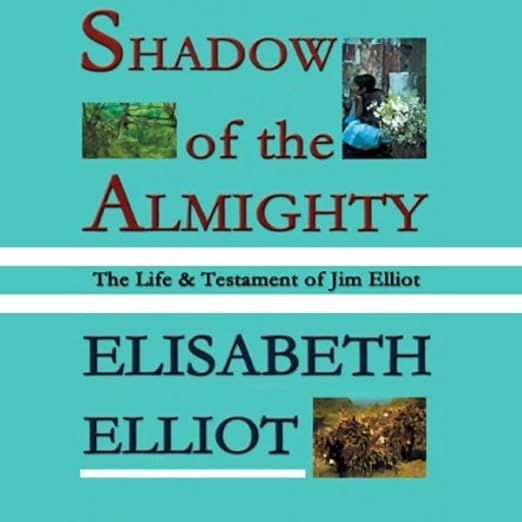
Elisabeth Elliot narrates this biography of her husband herself, and that fact alone makes this audiobook edition an artifact of unusual intimacy. She was twenty-nine when Jim was killed on the banks of the Curaray River in 1956. By the time this recording exists in the world, she has lived decades with what happened, returned to the very people who killed him, and written about him in a way that refuses to make him a legend. Listening to her read his journal entries, her voice controlled and unhurried, you feel the weight she has chosen to carry publicly so that others could meet the man she knew privately.
A Portrait Built from Journals, Not Legend
What separates Shadow of the Almighty from hagiography is that Elisabeth Elliot refuses to editorialize Jim Elliot into a symbol. She lets his own words do the work, drawing extensively from his personal journals and letters to build a portrait of a young man who was spiritually intense but also physically exuberant, academically rigorous, and capable of striking self-doubt. Jim was studying biblical Greek at Wheaton College and wrestling with questions about vocation that will feel familiar to anyone who has spent their twenties asking what they are supposed to do with a life. That ordinariness is what makes the trajectory so striking, and it is what keeps this from becoming the kind of missionary biography that exists only to be admired.
Reviewer Charlotte, who has read the book four or five times, put it simply: each time she walks away loving Christ more. That kind of testimony is not primarily about craft; it is about the material itself, and how faithfully Elisabeth assembled it. Jim’s prayer as a twenty-year-old, recorded in his journals and quoted by multiple reviewers, captures the spirit of the whole book: he did not ask for high station, only that his life would exhibit the value of knowing God. The biography becomes the evidence that his prayer was answered in ways he did not foresee and could not have controlled.
The Curaray Sequence and What Comes Before It
Most people who know anything about Jim Elliot know the ending. Five young missionaries, a strip of white sand on the Curaray River, the Auca people, and silence. Elisabeth Elliot does not withhold this or rush toward it. She builds methodically through Jim’s childhood, his college years, his discernment process, his courtship with Elisabeth herself, and his early years in Ecuador. By the time the Curaray sequence arrives, you have spent enough time inside Jim’s inner life to understand exactly what he understood about what he was walking into, and exactly what he was willing to risk and why.
One reviewer described feeling shocked at how abruptly the missionary expedition ended, how little contact was ultimately made with the Auca men for all the preparation involved. That abruptness is part of the point. Elisabeth Elliot is not interested in making the death cinematic. She is interested in making the life legible. The final pages are quiet in a way that is more devastating than any dramatic ending could be, and the eleven-hour runtime earns that quietness completely.
Hearing the Author Speak Her Own Loss
The particular power of this audiobook comes from the voice. Elisabeth Elliot narrates without theatrical inflection, which is exactly right for material this intimate. When she reads Jim’s most ardent journal passages about faith and mission, there is no sentimentality in her delivery, only a kind of earned clarity. She lived the aftermath. She returned to the Auca people with her daughter and the widow of another slain missionary. Her equanimity in this recording is not detachment. It is something harder to name and more instructive to witness.
The 11-hour and 26-minute runtime does not feel long. The devotional chapters that might seem slow in print flow naturally in audio because Elisabeth Elliot’s pacing is so deliberate and assured. This is one of those cases where a self-narrated audiobook is not merely adequate but is the definitive form of the text. No hired narrator could bring what she brings to these pages, because the loss described is hers and the faith described is hers, and that fact is audible in every sentence she reads.
Who Should Listen and Who Might Struggle
If you are a practicing Christian or have any interest in Christian history, missionary biography, or mid-twentieth-century evangelical culture, this audiobook belongs in your library. It works equally well for readers interested in biography as a literary form, since Elisabeth Elliot’s assembly of primary source material is genuinely skillful. If you approach religion purely as a sociological phenomenon rather than something you engage with personally, the devotional passages may feel opaque. The book does not argue for faith; it assumes it. That is not a flaw, but it is a reality worth knowing. Listeners who want a critical or external perspective on the Elliot story will need to supplement this with other sources. What Shadow of the Almighty offers is something rarer: a window into a life lived from the inside out, narrated by the person who knew it best.
Frequently Asked Questions
Does Elisabeth Elliot’s narration hold up over the full 11-hour runtime?
Yes. Her delivery is measured and unhurried, which suits the devotional nature of the material. She reads Jim’s journal entries with a quiet authority that no outside narrator could achieve. Some listeners may wish for more vocal variation, but most find her restraint deeply appropriate to the subject.
Is this audiobook accessible to listeners who are not Christian?
The book assumes faith rather than arguing for it, so non-religious listeners may find the devotional passages opaque. That said, the biographical storytelling, Jim’s intellectual curiosity, and the Curaray narrative have drawn secular readers who appreciate the book purely as an account of conviction and sacrifice.
How does this biography handle the Auca people and the ethics of missionary contact?
Elisabeth Elliot writes from within the worldview of the missionary project and does not engage with postcolonial critiques of that work. The Auca people appear largely as the context for Jim’s calling rather than as fully drawn subjects in their own right. Readers seeking that perspective will need additional sources.
Is this part of the Lives of Faith series, and does it matter for listening order?
It is listed under the Lives of Faith series but stands entirely on its own. No prior knowledge of the series or any other book is needed, and most listeners treat it as a standalone biography.