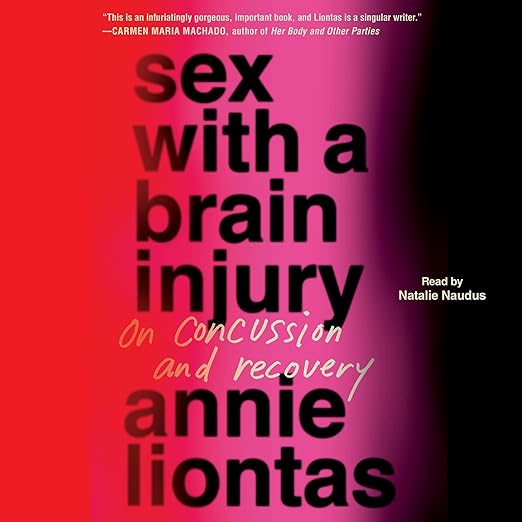
Recovery memoirs usually promise an arc, and the honest thing to say about this audiobook is that Annie Liontas declines to supply one. Sex with a Brain Injury spends nine hours and twenty-one minutes on essays that circle multiple concussions suffered in her thirties, a marriage under pressure, her own rage, and her mother's battle with addiction, and the circling is the method rather than a failure of it. Simon and Schuster Audio put the recording out in January 2024 with Natalie Naudus reading. Whether it works for you depends less on your interest in head trauma than on your patience for a book that keeps changing its angle of approach and refuses to announce when it has finished changing.
Each Piece Built to End on a Turn
Sharpest of the responses on file is the four-star one, filed on the release date in January 2024, which calls the essays a mixed bag: some clear and poignant, others as muddled as the cognitive effects of a concussion, perhaps reflecting the author's lived experience. That same response flags the title. Anyone arriving for a book about intimacy after head trauma gets something a great deal wider, and it says so without heat. Both observations are correct. Neither is fatal, in my reading, because the unevenness becomes legible as design once you accept that Liontas is writing from inside the impairment rather than from a recovered vantage point looking back on it. This is not a report filed after the fact.
What holds the collection together is not chronology but a habit of pulling outward. A passage about her own diagnosis sits next to Henry VIII and Harriet Tubman. A chapter about pain becomes a chapter about how the criminal justice system handles head injury, and about who gets believed when the damage does not show on a scan. The listing calls the result a memoir in essays, and the phrase earns its keep, since each piece is built to end on a turn rather than a summary. In audio those turns land as beats instead of the subheads you would have skimmed on a page. Nine hours is a long stretch with a hard subject, and the refusal to sit still is the main reason it never curdles into a case study.
Research That Stops an Appeal for Sympathy
Validation is what the February 2024 review describes, and it gives the clearest account of what this book does for the people it is about. That reader describes feeling validated after a run of injuries they themselves place in quotation marks as minor, and says the book reads as though someone had written their story for them. It is a narrow claim and a real one. Most writing about head trauma comes from clinicians or from families, and the gap Liontas fills is the account from inside, by someone still living in the aftermath rather than reporting on it from a safe distance. Nine hours of that is not repetitive. It is cumulative, and the difference matters.
Wider still is the claim in the March 2024 review, which argues the memoir suits not only people with head injuries but anyone trying to get through modern life, and calls the research meticulous without the prose turning clinical. I would put the same point differently. The research is what stops the personal material from becoming an appeal for sympathy. Liontas brings in history, philosophy and the legal record, and every excursion comes back to a body that still has to get through the afternoon. The Stonewall Israel Fishman Nonfiction Award sits on the listing beside a second prize, and both recognitions land in that register: this is argument as much as confession.
Not One Response Mentions Naudus by Name
Weigh the content load before you commit. The September 2024 review loves the book and still calls it hard going, because the overlap with that reviewer's own brain injury brought a great deal back to the surface. If you or someone in your household is living with post-concussion symptoms, take the warning at face value, and remember that audio removes the escape hatch of skimming ahead. Liontas also writes about her mother's addiction and about anger inside a marriage, so the difficult passages are not confined to the medical chapters. The structure gives you exits between essays. It gives you very few inside them, and a trial run on a single essay will tell you quickly whether the register suits you.
Two features of this listing deserve a mention. Not one written response mentions Natalie Naudus or the recording, which leaves the performance unassessed by the only people who have actually heard it; every one is phrased in the language of reading rather than listening. And the site files a prize-winning work of nonfiction under literature and fiction, alongside its memoir and LGBTQ tags. Neither point affects a word Liontas wrote. Both affect what you can find out before you hand over a credit, and the second is how a book like this ends up recommended from the wrong shelf entirely.
Able to Hold the Medicine, the Marriage, the Anger
Anyone who wants the injury set in a social frame will find their reviewer here: the August 2025 review praises the deep dive into brain injuries as fascinating, entertaining, and socially important to the justice system, which is an unusual trio of adjectives to earn at once. If the phrase walking wounded means something in your own life, or if you work in disability advocacy, queer health, or with people whose behavior has been read as character when it was neurology, the nine hours repay the time. Liontas writes for that listener without flattering them.
Skip it if you came for a protocol. Liontas offers no recovery plan, no supplement list, no timeline, and the book is openly suspicious of the notion that a new normal is somewhere you arrive on schedule. Skip it too if a fragmentary shape will frustrate you, because the essays vary in clarity on purpose and the audio format gives you no easy way to hunt down the clear ones. What is left is a memoir that treats a hidden injury as a public subject, and treats its listener as someone able to hold the medicine, the marriage and the anger in the same hour.
- Narrator: Natalie Naudus reads for Simon and Schuster Audio, a single voice carrying essays that swing between legal history and private rage.
- Subjects: Head injury and identity, queer inheritance, addiction, disability and the courts
- Tone: Raw, sharp, and deliberately unsettled
- Bottom line: A memoir that earns its unevenness, worth the nine hours if you want understanding rather than a recovery plan.