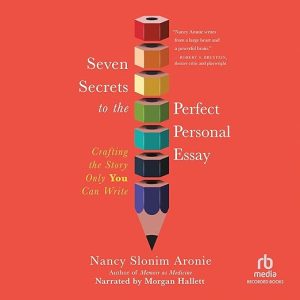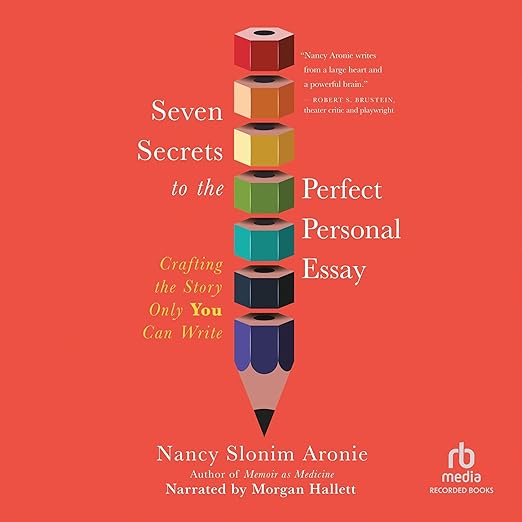
Nancy Slonim Aronie's Seven Secrets to the Perfect Personal Essay opens this audiobook with a writer who has spent decades helping people find their stories. That is not an abstraction. Aronie founded the Chilmark Writing Workshop on Martha's Vineyard, contributes weekly to her local paper, and leads writing groups that are, by reviewer account, genuinely popular. Her new guide to the personal essay builds on her earlier Memoir as Medicine and addresses specifically the shorter form, which has its own demands: you have less room to build, less time to earn trust, and less narrative runway before the reader decides whether to stay.
The audiobook format suits this material in ways I did not fully anticipate when I started listening. Personal essay instruction is, at its core, about voice, and hearing Aronie's principles in audio rather than reading them on the page adds a dimension that print cannot replicate. When she talks about the need to "kill 'em with the first line," the instruction carries differently when it arrives as a sentence from a narrator who herself has to justify your attention in the first seconds of an audio file. Morgan Hallett's narration creates exactly the kind of first-impression pressure that Aronie is describing.
Vulnerability as Craft, Beyond Simply Being Honest
The structure of the book, seven secrets organized around specific craft elements, is clear without being mechanical. Aronie addresses the hook, the deployment of direct quotes, the use of drama and vulnerability, the management of universal themes alongside personal specificity, and the role of self-reflection in moving a reader from interest to genuine investment. Each secret is illustrated with examples from her own essays and from those of contributors, including accounts of actor Tony Shalhoub's unlikely canine savior and Kate Taylor's collaboration with Peter Asher and Elton John in Los Angeles in 1970. These examples are not chosen for celebrity recognition; they are chosen because they demonstrate the principles in practice.
The discussion of vulnerability as a craft technique, rather than an emotional state the writer either has or lacks, is the most useful section for experienced writers who already understand the basic mechanics of essay structure. Aronie is interested in the specific techniques that create the impression of vulnerability on the page, which is a different question from simply advising writers to be honest. Being honest is necessary but not sufficient. The craft question is how you render honesty in a form that makes a stranger care about it, and Aronie addresses that question with more precision than most writing guides manage.
Hallett Reads Tangier 1969 Aloud to Prove It
The audiobook is the right format for this guide specifically because the examples are read aloud rather than presented as visual text. When Hallett reads through an essay excerpt that Aronie is using to illustrate a principle, you experience both the principle and its application in sequence, which is how good instruction actually works. One reviewer singled out the essay "TANGIER, 1969" as her favorite in the collection, calling it "edgy." Hearing a piece like that read by a skilled narrator, immediately after hearing Aronie explain what it is doing structurally, is a more efficient learning experience than alternating between instructional text and print examples.
Aronie also addresses the current moment directly, noting that in a culture "increasingly inundated with generic AI-generated text, a well-crafted personal narrative is more important than ever." That framing is not technological anxiety for its own sake; it is an observation about what the personal essay can do that no automated system can replicate, which is to create the specific texture of a particular human consciousness encountering particular events. The book's argument is that this capacity is worth developing, and the seven secrets are in service of that argument rather than merely procedural.
Aronie Skips the Motivational Case Entirely
This guide is oriented toward writers who are already motivated and who need craft instruction rather than motivation. Aronie's warmth and humor are consistent throughout the seven hours, but she does not spend significant time convincing you that writing your story matters. She assumes you already believe that and moves directly to how. Listeners who need the motivational case made first may find the pacing slightly brisk in the early sections.
The college admissions essay context mentioned in the subtitle may lead some listeners to expect a more tactical, application-focused guide. Aronie does address the college essay as one context where personal essays matter, but her primary interest is in the essay as an act of self-expression and human communication rather than as an admissions tool. The skills she teaches are applicable to college essays, but the book's soul is literary rather than strategic.
For Writers Who Bury Their Best Material
Writers at any level who want to develop their personal essay craft will find this audiobook useful. It is particularly well-suited to listeners who have been told that their writing is technically competent but emotionally distant, or who struggle with the opening paragraphs of personal pieces and tend to bury their most interesting material. The instruction is specific enough to be actionable, and the examples are strong enough to be genuinely aspirational. Listeners seeking a comprehensive writing guide covering fiction, structure, or genre beyond the personal essay should look at broader craft texts; Aronie is focused specifically on the short personal form and maintains that focus throughout.
- Narrator: Morgan Hallett reads with warmth that matches Aronie's own voice, sustaining the sense of a generous mentor talking directly to the listener.
- Subjects: The personal essay as declaration of humanity, vulnerability as craft technique, the hook as first obligation
- Tone: Warm and encouraging, with flashes of real wit and the occasional sharp observation about what makes writing fail
- Bottom line: Aronie's Seven Secrets audiobook works because the advice is specific enough to be actionable and the examples are strong enough to be genuinely instructive.
Questions Listeners Ask
How does Morgan Hallett's narration handle both the instructional content and the essay examples in the same audiobook?
Hallett uses the same warm, engaged register throughout, which unifies the listening experience rather than creating a tonal split between lecture and example. This suits Aronie's approach, which treats craft instruction and creative demonstration as part of the same conversation.
Is this audiobook appropriate for complete beginners to personal essay writing, or does it assume prior experience?
Aronie writes for motivated beginners as well as experienced writers looking to sharpen specific techniques. The guide starts with foundational principles and builds from there, so no prior experience with the personal essay form is required.