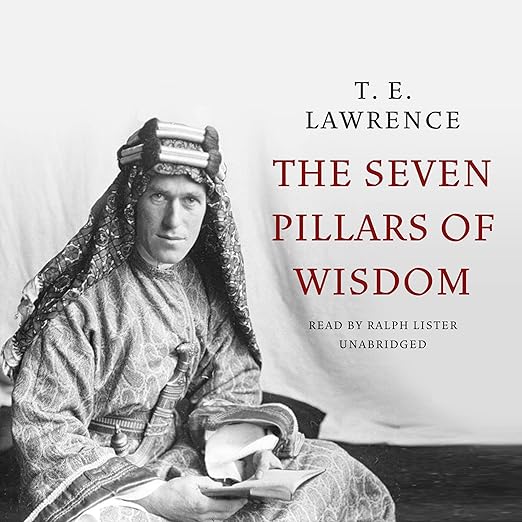
I started Seven Pillars of Wisdom during a week when I had committed to several long walks, the kind that require something to follow through two or three hours at a time. I needed something substantial and unhurried, something that would reward sustained attention rather than punish distraction. I chose Lawrence almost on impulse, having circled the book for years without quite committing, and within an hour I understood both why it commands such devotion and why it has also always been a difficult read: because T.E. Lawrence is simultaneously telling you about one of the most extraordinary military campaigns of the First World War and conducting a merciless examination of his own complicity, his own vanity, and his own doubt, and the two narratives press against each other across nearly eight hundred pages of dense, literary prose.
The facts of Lawrence's involvement in the Arab Revolt are remarkable enough on their own. As a young British intelligence officer and Oxford-educated Arabist, Lawrence found himself helping organize and lead a guerrilla campaign against Ottoman forces in support of Emir Faisal's Arab army, with the stated goal of liberating the Arab territories and establishing an independent Arab state. The revolt succeeded militarily. The political promises were never honored. Britain and France had already carved up the Middle East in the Sykes-Picot Agreement while Lawrence was in the desert fighting under banners he would later learn had been betrayed. That knowledge shapes everything about how this memoir is written.
Is Seven Pillars of Wisdom Worth Your Time?
Lawrence's prose is not easy, and the audiobook edition makes that plain from the opening pages. His sentences are long and elaborately constructed, his vocabulary draws on sources ranging from Arabic to medieval English, and his rhetorical registers shift dramatically - from spare battle journalism to lyrical landscape writing to almost philosophical meditation - sometimes within the same chapter. The book has been described, accurately, as simultaneously a travelogue, a philosophy treatise, and an action novel, and the difficulty of listening to it is inseparable from those ambitions. Lawrence was not trying to write a clear, accessible account of what happened. He was trying to write a book worthy of the experience, and whether he succeeded is a question readers have been arguing about for a century.
What the memoir does with unmistakable brilliance is capture the moral contradictions of the campaign. Lawrence was genuinely committed to the Arab cause; he was also an agent of an imperial power that was never going to honor the commitments he was implicitly making. He knew this, and the knowledge is encoded in the prose's peculiar quality of simultaneous pride and shame. The famous passage where he describes what it felt like to lead men into battle knowing that their ultimate political goal had already been sold is one of the most searing things in modern memoir literature. Winston Churchill's description of this book as unsurpassable as a narrative of war and adventure undersells it; it is as much about the impossibility of clean hands as about the adventure itself.
The Best Parts of Seven Pillars of Wisdom
Ralph Lister's narration is, in a word, essential. This is a book that could be defeated by a narrator who can't navigate the archaic sentence structures, the long philosophical digressions, or the sheer range of tonal registers. Lister handles all of it with a quality that is hard to precisely name but easy to recognize: he understands what Lawrence is doing in a given passage and reads accordingly. The battle sequences have propulsive energy; the meditative sections breathe properly; the passages where Lawrence is essentially confessing his own moral failures have the quality of someone telling the truth reluctantly. This is the kind of narration that makes a demanding text accessible without simplifying it.
Twenty-seven hours and forty-two minutes is a genuine commitment, and it needs to be said plainly: this is not casual listening. Lawrence does not carry momentum the way genre fiction does. There are stretches where the strategic detail accumulates and the reader must trust that the architecture of the campaign will become clear, which it does, eventually. But listeners who want consistent narrative propulsion will find the experience uneven. This is a book for people who read difficult things because the difficulty is part of the point.
Before You Commit to Seven Pillars of Wisdom
The prose style that Lawrence uses - part Victorian periodic sentence, part modernist experiment - is genuinely demanding in audio. Some passages that work on the page, where the eye can circle back, require careful attention when heard sequentially. Long listeners should expect to occasionally lose the thread of a sentence and have to follow its logic to the end rather than rereading it. The political context is also dense; a brief reading of a historical overview of the Arab Revolt and the Sykes-Picot Agreement before beginning will significantly improve comprehension of why certain events carry the emotional weight they do.
Who Should Pick Up Seven Pillars of Wisdom
This is for readers who want a primary source experience of one of the most consequential campaigns of the First World War, told by someone with a literary gift equal to the subject's complexity. It's for anyone interested in the origins of modern Middle Eastern politics, in the mechanics of guerrilla warfare, or in the specific texture of British imperial ideology at the moment it began to crack. It is not for listeners who want accessible popular history or a straightforward military narrative. Lawrence demands literary engagement, and what he gives in return - a portrait of a man trying to account honestly for what he did and what it cost - is among the most remarkable things the memoir form has produced.
Common Questions
Is Seven Pillars of Wisdom accurate as a historical account, or should it be read as memoir with caveats?
It is both memoir and deliberate literary construction. Lawrence was known to reshape events for narrative effect, and his portrayal of himself and others has been contested by historians. It should be read as one extraordinary participant's account, not as objective history. Pairing it with a scholarly history of the Arab Revolt will add useful context.
How does Ralph Lister's narration handle Lawrence's demanding prose style?
Exceptionally well. Lister navigates the archaic sentence structures, the philosophical digressions, and the shifting tonal registers with clear understanding of what Lawrence is doing in each passage. It's one of those narrations that makes a difficult text genuinely listenable.
At nearly twenty-eight hours, is the length justified, or does the book overstay its welcome?
The length is inherent to Lawrence's ambitions. He is not just narrating a campaign; he is accounting for a complex moral and political experience across two years. Listeners who engage with the book on its own terms find the length feels earned. Those expecting a tighter military narrative may find it padded.