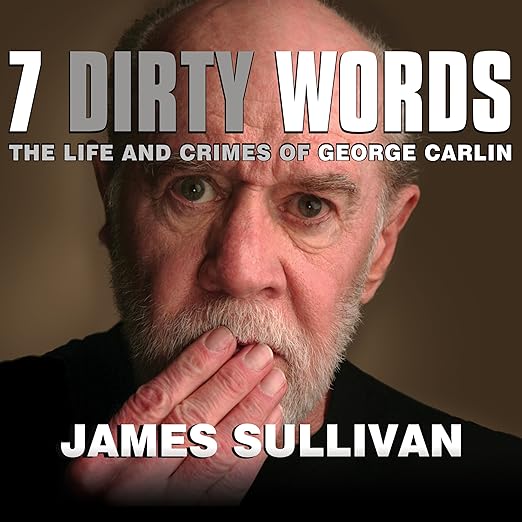
Quick Take
- Narration: Alan Sklar delivers this cultural biography with measured journalistic authority, he keeps the register analytical rather than performative, which is the right call for a critical study rather than a comedy recording.
- Themes: Censorship and free speech, comedy as counterculture, the making of an American satirist
- Mood: Thoughtful and historically grounded with genuine comic texture
- Verdict: The best critical biography of George Carlin available in audio, essential for fans wanting to understand the work’s place in American culture rather than just experience it.
I was halfway through my second cup of coffee on a weekday morning when I realized I had been sitting with this book for two hours without checking my phone once. Seven Dirty Words is not a comedy recording. It is a cultural biography, and James Sullivan approaches his subject with the rigor of a serious journalist who also clearly loves what he is writing about. That combination is rarer than it should be, and the result is a book that sits comfortably alongside Carlin’s own work rather than merely describing it from a respectful distance.
The title comes from the 1972 routine that led to a Supreme Court case on broadcast indecency, which is as good a frame as any for a biography whose central argument is that George Carlin was less a comedian than a philosopher who happened to work in the form of stand-up. Sullivan traces that argument across decades, from Carlin’s early days as a conventional entertainer who wore a suit and worked the same rooms as his contemporaries, through his transformation in the late 1960s and early 1970s into the subversive voice of a counterculture that was looking for exactly what he was offering.
Sullivan’s Strategic Choice and Why It Works
Reviewer Kindle Customer identified the book’s sharpest strength: Sullivan decides not to replicate Carlin’s comedy in his own prose. This is the right choice and not an obvious one. A lesser biographer might have tried to match the subject’s voice, producing something that reads like a pale imitation. Instead, Sullivan writes with the clarity of a journalist tracking the cultural contexts that made Carlin’s specific interventions possible. When he describes the Seven Dirty Words ruling, he gives you the legal history and the cultural stakes without making you feel you are reading a law review. When he traces Carlin’s cocaine years and their effect on the work, he treats the material as biography rather than spectacle.
The book’s scope is genuinely ambitious. Sullivan is writing the story of Alternative America from the 1950s to roughly 2008 as seen from Carlin’s position within it, which means the biography is also a history of how American comedy understood itself during a period of radical cultural transformation. Carlin becomes a tuning fork for the era: where he was and what he was saying tells you something real about where the culture was and what it needed to hear.
The Later Career and the Elder Statesman Problem
One of the more interesting sections deals with Carlin’s renaissance in the 1990s, when a younger generation of comedians began treating him as a founding figure and his work found audiences his original peers could not have imagined. Sullivan tracks how this happened without sentimentalizing it: Carlin’s late period is both a genuine artistic achievement and a product of specific cultural conditions of the 1990s, when transgression was newly marketable in ways it had not been in the 1970s. The elder statesman dynamic is complicated, and Sullivan is honest about the complications.
Reviewer Thomas Luneburg noted that the biography is lacking depth in certain areas, particularly around Carlin’s personal life, and that assessment is fair. Sullivan is primarily interested in the work and its cultural context, and the domestic details are thinner than some readers want. But this is a critical biography, not a comprehensive personal account, and within its declared scope it is thorough and carefully argued. If you want the interior family life, Kelly Carlin’s memoir A Carlin Home Companion fills that gap in ways this book does not attempt.
Sklar’s Performance and the Audiobook Register
Alan Sklar has narrated a substantial amount of nonfiction, and his approach here suits the material well. He reads Sullivan’s prose with clarity and appropriate register, letting the writing do the work rather than adding extra performance. For a book that is primarily analytical rather than dramatic, this restraint is the right instinct. There are moments where Carlin’s routines are quoted at length, and Sklar handles these with intelligence: he is not doing an impression, he is delivering text, and the distinction matters for a book arguing about the work rather than reproducing it.
At 10 hours and 17 minutes, the audiobook is a satisfying length for the material. It does not rush the cultural history or shortchange the later career, and it ends with a sense of completeness that the subject’s death in 2008, which falls within the book’s timeframe, provides with appropriate weight. The 4.2 rating across 88 reviews represents a genuinely engaged readership that takes the cultural argument seriously.
Frequently Asked Questions
Does Seven Dirty Words work as a standalone listen, or do I need to know Carlin’s routines well first?
Sullivan provides enough context for listeners new to Carlin’s work, but familiarity significantly enriches the experience. Reviewer J. Gill noted it works as a great introduction, while Carlin fans find it functions as a companion piece to the stand-up itself. Both entry points are valid.
How does this book compare to Kelly Carlin’s memoir A Carlin Home Companion as a way to understand George Carlin?
Sullivan’s biography is primarily interested in the work and its cultural context, while Kelly Carlin’s memoir focuses on the private family life. They complement each other directly: Sullivan tells you about the comedian, Kelly tells you about the father. Reading both gives a much fuller picture than either alone.
Does the book engage with the Supreme Court case about the Seven Dirty Words routine?
Yes. The FCC v. Pacifica case is central to Sullivan’s framing of Carlin’s cultural significance, and the book treats it as both a legal event and a marker of how comedy can function as a genuine challenge to institutional power. The title is drawn directly from this episode.
Is Alan Sklar’s narration appropriate given that the book quotes Carlin’s routines extensively?
Sklar reads the quotations as text rather than performance, which is the right choice for a critical biography. He is not attempting to impersonate Carlin, and listeners should not expect or want him to. The material is analytical, and the narration serves the analytical register throughout.