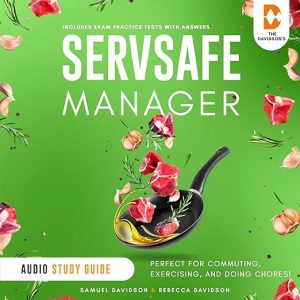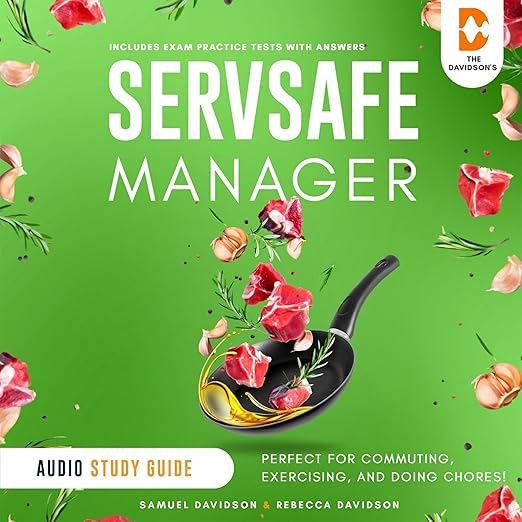
Restaurant managers chasing a ServSafe certification are the entire reason this audiobook exists, and narrator Brennan Koenigsreuter treats the material with exactly the straightforward clarity that compliance-driven content needs. The ServSafe Manager Study Guide covers the full syllabus a working food-safety exam actually tests: foodborne illness and contamination, the time-and-temperature danger zone, cross-contamination and allergen management, cleaning and sanitizing procedures, personal hygiene protocols, FDA Food Code standards, HACCP systems, and the managerial responsibilities that come with running a compliant kitchen. At nine hours and twenty-one minutes, it's a genuinely complete pass through the material, not a highlight reel.
This is produced by Davidsons Audiobooks, and the pitch leans hard on the idea that sound itself, described in the synopsis as 'energy, frequency, and vibration', helps lock in retention better than silent reading, especially while commuting, cleaning, or working out. That's a big claim dressed in scientific-sounding language, and it's worth treating skeptically even while acknowledging the underlying, much older idea, that repetition and audio review genuinely help exam prep, is basically sound.
The actual content coverage is comprehensive rather than superficial. Cross-contamination and allergen management, an area where a lot of shorter food-safety guides go thin, gets real attention here, as does the more procedural material on training staff and handling an actual food recall, the kind of managerial content that separates a ServSafe Manager credential from a basic food handler card. The audiobook clearly understands what the exam is actually testing, not just the general subject area around it.
Realistic exam-style questions paired with audio-based answer explanations round out the structure, which matters for a study guide specifically: passive listening alone rarely builds exam fluency, but hearing a question, attempting an answer, and then hearing the explanation replicates active recall reasonably well, even without a visual test in front of you. That structure is the difference between a study guide and a straight lecture, and this one commits to it fully across the runtime.
The stakes behind this specific certification are worth naming plainly. A ServSafe Manager credential is often a genuine requirement, not just a resume line, for anyone running a commercial kitchen in many US jurisdictions, and food safety failures carry consequences that range from a failed health inspection to real foodborne illness outbreaks traced back to a specific restaurant. That real-world weight is part of why the audiobook's exam-question structure matters so much: this isn't trivia, it's the material a working manager needs to actually retain under pressure, not just recognize on a multiple-choice test.
HACCP Traces Back to NASA's Space Program
Brennan Koenigsreuter's narration stays in the right register throughout: clear, unhurried, treating dense regulatory material, FDA Food Code standards, HACCP checkpoints, with the same measured pace regardless of how dry a given section is on paper. That consistency matters more than charisma for a study guide; a listener needs to trust that important material isn't getting rushed just because it's less exciting than, say, the foodborne illness chapter.
The commute-and-multitask framing genuinely fits how a working restaurant manager actually studies. Nobody preparing for a ServSafe exam while running a kitchen has hours of uninterrupted desk time, and a nine-hour audio guide that can be absorbed across a week of commutes, prep shifts, or gym sessions solves a real scheduling problem that a traditional print study guide doesn't address nearly as well.
The current rating, a perfect five stars across fifty ratings, is a meaningfully strong signal for a niche exam-prep title, even without individual written reviews attached yet to unpack the specifics. Certification study guides live or die on whether they actually match what the real exam covers, and a perfect early rating suggests this one is doing that job for the people who have used it so far.
HACCP, the Hazard Analysis and Critical Control Points system referenced throughout, is itself a decades-old food-safety framework originally developed for NASA's space program before becoming standard practice across the American food service industry, and the audiobook's decision to build an entire section around it signals a level of seriousness beyond a bare-minimum exam cram. Understanding HACCP's actual logic, identifying critical control points before contamination happens rather than reacting after the fact, is arguably more valuable to a working manager long after the exam itself is passed.
Energy and Vibration Claims Deserve Some Skepticism
The marketing language built around 'energy, frequency, and vibration' deserves a skeptical ear. The synopsis leans on the phrase 'research has shown' without citing a specific study, and listeners should understand that what's actually happening is straightforward audio-based spaced repetition, a genuinely useful study technique, dressed in language that oversells its novelty. Don't let the framing distract from the more mundane truth: this works because repetition and active-recall questions work, not because of anything mystical about sound waves.
No individual written reviews are attached to this listing yet, which means a prospective buyer is relying on the perfect rating average and the Davidsons Audiobooks track record rather than detailed listener testimony about which sections landed best. For a certification exam where passing genuinely affects someone's job and their employer's compliance standing, that's worth factoring in before treating this as a sole source of preparation rather than one part of a broader study plan.
Food-safety regulation also shifts over time in ways a fixed audio recording cannot. Local health department requirements and even the underlying FDA Food Code get periodically revised, so managers using this to prepare for an exam scheduled well after purchase should double-check that the covered material still matches the current version of the ServSafe Manager exam blueprint before relying on it exclusively.
Restaurant Managers Get an Audiobook Fit for Shift Work
Working restaurant managers, culinary professionals, and hospitality leaders actively studying for the ServSafe Manager Exam are the exact intended audience, and the audiobook format solves a real problem for people without much dedicated study time outside of shift work.
It's also useful for anyone managing food-safety compliance more broadly, even without an immediate exam date, since the coverage of HACCP systems, allergen management, and inspection readiness has value independent of the certification test itself.
Culinary students working toward their first management-track certification, not just current working managers, are also a natural fit, since the material assumes no prior food-safety credential and builds systematically from foundational concepts through exam-specific practice questions.
A specific credibility gap is worth flagging plainly: pair this with the official ServSafe materials rather than relying on it alone, since third-party study guides, however well produced, are not a substitute for the certifying body's own current exam content, and food-safety regulations do shift over time in ways an audiobook can't update itself to reflect.
Questions Listeners Ask
Can this audiobook replace official ServSafe study materials?
It should not, on its own. Treat it as a strong companion to the certifying body's own current exam content rather than a sole source of preparation, since food-safety regulations do shift over time.
Is the ServSafe Manager Study Guide audiobook useful for people not studying for the exam?
Yes, to a degree. Anyone managing food-safety compliance day to day will find the HACCP and allergen-management coverage useful independent of the certification test itself.