Quick Take
- Narration: Fugelsang reads his own work with the timing of a seasoned stand-up comedian, the delivery is sharp, warm, and entirely in command of when to let a joke breathe.
- Themes: Christian nationalism and scripture, the gap between Jesus’s teachings and political Christianity, practical counter-argument
- Mood: Irreverent and pointed, but genuinely compassionate underneath the sarcasm
- Verdict: A scripture-grounded, politically sharp takedown of far-right Christianity that works both as polemic and as a practical debate guide.
I was driving back from a long weekend when I started this one, somewhere around the third hour of an otherwise uneventful stretch of highway. Fugelsang opens with a joke and then immediately cites chapter and verse, and I remember thinking: this is either going to be the most entertaining biblical exegesis I have ever heard or a disaster. It turned out to be the former.
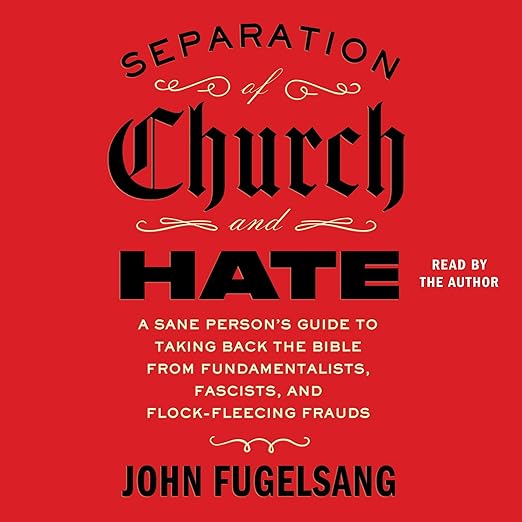
Separation of Church and Hate won the 2026 Audie Award for Nonfiction, and the recognition is deserved, not because the book is faultless, but because it does something genuinely rare: it makes theological argument funny without making it glib. Fugelsang’s background is specific and significant. He is the son of a former Catholic nun and a Franciscan brother, which means his relationship to Christianity is not the hostile outsider’s impatience but the disappointed insider’s grief. That distinction runs through everything he writes here.
Our Take on Separation of Church and Hate
The premise is straightforward: far-right Christian nationalism consistently weaponizes scripture in ways that are historically, contextually, and textually inaccurate. Fugelsang goes through the most common flash-point issues, covering abortion, immigration, and LGBTQ rights, and pulls the specific verses that fundamentalists cite, then traces their actual etymology and cultural context. His conclusion, repeated through various formulations, is that the extremists are not following Jesus. They are using the name of Jesus to do something Jesus specifically and repeatedly argued against.
The jacket copy invokes George Carlin and Christopher Hitchens, but the comparison undersells one important difference: Fugelsang is not an atheist making the case that religion is false. He is a believer making the case that a particular political movement has hijacked the faith he grew up in. That internal position gives the argument a different quality, less triumphant, more personally wounded, and therefore more persuasive to the readers who most need to hear it.
Why Listen to Separation of Church and Hate
The most practically useful section is the debate guide, which offers specific talking points drawn directly from the Bible that counter the most common fundamentalist arguments. Multiple reviewers note they returned to these sections repeatedly, using them in actual conversations with family members or coworkers. Fugelsang narrating his own material is essential to the experience. His comedy timing means the jokes land when they are supposed to, and the moments of genuine sorrow about Christianity’s trajectory land just as cleanly.
What to Watch For in Separation of Church and Hate
One four-star reviewer makes a fair point worth acknowledging: when Fugelsang cites scripture that supports his own position, he quotes it and moves on without applying the same contextual scrutiny he uses on the verses he is debunking. It is a mild inconsistency in an otherwise tightly argued book, and worth keeping in mind if you come to this as serious theological inquiry rather than a polemical rallying cry. The book is both, and it is more effective at the latter.
Who Should Listen to Separation of Church and Hate
This is for people who grew up Christian and have watched political Christianity become unrecognizable, for atheists who want to argue more effectively with religious relatives, for progressives who want scriptural rather than merely moral counter-arguments, and for anyone who has ever been told that a specific political position is what Jesus requires. Those looking for a balanced academic treatment of Christian political thought will want to look elsewhere. Fugelsang is on a side and is not pretending otherwise, and that transparency is part of what makes the book work.
What makes this audiobook format in particular worthwhile is the timing. Fugelsang’s background in comedy means he knows how to pace an argument, when to slow down for a serious point and when to let the absurdity land. The Bible passages he selects are quoted directly and then unpacked with both textual context and the kind of lived frustration that separates this from a purely academic exercise. Listeners who have tried to have these conversations with family members and run out of language will find something useful here, not just a set of arguments but a model for how to hold those arguments with both rigor and warmth.
Frequently Asked Questions
Do you need to be Christian to appreciate this audiobook?
No. Fugelsang explicitly addresses believers, agnostics, atheists, and anyone who has had to navigate conversations with Christian nationalists. The arguments are designed to be accessible regardless of personal faith, and the humor works independently of theological investment.
Does Fugelsang go after Christianity as a whole or specifically Christian nationalism?
Specifically Christian nationalism and the far-right political use of scripture. The book’s central argument is that these political movements have distorted and betrayed Christian teaching, not that Christianity itself is invalid. Fugelsang makes clear he is defending what he considers true Christianity against its political hijacking.
How practical is the debate guide portion, can you actually use these arguments in conversations?
Several reviewers report doing exactly that. The arguments are scripture-based rather than purely philosophical, which means they operate on the same textual ground as the fundamentalist positions they counter. Whether they change anyone’s mind depends on the specific conversation, but the material is genuinely usable.
Is this a good listen if you already agree with Fugelsang’s politics?
Yes, but with one caveat. A four-star reviewer who largely agreed with the arguments found the book somewhat less thorough than expected, specifically noting that Fugelsang applies less contextual scrutiny to verses that support his own views. If you want rigorous hermeneutics, manage expectations. If you want an energizing and well-argued rallying cry, this delivers.