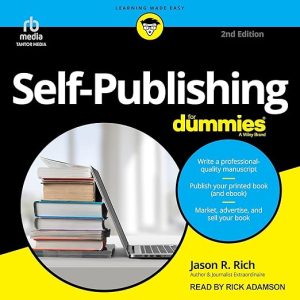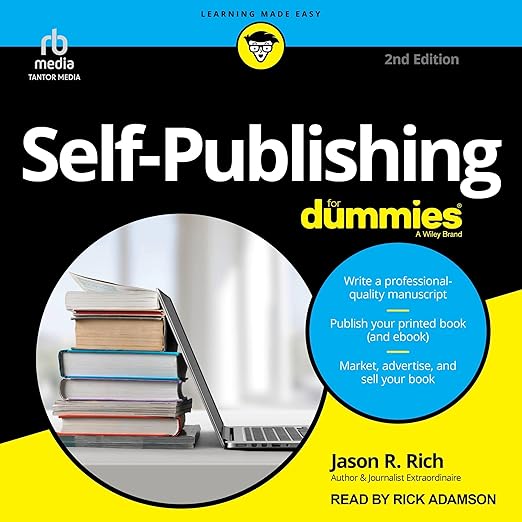
Jason R. Rich's Self-Publishing for Dummies, 2nd Edition arrives as an audiobook at a moment when the self-publishing industry has genuinely transformed what it means to be an author. Rick Adamson narrates sixteen hours and twenty-two minutes of practical instruction covering everything from manuscript preparation through distribution strategy and marketing, and the updated edition specifically addresses the technologies and trends that were not fully formed when earlier guides were written. The Dummies format has a specific reputation in the market for comprehensive, accessible, no-agent-required guides, and Rich's publishing entry lives up to that reputation by treating the entire process as a learnable craft rather than a mystery that traditional gatekeepers have sole access to.
Writing First, Platforms and Pricing Later
The structural intelligence of this audiobook is the way it mirrors the actual sequence of decisions a self-publishing author needs to make. Rich begins with writing and editing, not with platforms or pricing, which correctly identifies the creative foundation as the prerequisite for everything else. He then moves through cover design, printing and ebook formatting options, obtaining an ISBN, hiring an editor, building distribution channels, and developing a marketing approach for a target audience. Each section is positioned so that the logic of the sequence is apparent, which matters enormously for listeners who are new to the process and trying to understand not just what to do but why to do it in this particular order.
The second edition's updates are meaningful. The ebook market has matured and fragmented since the early self-publishing guides were written, and Rich addresses current platform realities and marketing techniques that reflect how readers actually discover and purchase independent titles in the present environment. This is the core justification for the updated edition over its predecessor, and it delivers on that promise with content that does not feel dated or anchored to industry conditions that no longer apply. One reviewer called the book a comprehensive publication that covers the entire process from A to Z, and that description accurately represents both the ambition and the execution. Another described it as invaluable as a reference, noting that the depth allows you to pick and choose your path through the content based on where you are in the process.
Adamson Chooses Clarity Over Charisma
Rick Adamson's narration suits this material precisely. He reads with authority and precision, which is what listeners need from instructional content: clarity over performance, accuracy over charisma. The Dummies series format lends itself to audio better than many assume, because the structure of the series, clear headers, defined steps, consistent terminology, provides an organizational scaffold that makes the audio version easy to follow without the visual cues of print. Adamson works within that scaffold competently, signaling transitions between topics without the narration feeling mechanical.
At sixteen hours and twenty-two minutes, this is a substantial commitment. But the comprehensive scope is precisely the selling point. This is a guide you consult repeatedly as your publishing project develops, not a narrative you consume once and file away. The chapter structure supports exactly that kind of modular return, making it genuinely useful across multiple stages of a writing and publishing project. The marketing sections in particular repay revisiting once you have a finished manuscript and are looking at specific distribution platforms, because the advice reads differently when you are actually making the decisions rather than preparing for them theoretically.
Platform Details Age Faster Than the Runtime
The audiobook format creates a genuine challenge for content that relies on specific platform interfaces, pricing structures, and technical specifications. These details change faster than publishing cycles, and some of the more granular operational information in this edition may become dated. Rich and the Dummies format generally anticipate this by focusing on principles and process rather than specific button-click instructions, but listeners who need precise, current platform guidance will want to supplement the audiobook with current documentation from the specific distribution and publishing services they plan to use.
The sixteen-hour runtime also means this is not an audiobook for casual listening. The density of the content requires active engagement; listeners who treat it as background audio will retain very little of practical use. The most effective approach is to listen to sections relevant to your current stage in the publishing process, pause to take notes or implement what you have learned, and then return for the next section. The chapter structure supports this kind of modular engagement far better than a linear end-to-end listen would produce in terms of retained, actionable knowledge.
Near-Completion Writers Want the Full Landscape
This audiobook is the right starting point for writers who have completed or are near-completing a manuscript and want to understand the full landscape of independent publishing before committing to specific platforms or services. It is also valuable for writers who attempted self-publishing with a previous title and ran into specific gaps in their understanding of editing, distribution, or marketing that they want to fill. Those who are already publishing successfully and have established systems will not find much new information here, but the comprehensive framing may still be useful for identifying areas where their current process has room for optimization. Writers who want a guide that covers both ebook and print formats equally will find this audiobook more balanced in its treatment of both channels than many self-publishing resources that default heavily to one format over the other. That even-handed coverage is one of the stronger arguments for choosing this guide over narrower alternatives.
At 16 hours, how should I structure my listening to get the most practical value from this audiobook?
The most effective approach is to listen in stages that parallel your actual publishing process. If your manuscript is nearly ready, start with the editing and cover design sections. Move to distribution and marketing as those decisions become relevant. The chapter structure is designed to support modular return visits rather than requiring a single end-to-end listen.
Does the Self-Publishing for Dummies, 2nd Edition audiobook discuss building an author platform and social media marketing?
Yes. The marketing chapters address both traditional and digital approaches, including online marketing techniques and building an audience. The updated edition specifically incorporates current online marketing strategies that were either absent or underdeveloped in earlier self-publishing guides.