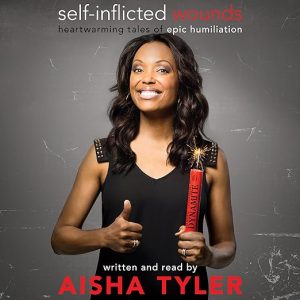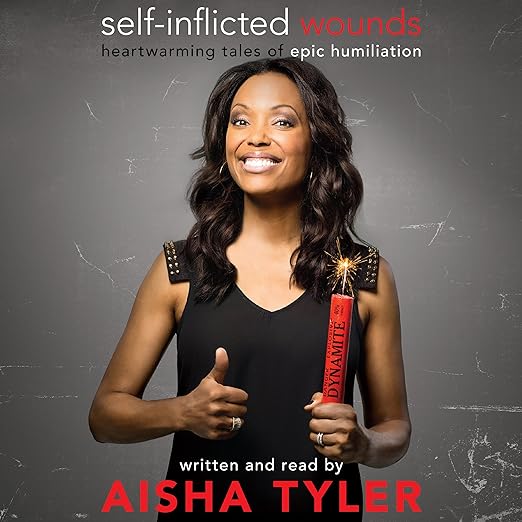
- Performance: Aisha Tyler narrating her own work is the whole argument for this audiobook's existence, her comic timing and self-aware delivery are inseparable from what makes the essays work.
- What it covers: Spectacular personal failure, humor as resilience, the education of a life told through its worst moments
- Feel: Laugh-out-loud and unexpectedly tender, with a warm undercurrent of genuine honesty
- Our call: Tyler's author narration transforms a collection of mortifying essays into something genuinely alive, this is the format the material was born for.
I came to Self-Inflicted Wounds having spent a long weekend in a particularly self-serious corner of literary nonfiction, and what I needed was someone who had done objectively terrible things to themselves and found a way to make that funny without making it false. Aisha Tyler delivered. I listened to the first two essays at home, laughed until my neighbor knocked on the wall, and finished the remaining ones during an overnight train journey where I had to keep suppressing audible reactions out of consideration for the people sleeping around me.
Tyler was already a working comedian, actress, and podcast host, the Girl on Guy podcast had a devoted following before this book came out, and the essays in Self-Inflicted Wounds read like the print extension of that sensibility. The premise is straightforward: Tyler catalogs a series of humiliations and disasters that were, in each case, entirely her own fault. Not bad luck. Not other people's cruelty. Her fault, chosen, executed, and survived.
A Closer Look at Self-Inflicted Wounds
The genre of the comic humiliation memoir is well-trafficked enough that it takes a specific kind of voice to make it feel necessary rather than formulaic. Tyler has that voice. What distinguishes her from the self-deprecating tradition that can curdle into either false modesty or competitive victimhood is that her essays are genuinely analytic. She's not just recounting disasters for the laugh, she's examining what it reveals about how she makes decisions, what she was hoping for, and what she learned that she couldn't have learned any other way. One reviewer described her as walking the line perfectly between charming and horrifying, and that's the right observation: the essays are funny because they're specific and honest, not because they've been softened into palatability.
The standalone essay format works particularly well in audio. Each chapter is its own complete disaster arc, a mistake made, consequences managed, lessons extracted. There's no through-line you need to track, no characters to remember across chapters. You can dip in and out, or listen straight through, and either approach works. The chapter-by-chapter structure also means that if a particular essay's subject matter isn't clicking for you, the next one is its own fresh start.
What Makes Self-Inflicted Wounds Worth Hearing
Tyler narrating her own work is not a bonus feature here, it's the essential version. The comic timing embedded in these essays, the self-aware pauses, the delivery of a punchline that has been constructed across an entire paragraph, all of it requires Tyler's voice to land the way she intended. Reading these essays on the page without her performance would be like reading a stand-up special's transcript instead of watching it. The material is inseparable from the performance.
One reviewer noted that Tyler is erudite in a way that surprised them, and that quality comes through clearly in the audio. She moves between profane and precise with a comfort that suggests someone who has read widely and thought carefully, not someone performing intelligence. The Guy on Girl podcast community will find the book an extension of what they already love; listeners encountering Tyler for the first time will understand immediately why she has such a devoted audience.
Things to Know Before Starting Self-Inflicted Wounds
The book has a relatively modest runtime, just under seven hours, and the essay format means the emotional register stays fairly consistent throughout. Some listeners may find that after two or three essays, they have a complete sense of what the collection is doing and whether it works for them. Tyler doesn't significantly expand or deepen the project across its full length; she executes the same mode across different subject matter.
The essays also read on the profane side, as one reviewer noted. Tyler's comedy voice uses language freely, and the frankness extends to sexual, professional, and personal content that isn't particularly graphic but is definitely adult in orientation. If that framing doesn't suit you, the book will feel alienating quickly.
Who Aisha Tyler Is Writing For
Listen if you enjoy comedian-written essay collections in the tradition of Tina Fey's Bossypants or Mindy Kaling's Is Everyone Hanging Out Without Me, Tyler occupies similar territory, with her own specific flavor of erudite self-destruction. This is also the ideal format for listeners who want something that works well for commutes or travel, where the short, complete essay structure accommodates natural interruptions.
Skip it if you want sustained narrative or thematic development across a full-length book. This is a collection of essays, not a memoir with an arc, the individual pieces are strong, but there's no cumulative emotional journey pulling you through from opening to close.
Good to Know
Does the audiobook work for listeners who aren't already familiar with Aisha Tyler's comedy work?
Yes, though familiarity with her sensibility will heighten the experience. Tyler's voice and perspective are established clearly within the first essay, and the book doesn't require prior acquaintance with her standup, the Girl on Guy podcast, or her television work to be fully enjoyable.
Is Self-Inflicted Wounds more comedy than memoir, or does it have genuine emotional depth?
Both, in roughly equal measure. Tyler uses humor as the primary register, but several essays move into genuinely reflective territory about decisions, ambition, and the gap between what we hope for and what we actually do. The emotional honesty underneath the comedy is what keeps the collection from feeling like a performance without substance.
Is the content appropriate for sensitive listeners, given its description as sometimes brutally honest?
The honesty is frank rather than traumatic. The content skews adult, profane language, sexual situations described with humor, professional and personal failures described in specific detail, but nothing in the book is designed to disturb or upset. Listeners who are comfortable with adult comedy memoir will find the content well within their range.