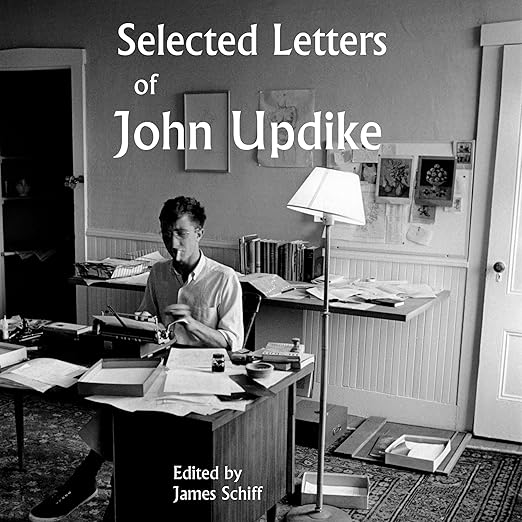
John Updike needed to write the way the rest of us need to breathe or eat. That observation, from editor James Schiff's introduction to the Selected Letters, is the lens through which 43 hours and 33 minutes of correspondence becomes not just literary biography but something more strange and more intimate: a man's mind, in motion, across six decades. This audiobook, narrated by Miranda Updike, who is the writer's granddaughter, is one of the more remarkable listening experiences in recent literary nonfiction, not because the letters themselves are revelatory in any single dramatic way, but because their accumulation is.
The verdict-first framing is warranted here: the audio edition of the Selected Letters is not a redundant format choice. It is the format. Schiff describes Updike's letter writing as not an adjunct to but rather an integral part of his astonishing literary output, and hearing these letters read aloud by someone who carries a biological and cultural inheritance from the man who wrote them transforms the experience of reading them. Miranda Updike does not perform her grandfather's voice; she reads it. The distinction is everything. There is a restraint in her narration that honors the letters' intimacy without pretending to an authority she cannot have, and that restraint, precisely because it does not try to replicate him, allows the letters themselves to speak.
The Love Letters to Mary, Honestly Accounted
The arc of the correspondence that Schiff has assembled begins with Updike barely a teenager, already submitting poems and cartoons to national magazines and writing flattering letters to famous cartoonists requesting drawings. The child who writes those letters is already fully himself: ambitious, charming, conscious of the impression he is making. By the time Updike is at Harvard writing more than 150 witty, substantive letters to his parents, the writer who would eventually produce the Rabbit tetralogy and decades of New Yorker essays is already present in compressed form, waiting for the material of a life to accumulate around him.
The love letters to Mary, his first wife, are the collection's most surprising material. Updike's public reputation was built partly on fiction that explores infidelity and desire with unusual frankness, and those themes in the letters, the ardent early feeling, the eventual heartbreak of the marriage's end, the honestly accounted breakup that Schiff describes, give the correspondence a texture that purely literary letters do not carry. He is not writing for posterity in these sections. He is writing because he cannot not write, and the emotional nakedness of the domestic letters against the professional fluency of his New Yorker correspondence creates the book's central contrast.
A Reviewer Called It Updike Unleashed
The reviewer who described this collection as a treasure trove and another who called it Updike Unleashed are responding to something real: the Selected Letters shows the writer in a mode that even his most confessional fiction does not quite replicate. In fiction, Updike controlled everything, including the distance between himself and his material. In letters, the control is present but permeable. The comic observations come out; the petty irritations come out; the genuine warmth for friends and family and the obsessive interest in his own craft come out without the mediation of literary form.
At 43 hours and 33 minutes, this is a substantial audiobook commitment. It is not designed to be consumed in large blocks but as a companion, as Updike's letters themselves were companions, arriving at intervals in the lives of their recipients and then departing. The structure of the collection, which moves chronologically through Updike's life, means that listening in order is the right approach. Each phase of his biography has a different epistolary register, and the accumulation of those registers is where the book's full meaning lives.
Collegial Letters to Joyce Carol Oates and Philip Roth
The letters to literary peers deserve special attention. Updike's correspondence with Joyce Carol Oates and Philip Roth, among others, shows a mind that was genuinely collegial: curious about what other writers were doing, generous in praise when praise was warranted, and direct about aesthetic disagreements without being unkind. These sections are invaluable for anyone interested in the postwar American literary landscape as experienced from the inside by one of its central figures.
The later letters, from the period of declining health that preceded Updike's death in 2009, are the collection's most difficult and most moving material. He does not write about mortality with the rhetorical grandeur that the subject might seem to invite. He writes about it the way he wrote about everything: observantly, precisely, and with the irony that was his characteristic defense against sentiment he could not fully control. Miranda Updike's narration of these final letters carries a specific weight that is entirely appropriate to the material and impossible to explain fully from outside the experience of listening.
A Transmission Across Time, Granddaughter to Grandfather
Readers who have spent time with Updike's fiction, particularly the Rabbit novels, the Bech books, or his collected New Yorker essays, will find the Selected Letters an essential companion volume that illuminates those works from unexpected angles. The audio edition with Miranda Updike narrating is the recommended format: the granddaughter's voice reading the grandfather's letters creates a transmission across time that no print edition can replicate. General readers with an interest in American literary history will find the correspondence accessible even without deep familiarity with the fiction; Updike's letters are written to be understood, not to impress. Those seeking a brief biographical introduction to Updike should look elsewhere first: this is not an entry point but a deep immersion for listeners already committed to the territory.
The Short Version
- Voice: Miranda Updike, John Updike's granddaughter, narrating the Selected Letters creates an intimacy that no outside narrator could replicate. Her familiarity with the material's subjects and her relationship to the voice on the page give the 43-hour runtime an authenticity that is the central reason to choose the audio edition.
- Big ideas: the literary life across six decades, love and its costs, writing as essential as breathing
- Atmosphere: Intimate and often funny, with the weight of a full life accumulating slowly
- Worth it?: For anyone who has read Updike's fiction and wanted to hear the mind behind it thinking in real time, this audiobook is an extraordinary act of access.
Who narrates this audiobook and what is her connection to John Updike?
Miranda Updike, John Updike's granddaughter, narrates the Selected Letters. Her family relationship to the author gives the narration an intimacy and restraint that distinguishes the audio edition from a conventional celebrity-narrator recording of literary correspondence.
How should a listener approach a 43-hour audiobook of letters?
The collection is designed to be experienced in sequence rather than sampled. Each phase of Updike's life carries a distinct epistolary register, and the meaning accumulates across the full arc. Short daily listening sessions, treating it as a companion rather than a text to be completed, align better with the nature of correspondence than extended marathon sessions.
Does this audiobook contain the personal letters as well as literary correspondence, or is it primarily professional?
The collection is broadly inclusive. It contains love letters to his first wife Mary, the painful correspondence around their eventual divorce, letters to his children, correspondence with literary peers including Joyce Carol Oates and Philip Roth, and professional exchanges with his Knopf and New Yorker editors. Schiff has assembled a full portrait rather than a purely professional one.