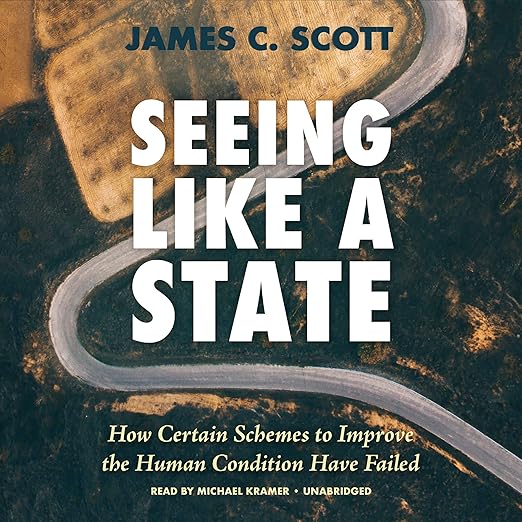
Quick Take
- Narration: Michael Kramer delivers Scott’s dense academic prose with steady, unhurried authority — he never rushes the argument, which suits a book that rewards patient attention.
- Themes: state legibility and social control, the limits of high-modernist planning, local knowledge versus top-down expertise
- Mood: Intellectually demanding but quietly revelatory — the kind of book that rearranges furniture in your brain
- Verdict: Essential listening for anyone who has ever wondered why ambitious government programs so often destroy the very things they set out to improve.
I came to this one during a long stretch of evening walks, headphones in, moving through my neighborhood at a pace that felt almost deliberate by the time I finished. There is something fitting about listening to James C. Scott while watching streets and buildings arranged according to some planner’s vision of how life should flow. Seeing Like a State is the kind of book that makes the familiar suddenly illegible, which is, of course, exactly its point.
Scott published this work in 1998, and in the years since it has become one of those foundational texts that gets cited across disciplines without always being read in full. The audiobook, clocking in at just over sixteen hours, gives you the full argument — no shortcuts, no condensed version — and Michael Kramer’s narration makes the journey worthwhile even when Scott’s academic density starts to build. It belongs to the Veritas Paperbacks line, which means this is the complete, unedited scholarly text rather than a popularized adaptation.
The Four Conditions That Break Everything
Scott’s central thesis is architectural. He identifies four conditions that, when combined, produce catastrophic state-led interventions: the administrative simplification of nature and society, a high-modernist ideology that treats science as capable of redesigning human life from the ground up, the willingness to deploy authoritarian power to enforce those redesigns, and a weakened civil society that cannot push back. You need all four, he argues, for a truly spectacular failure. Remove any one of the four, and the scheme either never gets implemented or collapses before causing maximal damage.
The case studies he marshals are extraordinary in their range. Collectivization in Soviet Russia, compulsory ujamaa villages in Tanzania, Le Corbusier’s urban planning ideas realized in Brasilia, the Great Leap Forward in China, the scientific forestry experiments in eighteenth-century Prussia that inadvertently created Waldsterben — all of them serve as evidence for the same underlying pattern. States that try to make their territories and populations legible, measurable, and manageable tend to strip away the local complexity that kept those territories and populations alive in the first place. The German forest was supposed to become a more productive machine; instead it became a monoculture susceptible to the first serious pest that came along. The logic of optimization had removed the redundancy that made the system resilient.
Metis Versus Techne: What the Planners Keep Missing
The most generative concept in the book is Scott’s use of the Greek word metis — the kind of practical, situated, experiential knowledge that cannot be written into a manual. Farmers who have worked a particular piece of land for generations carry information in their hands and eyes that no soil survey can fully capture. Urban neighborhoods that look chaotic to a planner’s map generate the informal networks of trust and mutual aid that actually keep communities functioning. Scott’s point is not that formal knowledge is useless but that the moment a state begins treating metis as an obstacle to be overcome rather than a resource to be incorporated, it starts making very expensive mistakes.
One of the reviewers whose comments made it into the metadata described the book as offering a way of understanding our world through different eyes — and that captures something real. Scott is not writing a polemic against government or expertise. He is writing something more precise and more unsettling: a diagnosis of the specific combination of conditions that turns good intentions into catastrophe. A reviewer writing from Germany noted that Scott’s discussion of Haussmann’s redesign of Paris presents the official reasons somewhat differently than the historical record supports — that kind of close observation of official narrative versus what was actually happening is exactly what Scott’s framework illuminates.
The section on ujamaa villagization in Tanzania is particularly devastating, both in the human cost it documents and in the clarity with which Scott traces the logic that made it seem inevitable to the planners who designed it. Tanzanian peasants had developed complex, interlocking farming systems across dispersed homesteads that took advantage of soil variation, water access, and mutual aid networks. When the state consolidated these populations into planned villages for administrative legibility, the ecological intelligence embedded in the dispersal was lost almost immediately. The villages were legible. The farming systems that had fed people for generations were not.
Kramer’s Narration and the Patience the Book Requires
Michael Kramer is one of the most experienced voices in nonfiction audio, and his performance here is consistently professional. His pacing is measured without being slow, and he handles the book’s many foreign names and historical terms without stumbling. What he cannot entirely solve is the structural challenge Scott himself poses: the argument lands fully by the second chapter, and the remaining fourteen hours constitute what one reviewer accurately called variation rather than escalation. The case studies accumulate rather than build toward a revelation.
Scott died in 2024, and a reviewer had wished for a revised edition analyzing recent political developments through his lens — that revision will not now come. What we have is a book written at a particular historical moment that has aged with unsettling accuracy. The conditions he describes have not gone away, and the patterns he traces are as visible in contemporary policy debates as they were in the collectivization drives he examines. Listening to it now does not feel like reading history. It feels like reading a diagnostic manual for the present. Listeners with backgrounds in political science, urban planning, history, or anthropology will find this audiobook immediately productive — and those coming from adjacent fields will likely find it challenges assumptions they did not know they held.
Frequently Asked Questions
Do I need a background in political science to follow Scott’s argument?
No, but patience with academic writing style helps. Scott builds his argument through extended case studies from Tanzania, Russia, China, and elsewhere, and Kramer’s steady narration keeps the prose accessible. The core thesis is clear early; the challenge is sustaining attention through sixteen hours of supporting evidence.
Is this book critical of government in general, or is the argument more specific?
It is quite specific. Scott is not making a libertarian argument against state intervention. He is diagnosing a particular combination of conditions — high-modernist ideology, authoritarian enforcement, and the suppression of local knowledge — that tends to produce disasters. States that incorporate local expertise and maintain space for civil society feedback appear throughout the book as implicit counterexamples.
How does the Veritas Paperbacks series context affect this edition?
The Veritas Paperbacks edition is an unabridged audio presentation of the full text. There are no supplementary materials, forewords, or updated introductions. The book is presented as originally published, which means the case studies end before the political developments of the 2010s and 2020s that many reviewers wish Scott had addressed.
Does Michael Kramer’s narration suit this kind of dense academic text?
Kramer is a reliable choice for long nonfiction. He keeps the pace disciplined and handles the book’s considerable range of proper nouns competently. The narration will not transform the listening experience into something dramatic, but it delivers the argument clearly and without distraction, which is the appropriate goal for a book of this type.