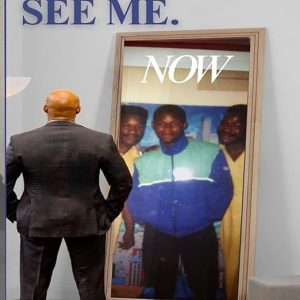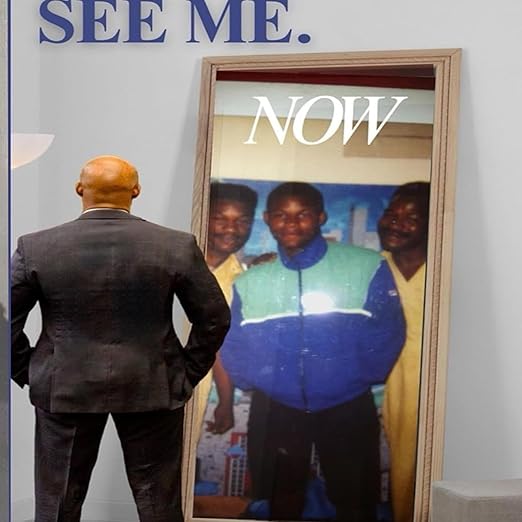
Rafiq Williams narrates his own memoir, and that is the first thing you need to know about this audiobook. Not because the decision is unusual, but because it changes everything about the experience of listening. When Williams describes what the streets of Philadelphia's inner city felt like at thirteen years old, the drug trade, the violence, the particular loneliness of a child who has learned to rely entirely on himself, he is not recounting these things from a safe distance. The specificity in his voice is the specificity of someone who was there. See Me. Now is a three-hour memoir that earns its brevity by refusing to waste a single minute of it.
An Accusation That Turns Private Pain Public
Williams grew up navigating a part of Philadelphia where stability was exceptional and danger was ambient. The memoir describes the survival strategies he developed as a child, the secrets he buried, the traumas he learned to suppress in order to keep moving. The book's central structural tension arrives when Williams, still a teenager, is accused of murder. That accusation is not treated as a climax so much as an inflection point, the moment when everything he had been managing privately becomes publicly visible and the question of who he is shifts from personal to institutional. How he moves through that moment and what it costs him is the heart of the memoir.
What distinguishes See Me. Now from the substantial category of inner-city survival narratives is its attention to the interior life of a child who is not, by necessity, able to express that interior life to anyone. Williams is not writing about the streets as an observer or a reformed former resident. He is writing about what it felt like from inside, the panic, the anxiety, the hypervigilance, the way surviving becomes its own kind of damage. That psychological precision makes the memoir unusually resonant for a work of this length.
Controlled Disclosure You Can Almost Visualize
The self-narration is the production's defining asset. Williams's voice in the early sections of the memoir has the quality of controlled disclosure: he is telling you things he has not always been able to say, and that effort is audible. Reviewers describe feeling as if they could 'visualize the story' as it was told, which is the specific quality good memoir narration achieves and which a performed reading would have approached very differently. In most memoir audiobooks, a passage arrives where the actor's interpretation becomes a filter. Here, the author's voice is the interpretation, and it is exact.
The book received a perfect five-star rating from its reviewers, and the responses reflect a community of readers who see their own experiences reflected in Williams's account. One reviewer writes of 'relatable moments within the Black crowd and how some of us may have grown up,' which points to something the memoir does that general-audience survival narratives often fail to do: it is written for and toward a specific readership without excluding others, and the audio format lets that directness land without mediation.
A Redemption Arc That Is Hard-Won, Never Softened
At three hours and six minutes, this is a short audiobook. Some listeners may wish for more time in certain sections, particularly the period around the murder accusation and its aftermath. Williams moves quickly through moments that carry enormous weight, and while the compression gives the memoir its urgency, it also means some threads feel unresolved or underexplored by the end. Whether that is a limitation or a feature depends on what you bring to the listening experience.
The memoir's emotional content is heavy. Williams is not sensationalizing his childhood, but he is not sanitizing it either. The drug exposure, the violence, the accumulated trauma of years of unsupported survival are present throughout the narrative. Listeners who come to memoir looking for redemption arcs will find one here, but it is hard-won and the path to it is not softened.
Self-Narration Narrows the Distance to Nothing
Williams's decision to write the memoir at this level of candor, naming the streets, naming the experiences, naming the panic and the hypervigilance of a child who had no safety net, reflects a conviction that the specificity of his account is part of its value. Generalized narratives of urban poverty and survival exist in abundance. What Williams is offering is particular testimony: this block, these people, this fear, this choice. That particularity is what makes the audiobook format especially appropriate for this material. A written page keeps a certain distance between the text and the reader. A self-narrated audiobook narrows that distance to almost nothing.
Williams's decision to keep the memoir at three hours rather than expand it into a longer narrative is worth noting as a craft choice. The compression matches the experience he is describing: a childhood where there was no time to pause, no space to reflect, no margin for anything beyond the next immediate problem. The short runtime does not feel like an incomplete project. It feels like the right container for a story that is fundamentally about scarcity, about what it means to make do with less than you need and still find a way forward.
Something Told as if for the First Time
Readers interested in urban memoir, survival narrative, and first-person accounts of institutional encounters with young Black men in America will find this audiobook precise and affecting. The self-narration makes it particularly valuable for listeners who are specifically interested in how voice and testimony function in memoir. At three hours, it is accessible as a standalone listen even for those who are new to the genre. Williams's writing and narration together produce the rarest thing in memoir: the sense that you are hearing something told for the first time.
A Few Questions About See Me. Now
Does Rafiq Williams narrate this audiobook himself?
Yes, Williams narrates his own memoir. The self-narration is central to the book's effect; his voice carries the specificity of lived experience in a way that distinguishes this production from performed memoir readings.
Is this audiobook suitable for listeners who are new to urban memoir?
Yes, though readers should be prepared for candid descriptions of violence, drug exposure, and trauma. Williams does not sensationalize, but he does not soften either. The memoir is accessible to new listeners without requiring prior knowledge of the genre.