Quick Take
- Narration: Scott R. Pollak handles nearly 35 hours of dense financial text with admirable clarity, a marathon performance that stays focused throughout.
- Themes: Value investing principles, fundamental analysis, margin of safety
- Mood: Dense and demanding, but rewarding for listeners willing to work
- Verdict: The foundational text of value investing in its most updated form, genuinely essential for serious investors, genuinely inaccessible without prior financial literacy.
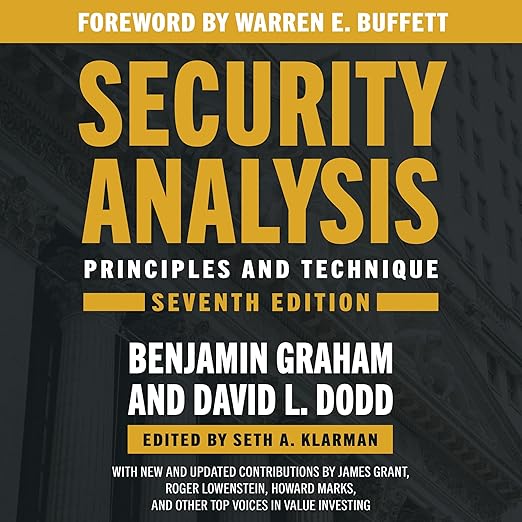
I started listening to Security Analysis on a Sunday evening with a glass of wine and approximately twenty minutes into it realized I needed to be taking notes. This is not casual listening. At nearly thirty-five hours narrated by Scott R. Pollak, the Seventh Edition of Benjamin Graham and David Dodd’s foundational text is one of the most demanding audiobooks I have encountered in the finance category, demanding not because it is poorly written or poorly produced, but because the material itself requires active engagement that passive listening cannot fully support. I am going to be honest with you about that trade-off, because I think it matters for your decision.
That said, I kept listening. Because this is Security Analysis, and its reputation is entirely earned. First published in 1934, revised across six previous editions, and now updated with commentary from contemporary value investors, the book remains the most thorough account of how to evaluate securities on their fundamental merits ever written. Graham’s concept of intrinsic value, his insistence on the margin of safety, his distinction between investment and speculation, these ideas have shaped every serious investor who came after him, including Warren Buffett, who studied under Graham directly. You cannot fully understand modern value investing without understanding this book.
Our Take on Security Analysis Seventh Edition
The Seventh Edition is a significant improvement over its predecessors specifically because of the contemporary contributions. Several of today’s respected value investors contribute chapters that contextualize Graham and Dodd’s methods within current market conditions, addressing questions of technology companies, intangible assets, and the ways that modern markets differ from the Depression-era environments the original authors were analyzing. One reviewer put it well: the book is not your get-rich-quick investment guide; it is how to be Warren Buffett, with historical context. The contemporary sections make that historical context navigable.
The note from a reviewer who found the 1930s language and outdated examples challenging is worth taking seriously. Graham wrote in an era when railroads and steel companies were the paradigmatic investments, and some of the specific examples require translation. But the underlying analytical framework is as applicable today as it was then. The book teaches you how to read a balance sheet, how to assess earning power, how to think about bond coverage and preferred stock priorities, skills that do not become obsolete because the specific securities change.
Why Listen to Security Analysis Seventh Edition
Scott Pollak brings patient, measured authority to a text that demands exactly that quality. He does not editorialize or inflect the material in ways that would distort Graham’s famously precise thinking. At thirty-five hours, the sustained quality of his performance is remarkable, this is a narrator who clearly prepared for the assignment rather than simply reading. The PDF companion mentioned in the product description is an important supplement for audio listeners: financial analysis that references tables and formulas is genuinely harder to follow aurally, and having the PDF open while listening closes that gap significantly.
The 4.7 rating from 238 listeners is impressive for a text this demanding. Multiple reviewers describe it as the value investor’s bible, and the review noting it is still relevant after all these years reflects a quality rare in finance writing: genuine timelessness at the level of principle, even as specific examples age.
What to Watch For in Security Analysis Seventh Edition
This is not and should not be your first book on investing. One reviewer states this plainly, and I agree with them completely. If you do not have a working understanding of financial statements, basic accounting concepts, and the difference between stocks and bonds, this book will be opaque rather than illuminating. Start with The Intelligent Investor (also Graham, considerably more accessible) and come back to Security Analysis once you have that foundation. Trying to learn investing fundamentals and advanced security analysis simultaneously from this text is a recipe for confusion.
The audio format also creates specific challenges for the more quantitative sections. Ratios, coverage calculations, and balance sheet analysis are hard to follow without visual reference. Download the companion PDF from your Audible library and use it actively.
Who Should Listen to Security Analysis Seventh Edition
Serious investors and finance professionals who want to understand the intellectual foundations of value investing will find this audiobook deeply rewarding. It is particularly valuable for anyone who has absorbed more accessible investment texts and wants to go deeper into the underlying analytical discipline. The Seventh Edition’s contemporary contributions make this the best version to start with for modern listeners. Anyone without prior financial literacy should build that foundation first. This is a long-term reference work, not a survey, and in the audiobook format, it functions best as a complement to active study rather than as passive entertainment.
Frequently Asked Questions
Do I need a financial background to understand Security Analysis?
Yes, meaningfully so. The book assumes familiarity with financial statements, basic accounting, and investment concepts. The Seventh Edition’s contemporary commentaries help, but complete beginners will struggle. Read The Intelligent Investor first.
What does the Seventh Edition add compared to earlier editions?
Contemporary value investors contribute chapters contextualizing Graham and Dodd’s methods for modern markets, addressing technology companies, intangible assets, and current market structures. These additions make the foundational text considerably more navigable for present-day listeners.
How does Scott Pollak handle the denser technical sections?
With considerable skill. His delivery is measured and clear without being monotonous, and he maintains consistent quality across a demanding 35-hour recording. The PDF companion document is essential for the quantitative material, however.
Is the audiobook format appropriate for a text this dense?
With caveats. The PDF companion document included with the Audible version is important, financial analysis referencing tables and formulas is genuinely harder to follow by ear alone. Listeners who use both formats simultaneously will get much more from the experience.