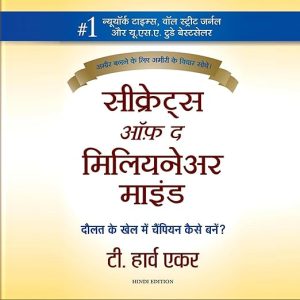
Open the description on this listing and you meet a wall of Devanagari script before you meet a single English sentence. The two English lines that do appear are purely administrative: this audiobook is in Hindi, and a PDF accompanies it. Everything else, the argument, the promise, the structure, is written in the language the recording is actually in. The English title displayed at the top is the only part of this product that is not Hindi.
The Page Buries Its Most Important Fact
That mismatch is the most important thing a browsing buyer needs to know, and the page buries it at the very bottom. Prateek Dutt Sharma reads for Manjul Publishing House, every written response comes from India, and the audio runs seven hours and forty-seven minutes in Hindi throughout. Anyone who recognizes the English title and buys without scrolling has purchased a recording they cannot follow. That is a listing design failure rather than an author's fault.
A second credit is missing entirely. This is a translated edition of a book written in another language, and no translator appears anywhere on the page. On a text this dependent on phrasing, a five-minute promise, a blueprint metaphor, seventeen numbered contrasts, whoever chose the Hindi wording made genuine authorial decisions. Those decisions are unacknowledged, and the byline reads as though the book had always existed in this language.
One Money Blueprint Against Seventeen Wealth Files
Underneath the language problem the argument is straightforward, and durable enough to have survived the crossing. Financial outcomes, Eker claims, are governed by an internal money blueprint set in childhood, not by education, intelligence, ability, timing, work habits, contacts, luck, or the choice of job, business or investment. Part one explains how that blueprint got installed and how to reset it. Part two lays out seventeen wealth files contrasting how the rich think and act against how the poor and middle class do.
Nothing Numerical Here to Miss by Listening
The material suits audio better than most personal-finance writing does, because almost none of it is numerical. No spreadsheets, no compound interest tables, no formulas that need seeing. What the book asks is that you recognize inherited attitudes and then argue with them, which is a listening task rather than a reading one. Seven and three-quarter hours of somebody methodically dismantling assumptions you did not know you held is a reasonable use of a daily drive.
Responses on the page point at exactly that effect. A five-star account filed on December 11, 2025 reports simply that a thinking pattern changed, which is the outcome the book sells and a modest, believable way of describing it. Nobody in this pool claims to have gotten rich. They claim to have started noticing something, which is what a book about inherited beliefs can plausibly deliver.
A two-part construction is why this has lasted. Part one is diagnostic and mildly uncomfortable, arguing that what your parents said about money in front of you is still running your finances decades later. Part two turns prescriptive, and the seventeen wealth files give it a shape you can actually hold, since each one is a single contrast rather than a chapter of theory. Listeners who bounce off abstract advice get concrete oppositions instead.
Four Votes Claimed, Five Opinions Printed Beneath
Page quality, printing quality very good, definitely go for it, reads a five-star verdict dated December 5, 2025. That is a verdict on a physical object, delivered on the page for an audio recording, and it counts toward the average shown. The fault is not the buyer's; retail listings merge editions routinely. It does mean the sentiment here is partly measuring paper stock, and at least one visible grade has nothing whatever to say about the recording.
Numbers on this page deserve a second look too. The star line claims an average over four votes, yet five graded opinions are printed beneath it. Those two figures cannot both describe the same set of raters. Every one of those five was filed in India. The 4.5 is a local verdict on a local edition, which is a perfectly reasonable thing to be, but the English title implies an aggregate this number is not.
Two last flags. The copy promises an accompanying PDF, and for a book built on seventeen numbered files that document is very likely the list itself, so retrieve it rather than trying to memorize a sequence while driving. And the book is explicitly about mindset rather than mechanics: nothing in the described structure touches instruments, markets or tax, so treat it as the layer underneath a financial plan rather than as the plan.
Wrong Purchase if You Don't Follow Hindi
Hindi listeners come first, obviously and correctly, and one four-star response puts the recommendation in the plainest terms available: a very good book that everybody ought to pick up. For someone who reads English fluently but thinks about money in Hindi, this edition offers what a printed translation cannot, which is the argument arriving in the same language as the internal objections it is trying to dismantle.
Beyond that, the natural buyer is somebody who has read financial advice and not acted on it. The premise is that the gap between knowing and doing is a childhood setting rather than a discipline failure, which is a more forgiving diagnosis than most of the category offers and therefore easier to keep listening to. Anyone running a small business who suspects their own ceiling is self-imposed will find part two aimed squarely at them.
Wrong purchase if you do not follow Hindi, and this page makes that far too easy to miss. Wrong purchase, too, if you want tactics: no instrument gets analyzed, no market gets discussed, no number gets worked through. The entire method is to change what you believe before you change what you do. Until you accept that framing, the seventeen files will land as slogans rather than as the argument they actually are.
Common Questions
What language is this audiobook recorded in?
Hindi, entirely. The description carries one English line confirming it, the publisher is Manjul Publishing House, the reader is credited as Prateek Dutt Sharma, and the listed language is Hindi. Only the displayed title is English, which makes this remarkably easy to buy by mistake if you do not scroll to the foot of the description.
Is a PDF included with the audiobook, and what is in it?
The copy states an accompanying PDF arrives with the audio. Given a second half organized as seventeen separate wealth files, that document most likely holds the list in a form you can look at. Retrieve it at purchase rather than trying to hold seventeen separate contrasts in your head while the recording plays.
Who translated the Hindi edition?
Nobody is credited. The byline names only the original author, and no translator appears anywhere on this listing despite the entire recording existing in a language the book was not written in. For a text this dependent on phrasing that is a genuine omission rather than a formality, and no way exists to look up who made those choices.